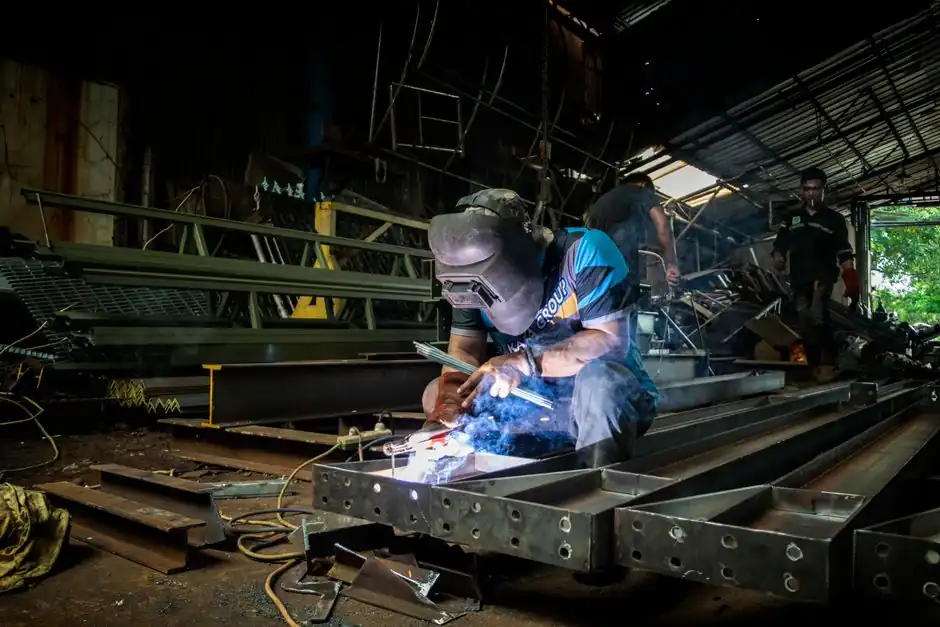
An electroslag pressure welder sized for concrete column work must deliver 200-650 A arc-stage current at 35-45 V welding voltage and a no-load voltage of 70-90 V, with the upper end of that current band reserved for bars above 32 mm where a 1,000 A-class source becomes mandatory [S2][S3]. The maximum bar diameter the welding head accepts, the power source's duty cycle, and the upset (forging) force of the clamping head are the four specifications that decide whether a given machine will hit JGJ 18-2012 weld-collar limits in production, not just on a lab bench [S1].
Two processes share the slag-bath heating principle but split on the question of whether the bar is in concrete or the steel is in a girder. Electroslag pressure welding (EPW) for rebar runs axial upset pressure inside a flux-filled mold to forge a bar-to-bar joint, while electroslag welding (ESW) for thick plate deposits filler wire between water-cooled copper shoes without forging [S1]. For cast-in-place piers, abutment stems, and retaining walls where bars run true and the crew can stage a clamp vertically, EPW is the right process; for built-up girders and cross frames the option set shifts to NGI-ESW, SAW, or SMAW under AWS D1.5 [S1].
Current, Voltage, and No-Load Specs That Decide Bar-Diameter Coverage
The arc-stage current range of 200-650 A and the welding voltage band of 35-45 V cover rebar diameters from roughly 16 mm up to 32 mm, and above 32 mm a 1,000 A source is needed because heat must penetrate the larger cross-section quickly enough to avoid lack of fusion at the bar-to-bar interface [S2][S3]. No-load voltage must be high enough to strike the arc through the granular flux, typically 70-90 V, well above a general arc welder that sits closer to 50-60 V open-circuit [S3].
The two numbers together decide whether the machine can heat the largest joint on the project fast enough for the slag pool to stabilise, and a published Chinese OEM spec sheet for the ZX7-630 model lists exactly this 200-650 A, 35-45 V envelope for the 16-32 mm diameter window with HJ431 flux [S2]. A practical rule used on Chinese high-rise sites is to spec the source at least 1.25x the calculated peak current for the largest bar, which is why EPW rigs on 40 mm columns typically carry a 1,000 A inverter rather than a 630 A transformer [S3].
Upset Force, Head Mass, and the Arc-Electroslag-Upset Cycle
After the arc melts the flux and current transitions to resistance heating through the slag, the welding head must deliver a controlled upset force that forges the plastic bar ends together and expels the slag as a visible collar; the JGJ 18-2012 schedule in table 4.6.6 ties current and time to bar diameter for HJ431 flux, and both rise with diameter [S3]. For a 32 mm HRB400 bar, typical upset force sits in the 25-40 kN band delivered by a hydraulic cylinder, while 16-20 mm bars can be upset by a manual lever head at 8-15 kN [S1].
The control box sequences three stages: arc strike (high voltage, low current, short time to establish the pool), electroslag (sustained current at the schedule value, voltage drops to 35-45 V as the arc disappears into resistance heating), and upset (current held briefly while the head drives the upper bar down). Inverter DC machines with programmable timers handle 16-40 mm bars more repeatably than manual AC transformer heads because the arc-to-upset transition is a timed relay event rather than operator judgement, which is why tall pier columns with many splices per shift tend to run inverter DC power sources [S1][S3]. On small piers with a 16-32 mm bar range the manual AC transformer head is still the lowest-cost option, and the worker carries only the clamp up the column while the 200-300 kg transformer stays on the deck.
Comparison of Three Main Machine Classes for Concrete Work
Three equipment classes dominate concrete column procurement in 2026, and they line up against bar-diameter coverage, upset force repeatability, head mass, and total cost as follows. Manual clamp with AC transformer welder covers 16-32 mm bars at the lowest first cost, runs an 8-15 kN manual upset, weighs 8-12 kg at the head, and depends on operator skill for collar quality [S1][S2]. Manual clamp with inverter DC welder extends coverage to 16-40 mm with a programmable arc-to-upset timer, delivers 20-35 kN upset via motorised lead screw, adds 4-6 kg to the head but cuts collar rejection rates on tall piers [S1][S3].
Semi-automatic dual-operator rig covers 25-50 mm with a 40-80 kN hydraulic upset, the heaviest head at 25-40 kg, and needs crane lifts between floors, but gives the best collar consistency on large-diameter bars where JGJ 18-2012 offset and mismatch limits are tightest [S1]. For projects that mix 16 mm ties in walls with 32-40 mm verticals in columns, the inverter DC class is usually the best balance because one machine and one head handle both ranges with only a schedule change, and the 1,000 A ceiling covers the worst-case bar without forcing a second power source on site.
Standards, Rebar Grades, and Flux Selection
In China the rebar EPW process is governed by JGJ 18-2012 (Specification for Welding and Acceptance of Reinforcing Steel Bars), with the per-diameter current and time schedule in table 4.6.6 and HJ431 granular flux as the reference consumable; in the US the comparable framework is AWS D1.4/D1.4M (Structural Welding Code for steel reinforcing bars), and ACI 318 covers splice provisions for the concrete side [S1][S3]. For plate ESW the code path is AWS D1.5 (Bridge Welding Code), with FHWA memorandum dated 2018-05-10 rescinding tolerance on main fracture-critical tension members, and the narrow-gap NGI-ESW variant operating in an approximately 19 mm (3/4 inch) gap is now accepted for non-fracture-critical tension members in AASHTO temperature zones 1 and 2 [S1].
Rebar grade matters because higher-strength HRB500 and Grade 60 bars need more heat input and longer electroslag time than HRB335 or Grade 40 at the same diameter, and the schedule must be re-validated per JGJ 18-2012 if the bar grade changes mid-project. HJ431 is the standard flux for carbon and low-alloy rebar EPW in China, with a SiO2-MnO-FeO balance tuned for slag conductivity and viscosity at 1,650-1,750 degrees C pool temperature; substituting a generic SAW flux will change the resistance heating curve and is a common source of lack-of-fusion defects in the field [S3].
When EPW Is the Wrong Tool, and What Fails on Site
EPW is wrong for horizontal or near-horizontal bars where the slag pool cannot be contained by gravity and a flux ring, which is why lap splices or mechanical couplers dominate beam and slab work. It is also wrong for bar diameters below 16 mm, where the upset force either cannot be controlled finely enough or crushes the bar, and for stainless or epoxy-coated rebar where the coating burns in the slag pool and releases fumes that the HJ431 flux was not designed to handle [S1][S3].
Common field failures trace back to three spec errors: a power source undersized for the largest bar (visible as lack of fusion at the bar centre, which ultrasonic testing catches), an upset force too low for the bar diameter (visible as slag inclusions trapped inside the collar, caught by radiographic or destructive testing), and a no-load voltage below 70 V which prevents arc strike through damp flux and forces the operator to crank current, overheating the bar surface before the pool forms. For concrete work that mixes pile cap rebar (often 32-40 mm) with column verticals (25-32 mm) and wall ties (12-16 mm), the right call is usually one inverter DC machine at 1,000 A rather than two transformer units, because the schedule change between diameters is faster than swapping machines.
Sourcing, Cost, and What to Verify Before Purchase
Chinese OEM EPW machines in the 200-650 A, 16-32 mm class ship at negotiable FOB/CFR/CIF terms with minimum order quantity of one piece, and common model codes include ZX7-630 for the inverter DC class and BX1-series designations for the AC transformer class [S2]. For the 1,000 A / 16-40 mm class buyers typically need a custom build or a higher-tier model, and lead time runs 30-60 days versus 7-15 days for off-the-shelf 630 A units. For teams that handle both column rebar and built-up girder plate, electroslag pressure welder picks for road-maintenance rebar crews covers the field-deployment side, while a stud welder reference is useful where shear studs are specified on the same pier cap pour.
Before signing the PO, verify four items against JGJ 18-2012 and AWS D1.4/D1.4M: the no-load voltage test certificate (must read 70-90 V open-circuit, not the marked nameplate value alone), the upset force calibration record at the operating pressure, the per-diameter current/time schedule the control box ships with, and a sample weld collar macroetch on the actual HRB400 or Grade 60 rebar lot that will be used on site. The next signal worth tracking is whether the project specification moves from JGJ 18-2012 to the 2024-revision draft, and whether AWS D1.4M issues a coordinated amendment on inverter DC EPW heads above 32 mm in the same window.
The underlying component specifications are covered under electroslag pressure welder.