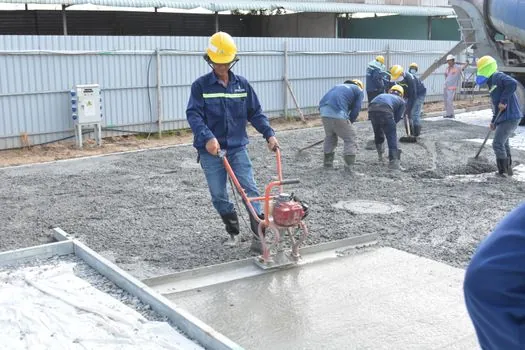
Walk-behind power trowels in the 600 to 960 mm rotor diameter class cover most plumbing-installation slab pours, with 4-blade rotor configurations, 3 to 5 HP engine or electric-motor output, and blade speeds between 50 and 145 RPM matching the working area and finish class of mechanical-room, chase, and plant-room floors [S1][S2][S3].
Plumbing work generates a wide range of slab footprints, from narrow 1 to 2 square metre pipe-duct chases to 200 square metre plant-room mezzanines, so a single 1200 mm ride-on unit is rarely justified; a fleet of 24 to 36 inch (600 to 960 mm) walk-behind machines covers nearly every pipe-hanger, drain-trench, and equipment-pad pour a plumbing crew schedules [S2][S3][S6].
Plumbing-Slab Floor Plan and Trowel Diameter
Plumbing-installation slabs fall into three footprint bands, and rotor diameter should track those bands rather than crew strength or engine size [S2][S6].
For chases and equipment pads under 10 square metres, a 600 mm (24 inch) ST-24-class rotor with 220 by 130 mm blades, 50 to 100 RPM drive speed, and a 60 kg net weight is the practical lower limit, because the frame must still clear rebar chairs and small pipe penetrations without rocking [S2]. For 10 to 50 square metre plant-room and bathroom-cluster pours, the 800 to 920 mm ST-30, SE-S80H, or SE-S90H class with 265 to 350 mm blades and 50 to 130 RPM drive speed is the workhorse band, balancing single-operator handling with a 0.7 to 1.0 metre working pass per rotor revolution [S2][S6]. For main floor slabs above 50 square metres a 960 mm PT160-960 with 109.4 kg dry weight and 1900 by 935 by 1100 mm frame dimensions is the upper sensible bound for walk-behind machines, since the 3.6 kW (4.8 hp) Honda GX160 power-pack output at 3600 RPM keeps the rotor flat under load without forcing a step up to a 7 to 13 HP ride-on class [S3][S7].
Engine vs Electric Motor: Site Power and Ventilation
Plumbing-installation sites are split between open plant rooms with good ventilation and confined switchgear / battery rooms with restricted airflow, so the drive decision is driven by site power and exhaust rules, not by operator preference [S1][S4].
Electric-drive walk-behind trowels, such as the 2 to 3 HP 2880 RPM ESI-PT-N and ESI-PT-DS models or the 3-phase 3 HP ELGI / Havell's motor on the FM-PTS-3 and FM-PTB-3, are mandatory inside any enclosed space where a petrol or diesel exhaust cannot be vented, and they also let the operator vary blade RPM continuously to track bleed-water disappearance [S1][S4]. Petrol models, including the FM-PTE-3 with its 0.75 to 1.0 litre per hour fuel consumption figure on a 3 HP Honda engine, and the 5 to 6.5 HP GX160 / GX270 petrol and RO170F / RO178F diesel options in the SE-S80H to SE-S120H line, are the right call on open decks, roof plant areas, and external service-yard slabs where no three-phase supply is available [S1][S4][S6]. The 46 inch base FM-PTB-3 with 17 inch blades, 120 RPM, and a 3 HP 3-phase electric motor is the heaviest electric walk-behind commonly stocked for plumbing-scale slabs, and it covers a 1.17 m working pass in a single sweep, useful for large battery-room or pump-station floors [S4].
Blade Material, Pitch Range, and Finish Class
Blade selection, not frame size, sets the floor flatness (FF) and floor levelness (FL) numbers that the plumbing penetrations and floor drains depend on, and the material choice changes blade life by 20 to 30 percent on abrasive aggregate mixes [S5].
High-carbon steel power-trowel blades outlast spring-steel blades by 20 to 30 percent on abrasive aggregate mixes, and the best-performing blades are precision-ground to consistent thickness and heat-treated to a Rockwell C 40 to 50 hardness, which is the band where wear life, edge retention, and burnishing quality all balance [S5]. For plumbing slabs, the practical translation is: spec a 4-blade rotor with a pitch range that reaches 0 to 15 degrees, as on the Sealine SE-S series, so the same machine can float at low pitch and burnish at high pitch across 3 to 5 finishing passes [S6]. Float blades (8 inch width, 1.5 to 2.0 mm thickness) are used 1 to 3 hours after pour to embed aggregate, then finish blades (5 to 6 inch width, 1.0 to 1.5 mm thickness) take over after bleed water disappears; combination blades (6 to 7 inch width) cover pours under 400 square feet where one set has to do both jobs [S5]. A finishing crew typically consumes 4 to 8 blade sets per month on abrasive mixes, so a 20 to 30 percent longer blade life is a real line-item, not a marketing line [S5].
Walk-Behind vs Ride-On for Plumbing Crews
Plumbing-installation slabs do not justify ride-on power trowels below roughly 200 square metres of contiguous pour, and walk-behind units in the 24 to 36 inch rotor class are the correct default for the work [S7][S8][S10].
Ride-on machines from lines such as the Husqvarna CRT 48 with a 1220 mm troweling diameter, or the Full-Track FT-48 (120 cm) at 9 to 13 HP, are engineered for large warehouse and deck pours above 500 square metres, where dual rotors spinning at 80 to 150 RPM and 8 total blades apply the down-pressure that walk-behinds cannot match [S7][S10]. For plumbing, the equivalent spec ceiling is the 36 inch M365 / M365RP Marshalltown walk-behind, which accepts 160 to 260 cc engine options and is the largest single-rotor size most crews can hand-control on a 200 mm step or threshold without a ramp [S8]. Anything above 36 inch on a plumbing job usually means adding a second operator or a ride-on, both of which cost more than the extra hand-trowel finish on a one-off 100 square metre mechanical-room pour [S8][S10].
Frame Weight, Transport, and Stair Access
Plumbing crews carry trowels up service stairs and through door frames more often than they wheel them onto a slab, so net weight and footprint dimensions drive the spec as much as rotor diameter does [S1][S2][S3][S4].
Walk-behind weights cluster between 60 and 120 kg: 60 kg for the 600 mm ST-24, 75 kg for the 800 to 1000 mm ST-30 and ST-36, 80 kg for the 1200 mm ST-48, 94 kg for the 900 mm ESI-PT-N, 109.4 kg for the 960 mm Honda PT160-960, and 120 kg for the 900 mm ESI-PT-DS, which is the practical ceiling for two-person stair carry into a plant room [S1][S2][S3]. Packing footprints of 600 by 600 by 860 mm for the ST-24, 850 by 850 by 860 mm for the ST-30, 1050 by 1050 by 880 mm for the ST-36, and 1200 by 1200 by 880 mm for the ST-48 also decide whether the unit fits a service lift or has to be slung through a window opening [S2]. For tight bathroom-cluster pours where the 120 kg class will not pass through a 900 mm door, the 60 kg ST-24 with 600 mm rotor and 50 to 100 RPM drive is the only sensible pick, and it is the unit a plumbing contractor should keep on the truck as the universal fall-back [S2][S4].
Selection Criteria, Failure Modes, and Replacement Triggers
The right walk-behind power trowel for a plumbing slab is the smallest 4-blade machine that covers the largest contiguous pour in the job, sized to fit the service stair, and equipped with the blade material that survives the local aggregate [S1][S2][S5].
A direct side-by-side of the main walk-behind options for plumbing work lines up as follows: ST-24 (600 mm, 60 kg, 50 to 100 RPM, EY20 / GX160 / G160F / electric options) suits sub-10 square metre chases and pad pours; ST-30 and ST-36 (800 to 1000 mm, 75 kg, 50 to 130 RPM, same engine menu) cover 10 to 50 square metre plant-room and bathroom-cluster pours; PT160-960 (960 mm, 109.4 kg, GX160, 163 cc, 3.1 L tank) covers 50 to 200 square metre main-floor pours with a known spares chain through Honda India Power Products; FM-PTB-3 (46 inch base, 17 inch blade, 120 RPM, 3 HP 3-phase electric) covers large indoor slabs where exhaust is banned; FM-PTS-3 (34 inch base, 12 inch blade, 120 RPM, 3 HP electric) covers narrow indoor pours that a 46 inch base cannot enter [S1][S2][S3][S4]. Blade replacement triggers are concrete, not subjective: replace when edge rounding exceeds 1.5 mm, when Rockwell C hardness drops below 40, or when the crew burns through more than 4 to 8 sets per month, all of which point to a step up from spring steel to high-carbon steel rather than a different machine [S5]. Do not attempt to repair bent spider arms or cracked rotor housings in the field, replace the assembly, because imbalance at 100 to 150 RPM turns a hairline crack into a thrown blade within a single pass [S5][S7].
Two trackable signals for the next procurement cycle are the 1220 mm CRT 48 ride-on class, which sets the upper bound on rotor diameter that walk-behinds must be benchmarked against for floor flatness output, and the 1-bolt blade-change systems now offered on Full-Track walk-behinds, which cut field blade swaps from several minutes to under 2 minutes per set of 4 blades and directly reduce crew hours on multi-room plumbing fit-outs [S7][S10]. Also keep an eye on concrete placement trends: as pump-room and plant-room slabs trend toward 150 to 200 square metre single pours, the 960 mm PT160-960 class will absorb work that previously went to 1200 mm ST-48 or 46 inch FM-PTB-3 units, simply because the mid-size frame clears more doorways and stair cores than the heavy 120 kg class [S3][S4].
For component-level specifications, see power trowel, power cable, and power distribution.
Background reading: Arc Welding Machine Selection for Masonry: SMAW, FCAW, and Rod-Class Spec Map.