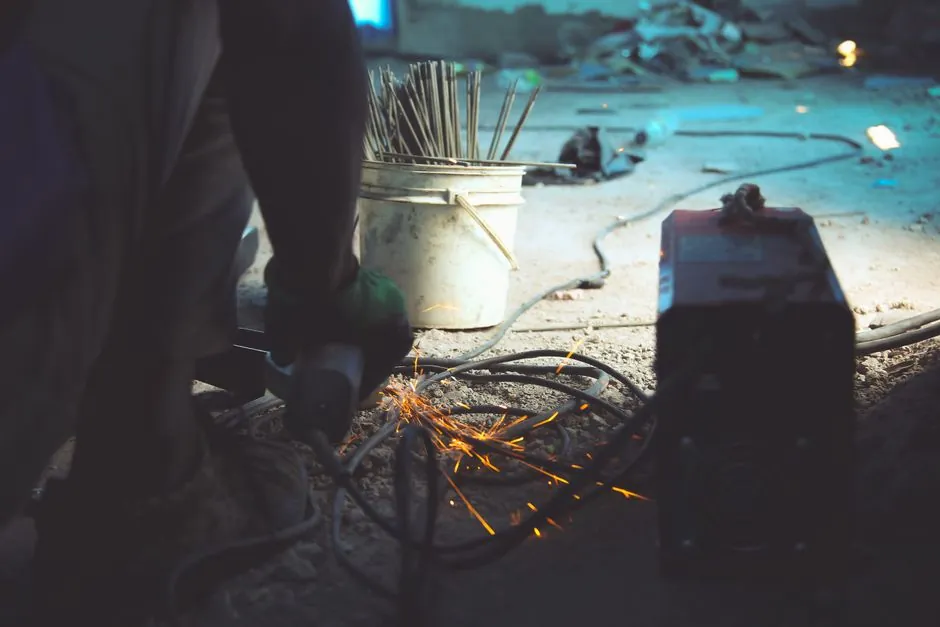
On a masonry job, the arc welding machine is almost always a shielded-metal-arc (SMAW) stick unit or a flux-cored arc welding (FCAW) rig, because both processes carry their own shielding inside a flux coating and keep working when a breeze hits the scaffold, when the steel is coated in mortar, or when the part is pitted with rust [S4][S6].
That tolerance is the entire reason masonry contractors keep a welder on payroll: AWS Certified Welder (CW) credentials, awarded through Accredited Testing Facilities, cover flat, vertical, and overhead positions and are nationally transferable, so a small masonry firm can run its own structural tack-welds and equipment repairs without scheduling a structural-steel subcontractor [S4].
Why SMAW and FCAW Beat MIG/TIG on a Masonry Site
Gas-shielded processes (GMAW/MIG, GTAW/TIG) lose their shielding envelope the moment wind speed climbs on open scaffold or around a half-built wall; the flux coating on an SMAW electrode or the flux core in an FCAW wire is bound to the weld pool, so arc stability and weld chemistry are far less sensitive to drafts [S4][S6].
Arc temperature at the electrode tip reaches roughly 6,500°F (about 3,600°C), well above the melting point of any carbon steel a mason will encounter in reinforcement plate, anchor bolt, or scaffold tube [S3]. That thermal headroom lets a stick machine bridge the mill scale, mortar splash, and pitting common to older masonry embeds, where pre-cleaning the joint down to bright metal is rarely practical [S4][S6].
TIG (GTAW) still wins on thin stainless, aluminum, and decorative iron, but the productivity hit, the need for argon backing, and the operator-skill curve rule it out for most masonry repair work, which is overwhelmingly structural steel in the 1/8 in to 1/2 in range [S3][S5].
Current Range, Duty Cycle, and Input Power: the Three Sizing Numbers
Three numbers decide whether a machine is the right size: maximum output current, duty cycle at that current, and input voltage. For light masonry repair (re-bar tack, bracket reweld, scaffold pin), 140–200 A output covers E6011 and E7013 rods up to 3/32 in and 1/8 in [S5].
For structural on-site welds and plate-to-anchor work in 1/4 in to 1/2 in steel, plan for a 250–400 A output window; machines such as the Ralli Wolf ARC 250 (RA25, RA25D, RA25S, ECO250) and ARC 400 series (RA40, RA40H, RA40HK, RA40HD) sit in this band, with the ARC 400 family aimed at construction, shipbuilding, and fabrication yards [S2].
Duty cycle is the figure masons underestimate: it is the percentage of a 10-minute window the machine can deliver rated output without tripping thermal protection. A 60% duty cycle at 250 A is the practical minimum for continuous scaffold work; lighter consumer inverters rated at 20–30% duty will throttle during a long vertical pass and produce inconsistent fusion [S2].
Input power separates site-ready from shop-only units. Submerged-arc-class three-phase 415 V shop machines are not practical on a scaffold; single-phase 230 V inverter stick welders, or engine-driven units where no mains is available, are the realistic options, with dual-voltage 120 V/230 V capability useful for mixed shop-and-site fleets [S2][S5].
Electrode Class Map: E6011 vs E7018 vs FCAW Wire
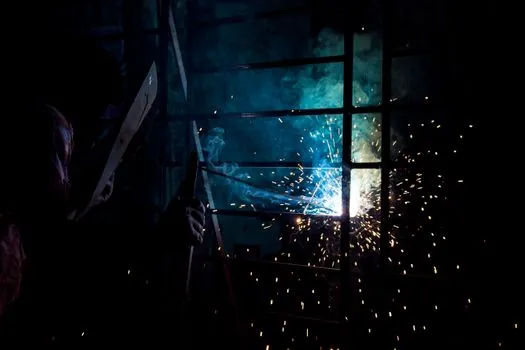
For masonry repair of older steel with surface contamination, the E6011 ("Farmer Rod") cellulosic electrode is the contractor favourite: deep penetration, fast burn-off, and forgiveness on dirty or scaled metal, at the cost of higher spatter and more smoke than low-hydrogen rods [S4].
For on-site structural welds where the rod is exposed to ambient moisture, the E7018 low-hydrogen electrode is the default: thicker flux coating, less penetration per pass, less spatter, and a weld metal chemistry that meets most structural-steel codes when kept dry [S4].
Storage discipline matters as much as rod choice. Cellulosic and low-hydrogen fluxes both absorb atmospheric moisture, and a Tennessee mason contractor reports that rods stored in the shop (high humidity) lose performance and have to be discarded, while rods kept in a climate-controlled office closet stay dry and usable; rod ovens or heated storage are standard practice on structural jobs for the same reason [S4].
FCAW (flux-cored arc welding) is the productive middle ground when a continuous wire feed and faster deposition matter more than the perfect bead: it runs on the same flux-shielding principle as stick, but with a gun-fed tubular wire, and is widely used for thicker structural plate in masonry-adjacent steel work where the wind sensitivity of MIG would be a problem [S3][S5].
Process Comparison: SMAW vs FCAW vs MIG vs TIG for Masonry Work
The four arc processes line up against the criteria a masonry contractor actually weighs: portability, wind tolerance, weld quality on dirty steel, and operator skill requirement. Stick (SMAW) is portable, wind-tolerant, forgiving of mortar and rust, and skill-moderate; FCAW is portable, wind-tolerant, faster than stick, and skill-moderate; MIG is fast, clean, and beginner-friendly but wind-sensitive and gas-dependent; TIG is precise on thin metal and clean but slow, gas-dependent, and skill-high [S3][S5].
For a masonry firm whose work is repair and on-site fabrication, the short-list reduces to SMAW as the primary, FCAW as the productivity upgrade for thick plate and longer runs, and TIG only if decorative stainless or aluminum work is a steady part of the order book [S3][S5].
For a structural-steel contractor carrying full fabrication responsibility, the multi-process inverter (SMAW + GTAW, or SMAW + GMAW + FCAW in one box, like the ESAB Rebel EMP 215ic class) is a way to keep a single machine on a service truck; for a mason, that flexibility rarely justifies the higher price versus a dedicated 250–400 A stick inverter [S5].
Selection Criteria Mapped to Masonry Use Cases
Scaffold pin, equipment frame, and truck-bed repair: 140–200 A stick inverter, E6011 rod, 120 V or 230 V single-phase input, compact portable chassis, accept 20–30% duty cycle because the work is short-duration [S2][S4][S5].
Anchor bolt embed plate, rebar tack, and structural bracket welding: 250 A class stick or MIG/FCAW multi-process, E7018 rod for structural compliance, 230 V single-phase, 60% duty cycle at rated output, hot-start and arc-force controls for clean arc initiation on dirty steel [S2][S4][S5].
Decorative iron, stainless handrail, and aluminum trim around masonry openings: 200 A TIG (GTAW) with AC capability for aluminum, argon shielding, and operator trained to AC balance and pulsing; not part of the standard masonry welder's kit, but worth specifying when the project mix demands it [S3][S5].
Feature Set That Pays Off on a Masonry Site
Hot Start boosts the open-circuit voltage at arc strike to prevent the electrode sticking on first contact, which is a frequent frustration on rusty plate; Arc Force (or "dig") momentarily increases current when the arc length shortens, keeping the puddle fluid on vertical-down passes; VRD reduces open-circuit voltage to under about 24 V DC for site-safety compliance in damp conditions, with the trade-off of slightly harder arc starting [S2].
Digital meters and remote-control sockets matter more than they look: a mason welding on a scaffold cannot easily walk back to the power source to trim amperage, so a foot-pedal or hand-pendant current control is a real productivity and safety gain on multi-pass welds [S2].
IP-rated enclosures (typically IP21S to IP23S for stick inverters) and thermal overload protection with auto-reset let the machine survive the dust and temperature swings of a job-site trailer, where a non-protected transformer welder will eventually short a fan or saturate a choke [S2][S5].
Standards, Certification, and Sourcing Anchors

Welder qualification on a masonry site should be AWS Certified Welder (CW) at a minimum, with the test covering flat, vertical, and overhead positions and producing a transferable, nationally accepted credential; the test combines a written component with a practical skills assessment, and certification is the contractor's strongest defence against liability on a structural weld [S4].
Electrode specification is governed by AWS A5.1 (carbon-steel stick electrodes) and AWS A5.20 (carbon-steel FCAW electrodes), which define the E60xx and E70xx classification system; E6011 and E7018 are the two rod classes a masonry contractor will buy the most of, and the four-digit code reads as tensile-strength-ksi, position-capability, flux-type, and current-polarity compatibility [S4].
Selection background, including definitions of duty cycle, current range, and shielding process, is consolidated in industrial reference material that lines up arc and resistance welding equipment against application criteria [S1]. For broader masonry context, the role of welding in masonry repair, including the preference for stick/arc welding on dirty, mortar-contaminated steel, is documented in masonry trade guidance [S4][S6], and the production/process trade-offs across SMAW, FCAW, GMAW, and GTAW are catalogued in welding-equipment reference pages [S3][S5].
Practical Pitfalls and What to Avoid
Do not specify a MIG (GMAW) machine as the primary on-site welder for masonry repair: the shielding gas envelope collapses in any wind over about 5 mph, and the resulting porosity fails visual inspection even when the joint looks superficially sound [S3][S5].
Do not store E7018 low-hydrogen rods loose in a humid shop or trailer: the flux absorbs moisture, the weld metal picks up hydrogen, and the joint can underbead-crack; use a rod oven at about 250–300°F (120–150°C) or a sealed heated cabinet if the rod is going to sit more than a few hours between uses [S4].
Do not oversize a hobby-grade 20% duty cycle inverter for structural work: thermal cutout mid-pass produces unfused craters and slag inclusions that do not show up until the next inspection, and the repair cost is always higher than buying a properly rated machine the first time [S2].
Do not assume any single process covers every masonry-adjacent weld: keep E6011 for dirty repair steel, E7018 for structural compliance, FCAW for thick-plate productivity, and TIG for non-ferrous trim, and the site is covered for the realistic range of work a masonry firm will see [S3][S4][S5].
Track these signals over the next planning cycle: the share of multi-process inverters under 50 lb in masonry contractor service-truck fleets, AWS CW certifications issued per region, and the cost spread between E6011 and E7018 rods as low-hydrogen storage handling tightens; any of these will sharpen the next purchase decision. For adjacent equipment decisions, see how the spec logic applies to rebar threading machines for masonry splices, to stud welder selection for electrical installation, and to laser level selection for concrete work, where process choice, tolerance, and site-power constraints follow the same decision pattern as welding-machine sizing. A working reference for how an arc welder integrates into the broader masonry equipment set is the arc welder specification page.
Spec-level background on the components involved: masonry insulation, and welding cutting tool.