
A pressure reducing valve holds downstream pressure at a fixed setpoint regardless of upstream swings or load changes; on steam systems, a 25P-series pilot-operated unit maintains stable outlet pressure through upstream perturbations and downstream demand fluctuations [S1]. The engineering choice is not a single product but a matrix of actuation principle, body material, end connection, and certification aligned to the working medium.
The market spans direct-acting diaphragm valves for domestic water at roughly 50-psi outlet, pilot-operated globe valves for saturated steam at high turndown, and differential-pressure types for thermal-liquid networks; selection failures most often trace to wrong actuation class, undersized Cv, or material incompatibility with the process fluid [S2][S3].
Direct-Acting vs. Pilot-Operated: Where Each Wins
Direct-acting (spring-and-diaphragm) pressure reducing valves use line pressure acting on a diaphragm opposed by an adjustable spring; downstream pressure rising above setpoint pushes the diaphragm against the spring and throttles the orifice [S3]. These units are compact, inexpensive, and self-powered — they need no external air or electric signal — and dominate residential potable water where the typical home setpoint is 50 psi against city mains that can exceed 100 psi [S3].
Pilot-operated pressure reducing valves use a small pilot valve to sense downstream pressure and modulate the main valve via the upstream fluid itself; a 25P series can accept interchangeable pilots for temperature, upstream-pressure, or remote shut-off functions on the same body [S1]. The pilot topology handles wider pressure ratios, larger capacities, and tighter control accuracy on steam, where a single self-actuated spring would struggle to stabilise across 10:1 turndown. Pilot-operated units are also preferred where downstream pressure must not deviate by more than a few percent of setpoint during large load swings.
Body Materials, End Connections, and Medium Compatibility
Body material selection tracks the medium: gunmetal and lead-free brass suit potable water, spheroidal graphite cast iron covers general water service, cast steel and stainless steel cover steam and aggressive fluids, and brass appears in domestic PN16 and PN25 lines [S2]. End connections range from threaded (small-bore domestic) through flanged (industrial steam) to butt-weld for high-temperature steam lines; the choice is governed by the pipe class and maintenance philosophy, not by the valve function itself.
Oxygen service is the classic compatibility trap — even small hydrocarbon or particulate contamination in an oxygen line can ignite under adiabatic compression, so specifying a pressure reducing valve for oxygen requires clean materials, degreased internals, and explicit ignition-risk controls, not just a body rated for the pressure class [S2]. Steam at the same nominal pressure class is far less sensitive to lubricant residue, which is why the same nominal DN50 flanged body can carry both fluids only with the right internal preparation.
Sizing Criteria: Cv, Inlet Pressure, and Turndown
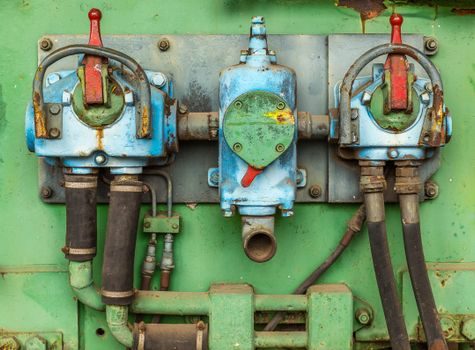
Sizing follows the same Cv-based procedure as any control valve: required flow at the worst-case inlet pressure and minimum outlet pressure must produce a valve opening that holds the outlet within the stated accuracy band. The pressure-reducing element behaves as a normally-open valve that contracts when outlet pressure at port B meets or exceeds the set value, and the closed-loop behaviour must be simulated against the actual load profile [S4].
For pump-fed hydraulic networks, the standard Simscape model includes a fixed-displacement pump with a pressure relief valve, a pressure-reducing valve, and variable orifices as loads; the simulation starts from no-flow, then ramps load to verify setpoint stability across operating envelopes [S5]. Engineers who skip this step typically discover instability only at commissioning — overshoot on sudden load drop or droop on ramp-up, both of which trace to either too-small a Cv or a pilot set too close to the relief-valve cracking pressure.
Standards, Certifications, and Sourcing Reality
European pressure equipment falls under the Pressure Equipment Directive (PED) categories, while drinking-water applications require DVGW, WRAS, ACS, or U.S. Pharmacopeia attestation depending on the jurisdiction; the same valve body will carry different certification marks for each market [S2]. For steam and process service, ASME-stamped bodies and Lloyd's, Bureau Veritas, DNV, or ABS marine approvals are commonly requested; the GOETZE product finder explicitly filters by pressure, temperature, nominal diameter, medium, material, and certificate set, which is the practical selection workflow [S2].
Lead-free brass is now the default for potable water in many jurisdictions, displacing standard brass, and stainless steel is taking share in pharmaceutical and food applications where cleaning chemistry attacks copper alloys [S2]. Sourcing pressure-reducing valves from China-based diaphragm-valve suppliers is a real option for chemical service, but the buyer should still validate lining compatibility and actuation class against the duty rather than accepting generic catalog matches.
Comparison: Four Realistic Options Against Four Decision Criteria
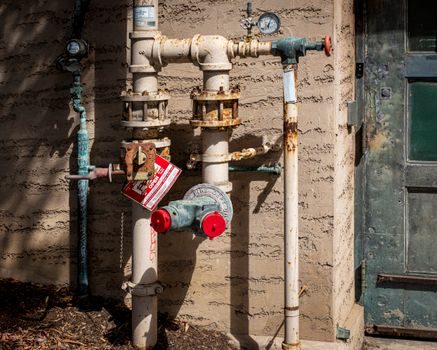
A buyer weighing variants should line them up against medium, capacity, accuracy, and external-power requirement. The four options below represent the realistic shortlist: a direct-acting diaphragm unit for domestic water, a pilot-operated globe valve for steam, a differential-pressure valve for thermal-liquid networks, and a high-pressure industrial regulator for gas or steam headers. Each row is a decision aid, not a vendor endorsement — verify with your own medium and certification list before purchase. [S1]
Domestic water at 50-psi outlet is the easy case: direct-acting, lead-free brass body, threaded ends, no external power, and acceptable accuracy at ±10% of setpoint [S3]. Steam at 100-psi saturated needs pilot-operated cast steel with a downstream pressure sensor port, with accuracy in the ±5% band and turndown above 5:1 [S1]. Thermal-liquid networks in process heating need a differential-pressure valve modelled as a port-B pressure limiter with setpoint stability across the full load range [S4]. Gas or high-pressure steam headers need a stainless or alloy-steel regulator with PED category higher than the residential unit, often supplied with a separate safety relief valve sized for full fire-case flow.
Where the Mainstream Choice Fails
A standard direct-acting water pressure regulator is the wrong pick when the medium is steam above 15 psi gauge, when the required turndown exceeds 3:1, or when outlet accuracy tighter than ±10% is needed — these cases need a pilot-operated or dome-loaded design [S1][S3]. It is also wrong for oxygen service without verified cleaning and ignition-risk documentation [S2], and for pharmaceutical water where the metallurgy, surface finish, and documentation must meet USP or equivalent [S2].
Pilot-operated steam regulators are the wrong pick for small intermittent loads where the pilot tube can foul or where the cost of the pilot circuit cannot be amortised; a simple direct-acting unit at the same nominal size will deliver acceptable control at lower installed cost [S1]. For diaphragm-valve selection in chemical service the same logic applies, and the diaphragm valve spec map is the closer reference for lined bodies and elastomer selection.
Field Reality and Integration With Upstream Protection
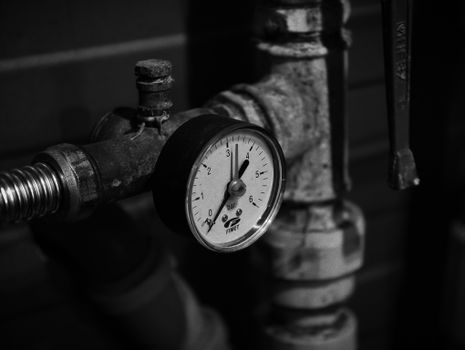
A pressure reducing valve does not replace overpressure protection. On steam, a separate safety relief valve sized for the full upstream capacity under blocked-outlet conditions is mandatory; on water, a thermal-expansion tank or relief device prevents pressure build-up when the regulator closes against a hot-water heater. On hydraulic power units, the pressure-reducing valve sits in series with a pressure relief valve and a fixed-displacement pump, each with a distinct setpoint hierarchy: relief highest, reducing in the middle, pump cut-off lowest [S5].
Commissioning should start with the pump running and loads zero, then ramp load orifices in steps while logging downstream pressure; the response should show a small overshoot and settle within two seconds on a properly sized pilot-operated unit [S5]. Persistent oscillation points to a too-small Cv or a leak path in the pilot circuit; sustained droop points to a worn seat or incorrect spring range. Buyers who also need process heating temperature control can pair the 25P with the 25PT pilot, which performs joint pressure-and-temperature trim on a single valve body, eliminating one body and one set of flanges from the install [S1].
Trackable signals for the next sourcing cycle: confirm PED category and DVGW/USP attestation before PO, request the pilot interchangeability matrix for steam units, and budget the safety relief valve as a separate line item rather than bundling it under the PRV. For buyers sourcing lined chemical-service regulators from Asia, the China diaphragm valve sourcing map lays out realistic lead times and lining options that overlap with the same vendor pool.
Spec-level background on the components involved: pressure calibrator.