
PTFE-filled POM composites lower gear-mesh friction because dispersed PTFE particles smear onto the mating steel surface during sliding and build a continuous, low-shear-strength transfer film that replaces direct POM-on-steel contact [S5].
Commercial grades load PTFE at 10-40 wt% into a 70-85% crystalline POM matrix (tensile modulus 2.6-3.1 GPa, moisture absorption below 0.2% at 23 °C / 50% RH) and consistently report lower friction coefficients than neat POM, with the trade-off being reduced tensile strength and impact resistance that must be checked against the tooth-bending stress [S1][S5].
The Mechanism: Transfer Film, Not Just "Slippery Filler"
Neat POM runs at a coefficient of friction of 0.35-0.45 against steel under dry sliding, which is acceptable for low-load motion but generates enough frictional heat at the pitch line to push the polymer toward its melting window (homopolymer Tm 165-175 °C, copolymer 160-170 °C) [S5].
PTFE itself is one of the lowest-surface-energy solid polymers, with a coefficient of friction of 0.05-0.10 and chain slippage along the (100) crystallographic plane; when PTFE particles are dispersed in the POM matrix, sliding contact pulls PTFE fibrils out of the wear track and deposits them on the steel counterface as a thin, oriented transfer film that shears at the PTFE-PTFE interface rather than at the POM-steel interface [S5]. PatSnap's 2026-04-28 composite analysis and the 2025-01-02 ASME Journal of Tribology study both report this film as the primary driver of the friction drop, with measured coefficients for POM/PTFE blends sitting consistently below unfilled POM across sliding speeds and contact pressures [S5][S6].
How Much PTFE, and What Particle Size
PTFE content in commercial gear grades is typically 10-40 wt%, balancing tribological gain against the loss of tensile strength and impact resistance that pure-PTFE addition causes [S5]. The 2023 Wiley study on POM friction and wear confirms that PTFE, carbon fibre, and graphite all reduce the coefficient of friction of POM under free-abrasive conditions, but only the PTFE route does so without the abrasive scratch damage that hard fibres inflict on a soft steel pinion [S2].
Particle size matters as much as loading: PTFE powders for POM compounding run 0.01-500 µm, with 0.05-100 µm giving the most uniform dispersion and the cleanest transfer film; below 0.05 µm the particles agglomerate, above 100 µm they act as stress concentrators at the gear tooth root [S5]. The interfacial bond between POM and PTFE is intentionally weak (PTFE has no reactive functional groups), which is exactly why the film forms easily under sliding shear without needing surface treatment of the filler [S5].
What It Does to Gear-Mesh Temperatures and Life
Friction at the tooth mesh converts mechanical work into heat; at high torque the resulting temperature rise lowers the polymer's storage modulus, raises hysteresis losses, and pushes the gear toward tooth thinning and tip plastic deformation rather than clean fatigue failure [S3].
Replacing the POM-steel interface with a PTFE-rich transfer film cuts frictional heating directly, which raises the critical torque at which the flash temperature reaches the POM melting point. Mohsenzadeh's 2022 work on POM/carbon-black nanocomposite gears (a related but harder-filler route) showed 52% and 65.2% life increases at 12 Nm and 14 Nm respectively over neat POM, with the failure mode shifting from fracture to thermal flow, and the same thermal argument applies to PTFE grades because the input heat flux at the mesh is lower to begin with [S3]. For dry-running gears, that extra thermal headroom is usually the difference between a gear that lasts the design life and one that welds itself to the pinion.
POM/PTFE vs the Alternatives on the Same Gear
Comparing common gear plastics on a fixed set of decision criteria, POM/PTFE sits in a specific corner of the trade space: [S4]
Friction coefficient against steel: PTFE 0.04-0.10, POM 0.1-0.3 (0.35-0.45 dry), POM/PTFE 0.10-0.20, nylon (PA6/PA66) 0.15-0.4, steel-on-steel 0.5-0.8 [S4][S5]. Wear resistance: POM/PTFE and POM both rated "excellent" for polymer gears, PA "good" (and PA's 1.5-3.0% moisture absorption drives dimensional change that accelerates wear), PTFE "poor" as a bulk gear material despite the lowest friction number [S4]. Moisture absorption: POM below 0.25%, POM/PTFE similar, PA 1.5-3.0% (the deciding spec for outdoor or wash-down gearboxes), PTFE and metals effectively zero [S4]. Cost and processability: PTFE is too soft to hold a fine-pitch tooth on its own, and PA needs humidity conditioning, so the practical gear-grade answer for dry, quiet, dimensionally stable mesh is almost always POM or POM/PTFE rather than neat PTFE or PA [S4]. Engineers comparing the same form factor in a gear pump or a precision gear reducer housing typically find POM/PTFE hits the friction-versus-stiffness target without the moisture penalty of nylon.
Where POM/PTFE Fits and Where It Does Not
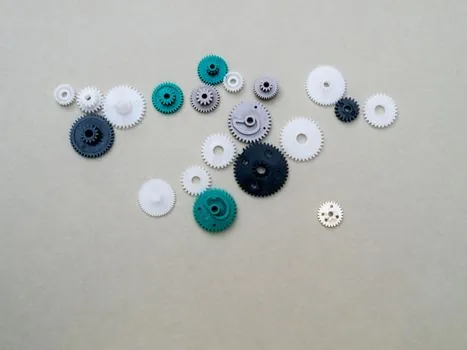
POM/PTFE is the right call for dry-running, low-noise, precision-moulded spur and helical gears in office equipment, automotive seat adjusters and window regulators, printer and camera drives, drug-delivery devices, and packaging-machinery conveyors where lubricant contamination is unacceptable [S4].
It is the wrong call when the gear carries sustained high torque at high pitch-line velocity (the thermal headroom over neat POM is real but finite), when the mating pinion is itself a soft polymer that the PTFE film will not adhere to, or when the design relies on POM's unmodified tensile strength of around 70 MPa, which PTFE addition measurably reduces [S5]. For high-torque, high-speed mesh, a gear coupling running in an oil bath or a metal gear pair is still the safer spec, and neat PTFE bearings make more sense than PTFE-filled structural gears in slow, heavily loaded pivots.
What to Verify on the Datasheet Before Specifying
Three numbers decide whether a POM/PTFE grade will actually survive the application: the PTFE loading in wt% (10-20 wt% is a common starting point for low-friction gears, 30-40 wt% for wear-critical dry slides), the particle-size range (0.05-100 µm preferred, avoid sub-0.05 µm agglomeration), and the resulting coefficient of friction measured against the actual pinion material rather than against a polished steel slider [S5][S6].
Cross-check the tensile strength and impact resistance after PTFE addition, since the 2025 study on POM/PTFE interfacial friction confirms the well-known trade that PTFE alone lowers the mechanical ratings of POM while improving the tribological ones [S8]. Also confirm the mould-shrinkage figure for the filled grade: PTFE changes the crystallisation kinetics of POM and can shift shrinkage by a few tenths of a percent, which matters for fine-pitch module gears held to ISO 1328 tolerance classes. The neat POM base resin's 70-85% crystallinity is part of why the dimensional stability holds up after the filler is added, but the filled grade should be qualified on its own data, not back-calculated from neat-POM mould trials.
Failure Modes to Watch on a Running Gear

Three failure signatures show up repeatedly in polymer gear testing and each one ties back to a specific material decision: tooth-thinning and tip plastic deformation indicate frictional heat has reached the POM melting window, typically above the critical torque; pitting and abrasive scoring indicate hard filler particles (glass or carbon fibre) are scratching the counterface, which a PTFE-only modification avoids; and tooth-root fracture indicates the PTFE loading has dropped the composite's tensile strength below the bending stress at the root, calling for a lower PTFE content or a hybrid fill such as PTFE plus a small amount of short carbon fibre [S3][S5].
For a procurement engineer writing a spur vs helical gear spec, the practical question is whether the gear will run dry and quiet, in which case POM/PTFE is the default shortlist, or whether the design needs helical teeth for higher load capacity, in which case the helix angle adds sliding that the PTFE film is specifically good at handling. Either way, condition-monitoring frequency on dry polymer gear meshes should be set tighter than for metal pairs, because the wear curve has a sharp transition once the flash temperature passes the POM melt [S3]; a condition-monitoring cadence based on the P-F interval catches that transition before the tooth profile is gone.
Track these signals over the next two quarters: published wear-rate data on POM/PTFE grades with PTFE loadings above 30 wt% running against non-steel pinions (aluminium, brass, PBT), and any OEM datasheet revisions that quote a transfer-film-stable coefficient of friction at PV values above 1.0 MPa·m/s, since most current data sits well below that threshold.