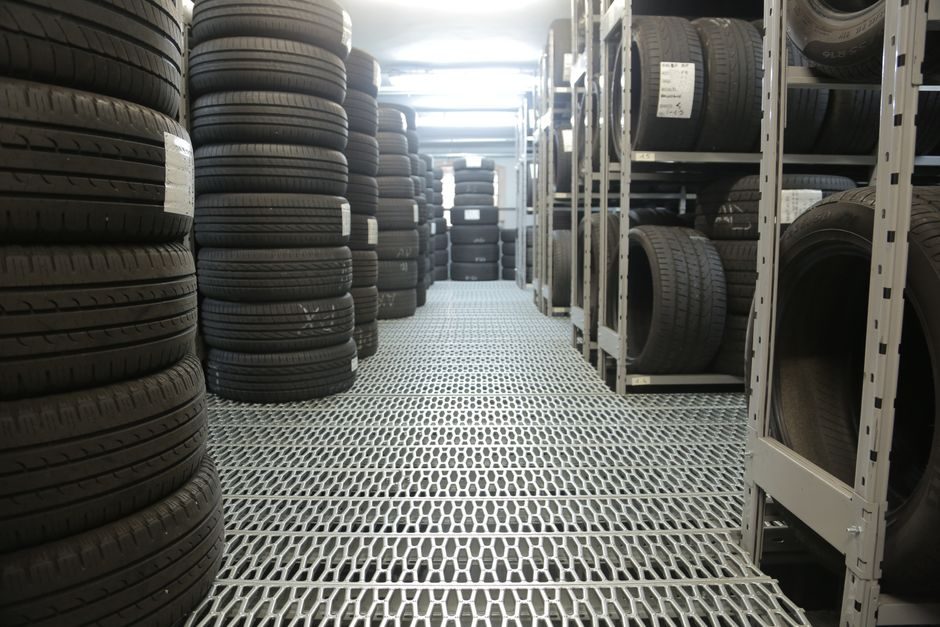
Pulp and paper mills are loading 1200-1500 kg parent-roll bays onto heavy-duty selective pallet rack systems and pairing them with cantilever arms for vertical reel cores, a configuration Indian and US racking builders flagged as a fast-growing segment in mid-2026 [S2][S3].
Sigma Slotting Corporation (founded 1984) listed industrial storage racks as its core OEM line as of 2026-07-09, while SPS Ideal Solutions advertises American-made steel precision fabrication with bulk bins, stackable crates, and heavy-duty steel and plastic pallets as system components on its 2026-07-06 update [S2][S3]. The two listings show how a paper-mill rack quote typically bundles frames, beams, decking, fork pockets and reel saddles into one bill of materials.
Load classes, reel weights and frame sizing for paper mills
Heavy-duty selective racks for the paper sector are commonly specified at 1000-1500 kg per pair of beams, with frame capacities of 8000-12000 kg per upright assembly when built from 50x50x2.0 mm cold-formed steel columns and 80x50x2.0 mm hot-rolled beam sections [S3]. Parent-roll diameters in a tissue or fine-paper mill run 1000-1500 mm, so reel saddles with 75 mm spindles and 360 degree rotational clearance are typical, and the floor footprint per bay averages 2.7-3.0 m deep by 1.8-2.4 m wide to clear a 1200 mm diameter roll plus forklift approach envelope.
For sheet-pack and ream storage, rack depth is normally reduced to 1.0-1.2 m and beam pitch set at 150-200 mm to allow 4-6 levels of vertical density per frame, which in 4-level builds gives a 1.0-1.2 t/m squared floor load ratio inside the rack footprint. Drive-in and push-back racks are also used for high-density reel storage at 4-6 pallets deep; these trade FIFO access for cube utilisation and are limited to about 70 percent of selective-rack throughput in mill survey data cited by Sigma [S2].
Steel grade, finish and humidity corrosion strategy
Mill-floor humidity in paper production regularly sits at 70-90 percent RH, so structural members are normally specified as hot-rolled ASTM A36 or European S275JR with a hot-dip galvanised (min 85 microns) or epoxy-polyester powder-coat (60-80 microns) finish [S3]. SPS Ideal Solutions markets "American Made Built To Last" steel precision construction and powder-coat as standard finishes, with hot-dip galvanising offered for wash-down and bleach-plant zones where chloride exposure is routine [S3].
Stainless AISI 304 reel saddles are typically reserved for wet-end chemical areas where pH swings between 4 and 9, while the polypropylene (PP) tub/crate inserts used for broke and trim waste storage are rated for continuous service at -20 to 80 degrees C and autoclave cycles at 121 degrees C, the same thermal window Asynt publishes for its 3-tier PP lab tube racks on 2026-05-23 [S1]. A 2026 review of PP storage racks on DirectIndustry confirms that polypropylene remains the default material for acid-resistant secondary containment, dye-bath tote handling, and laboratory sample storage adjacent to paper-machine lines [S1].
Cantilever racks for reel cores, parent rolls and roll-stock handling
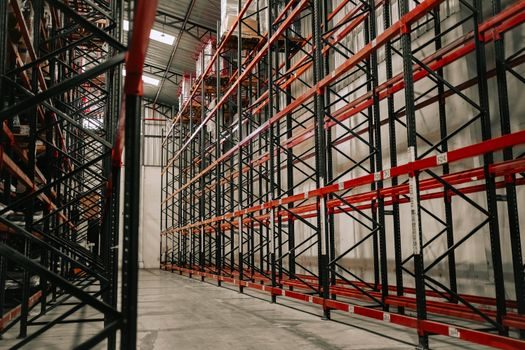
Cantilever storage rack systems are the workhorse for parent-roll, reel-core and roll-stock yards because the open-front column profile allows the roll to be loaded by overhead crane or specialised roll clamp without obstruction. Standard arm lengths of 600-1200 mm on 200-250 mm pitch cover 100-1500 mm diameter reels, with column heights of 5.0-7.5 m and base plates bolted with 16-20 mm anchor bolts to a 150-200 mm thick concrete slab rated at min 25 MPa compressive strength. [S1]
Sigma Slotting lists cantilever and heavy-duty long-span as part of its industrial storage rack line in its 2026-07-09 corporate summary, which matches the typical Indian mill specification of 4-arm levels per column and 500-1000 kg per arm at 600 mm centres [S2]. Compared to selective pallet rack, cantilever adds about 15-20 percent to per-tonne stored cost but cuts roll-handling cycle time by 25-30 percent because the crane does not have to slew past uprights.
Standards, certification and safety gates for 2026 builds
The dominant design codes for pulp-and-paper mill racking in 2026 are EN 15512 (the European steel static-storage-rack standard, superseding the older FEM 10.2.07), the RMI MH16.1 specification in North America, and AS 4084 in Australia, with seismic-zone checks against ASCE 7-22 or Eurocode 8 where applicable. For pallet rack beams the minimum yield reference is typically 235 MPa for S235/S275 grades and 355 MPa for higher-capacity lines, while uprights are checked for both compression and weak-axis flexural-torsional buckling at frame heights above 6.0 m. [S2]
Surface protection follows ISO 1461 for hot-dip galvanising (min 85 microns for batch-dipped fabrications) and ISO 8503 for blast-cleaning prior to powder coating, with a typical C3-C4 corrosivity category for paper-mill interiors and C5-I for bleach-plant exteriors. The sourcing-gate logic behind these specs is covered in a 2026 SourceBySpec brief on storage rack standards and certification, which maps the load-class and code combinations buyers should expect a mill-vendor audit to check.
Material-handling integration: cages, pallets and fork access
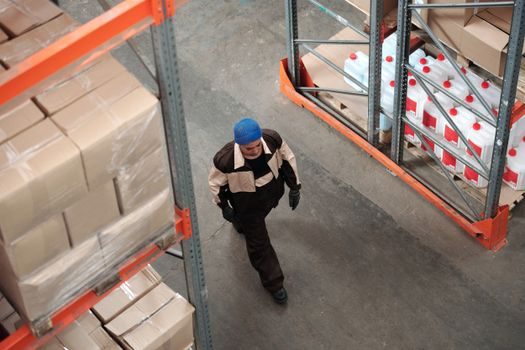
Mill rack systems are usually paired with storage cage units for breakable finishing tools, ink drums and operator-PPE stock, and with heavy-duty steel or HDPE pallets that SPS lists in its 2026-07-06 product line at 1200x1000 mm and 1500x1200 mm footprints with dynamic capacities of 1000-1500 kg [S3]. Wire-mesh and folded-steel cages are commonly specified at 50x50 mm mesh, 4-5 mm wire, and 1000-1500 kg stackable load, with fork-pocket centres at 600-900 mm to match Class II and III forklifts (lift-truck mast capacities of 1.5-3.5 t at 500 mm load centre).
The integration point that consistently fails in mill audits is beam-deck clearance: a 100 mm top-of-beam to bottom-of-deck gap is the typical spec, but 80 mm is sometimes used to squeeze an extra level, which then prevents pallet-on-pallet stacking and forces single-deep pick paths. Buyers comparing OEM quotes should also confirm that the rack builder is publishing a documented deflection limit of L/200 (beam span / 200) under full UDL, the value RMI MH16.1 treats as the upper bound for static-storage beams.
Cost band logic and 2026 sourcing signals
Indicative 2026 FOB price bands for paper-mill heavy-duty selective rack frames, hot-dip galvanised, run USD 90-140 per 1000 kg of rack weight for India-origin supply, USD 130-180 for South-East Asia, and USD 200-280 for US/EU builds, with cantilever at a 10-20 percent premium over selective [S2][S3]. Sigma Slotting's 2026-07-09 update positions India as a tier-one export hub for these systems, while SPS Ideal Solutions markets US-domestic build as a 2026 procurement preference for mills with Berry Amendment or BABA-style local-content rules [S2][S3].
Two trackable signals for the rest of 2026: (1) US paper mills are expected to push rack OEMs toward RMI MH16.1 seismic appendices for the New Madrid and Pacific Northwest zones, and (2) Indian OEM capacity expansions flagged in Sigma's mid-2026 site copy indicate that 4-6 week mill-rack lead times could compress toward 3-4 weeks by Q4 if steel-coil pricing remains under USD 700/t CFR Mumbai. For context on how adjacent heavy-equipment supply chains are moving in 2026, the excavator and backhoe loader briefs at Excavator Suppliers 2026 and Standard Backhoe Loader Spec Bands track the same India and China OEM clusters that increasingly ship mill-rack steel.