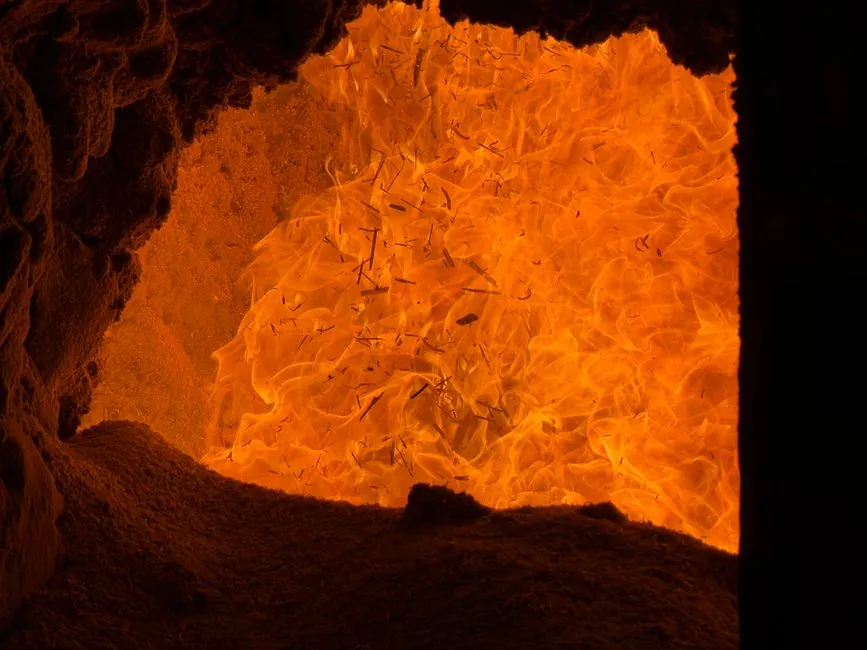
Radiant tube and direct fired heat treatment furnaces represent the two dominant paths for heating steel castings above 1,400°F, and the choice pivots on a single engineering trade: isolating the flame from the work versus accepting surface attack for lower capital cost [S3][S4].
Direct fired designs route burner products straight into the work chamber, while radiant tube designs enclose combustion inside sealed alloy tubes whose outer walls radiate and convect heat into a controlled atmosphere [S2]. Operating temperatures, atmosphere control, tube wall thickness, and alloy selection all behave differently between the two, and the cost of a wrong choice on a heat treat line is measured in scrapped castings and shortened furnace campaigns.
How Each Furnace Type Actually Heats the Work
Direct fired heat treatment furnaces burn natural gas or fuel oil inside the work chamber itself, so the slab or casting contacts the products of combustion directly, which is the root cause of surface oxidation and decarburization on the load [S3]. Radiant tube furnaces burn the same fuel inside a sealed metallic tube, so combustion gas never touches the load, and the chamber atmosphere is decoupled from the flame [S2][S4].
In a radiant tube, radiation from the hot tube surface accounts for 60 to 80 percent of total heat transfer at high temperature, with the remainder split between convection from the tube surface and conduction through the tube wall [S2]. Typical operating temperatures run 1,400°F to 2,100°F, with tube wall temperatures reaching 1,800°F to 2,000°F depending on alloy and firing rate [S2]. A pulse combustion CFD study showed outer radiant tube walls held within 84 K of uniform temperature and slab thickness gradients below 13 K in the soak zone, evidence of how stable the indirect path becomes once the chamber is isolated [S3].
Surface Integrity: Why Steel Castings Care Which One You Pick
Direct fired exposure means combustion byproducts, including CO2, H2O, and excess O2, contact the steel surface, driving oxidation scale growth and a measurable decarburized layer on the casting skin [S3]. For steel castings that subsequently go into quench and temper or machining, that translates to material loss, hard surface anomalies, and extra stock removal.
Radiant tube isolation, with a sealed chamber backfilled with protective atmosphere, lets the metallurgist hold a defined carbon potential and avoid both oxidation and decarburization [S4][S6]. The heat transfer in the indirect path is essentially black-body radiation from the tube OD plus natural convection to the load, which is why surface condition on the load is governed by the chamber gas rather than the flame [S2]. For alloy tubes running in carburizing service, the choice between HK, HP, or higher nickel grades is driven by tube temperature and carbon potential, not by the load itself, since the load never sees the flame [S6].
Thermal Efficiency and Fuel Cost Per Ton
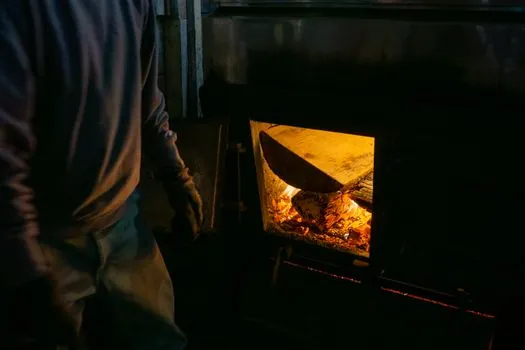
Properly designed radiant tube systems are reported to reduce energy consumption by 15 to 30 percent versus poorly designed radiant systems, and recuperative radiant tube designs push thermal efficiency above 75 percent versus 45 to 55 percent for conventional non-recuperative tubes [S2]. The mechanism is internal heat recovery: exhaust gas preheats combustion air inside the same tube envelope before leaving the stack.
Direct fired furnaces avoid the tube wall temperature penalty entirely because the flame is in the chamber, but they pay the price in scaling losses on the castings, which is energy embodied in scrapped or reconditioned steel rather than gas burned. For high ceiling, high infiltration spaces, radiant tube heating has been measured at 30 to 50 percent lower operating cost than forced-air unit heaters [S5]. The same physics, infrared heating of objects rather than air, apply to inside a furnace: the load receives radiation before the chamber gas does, so less energy escapes up the stack or out of the walls.
Mechanical Limits, Tube Life, and Maintenance Burden
Centrifugally cast radiant tubes cover 2-1/2 inch to 26 inch diameters, with wall thickness for a 6 inch diameter tube at 1,800°F typically specified in the 0.25 to 0.50 inch range per ASME B31.3 process piping guidance [S1][S2]. Maximum heat flux runs 15,000 to 35,000 BTU/hr per square foot of tube surface, set by alloy creep life and carburization resistance [S2].
Support design matters more than most spec sheets admit. Fixed supports must absorb 1.5 to 2.0 inches of thermal growth per 10 feet of heated length, and a poorly constrained support can cut tube life by 50 percent or more [S2]. Fabricated tubes are lighter and easier to install, putting less strain on supports than cast tubes of the same geometry [S7]. Wirco notes that cast radiant tubes are typically used in natural gas fired furnaces and that customers frequently return to non-OEM suppliers when original tube life disappoints, which is consistent with cast alloy tubes failing first at the hot zone, return bend, or support saddle [S1]. Direct fired furnaces have no radiant tubes, so the tube failure mode is gone, replaced by refractory wear, burner port erosion, and scale buildup on the chamber walls.
Selection Criteria for Steel Casting Operations
Pick a radiant tube furnace when the casting specification requires a clean surface, controlled carbon potential, or minimal post-heat-treat stock removal, and when the alloy of the load is sensitive to oxidation or decarburization at the austenitizing temperature [S3][S4]. Recovered cost from reduced scrap and rework typically justifies the 15 to 30 percent efficiency premium of a recuperative radiant design [S2]. For high-volume steel casting foundries running austempering or carburizing, the radiant tube path is effectively mandatory.
Pick a direct fired furnace when capital cost dominates, when the casting tolerates a mill scale layer, and when the downstream process includes shot blasting, machining, or pickling that removes the affected skin anyway. Direct fired is also a defensible choice for non-critical normalizing or stress relief on heavy castings where surface attack is acceptable and throughput per dollar of furnace is the key metric [S3].
Comparison Matrix: Radiant Tube vs Direct Fired at a Glance
Across the four criteria that drive a heat treat line spec, the numbers stack up as follows. Surface integrity: radiant tube wins, with isolated atmosphere and no flame contact, while direct fired accepts oxidation and decarburization [S3]. Energy efficiency: recuperative radiant tube exceeds 75 percent versus 45 to 55 percent for non-recuperative; direct fired can match radiant in raw heat input but loses energy to scaling losses [S2]. Capital cost: direct fired is lower, since the radiant tube envelope, alloy support structure, and atmosphere control panel are eliminated [S3][S4]. Maintenance burden: radiant tube carries tube replacement every 1 to 5 years depending on alloy and firing rate; direct fired carries refractory and burner port service instead [S1][S2][S7].
Standards, Materials, and Sourcing Notes
Wall thickness on radiant tubes follows ASME B31.3 process piping code guidance, incorporating thermal stress, creep life, and corrosion allowance [S2]. Cast radiant tube materials span the HK and HP families of high-nickel heat resisting alloys, with grade selection driven by tube temperature and the carbon potential the tube will see in service [S6]. Wirco's Champaign and Waupaca foundries centrifugal cast tubes from 2-1/2 inch to 26 inch diameter, a useful sourcing reference for plants needing replacement tubes outside OEM channels [S1].
Pulse combustion firing has been shown via CFD to keep radiant tube and furnace gas temperature within 84 K of uniformity and slab thickness gradient below 13 K at discharge, which makes it a credible upgrade path for existing radiant tube furnaces chasing better temperature uniformity [S3]. For a deeper look at how furnace selection interacts with upstream casting decisions, the pit molding vs flask molding comparison is a useful adjacent read, and operators weighing high-temperature alloy selection may also want to revisit resulfurized 4140 vs standard 4140 when the post-heat-treat machining step is the real cost driver.
Track two signals going forward: ASME B31.3 creep-life revisions that may push minimum wall thickness for 1,800°F radiant tubes higher, and recuperative burner retrofits that move the radiant tube efficiency band above the current 75 percent ceiling. Either shift will tilt the cost case further toward radiant tube designs for steel casting heat treat lines, while direct fired will remain the right answer for normalizing and stress relief on heavy castings where surface condition is secondary.
For component-level specifications, see heat treatment furnace, fired brick, and ballast water treatment.