
A reach truck is an electric Class II narrow-aisle forklift rated between 2,000 and 4,500 lbs capacity, with mast lift heights spanning roughly 270 to 542 inches depending on chassis and battery configuration [S1][S3][S5][S8].
The defining mechanical feature is a moving fork carriage that extends horizontally into a rack, allowing the chassis to stay centered in an aisle of roughly 96 to 108 inches while the forks reach 24 to 36 inches past the front wheels [S2][S4]. That extension is what separates a reach truck from a conventional counterbalance forklift, which sacrifices a rigid mast for a rear counterweight.
Capacity and Lift Height Envelope Across Current Models
Published OEM datasheets converge on a 3,000 to 4,500 lbs nominal capacity band for single-reach units, with Toyota explicitly listing 2,500 to 4,500 lbs across its single and double-reach lines and CLARK's NPX positioned at 4,500 lbs on 24V or 36V batteries [S1][S3]. Raymond breaks capacity down by series: the 7200 reaches 3,500 to 4,000 lbs at 270 inches elevated, the 7300 hits 3,500 to 4,500 lbs at 372 inches, and the 7530 High Capacity carries 4,500 lbs with 2,000 lbs still liftable at 505 inches of elevation [S5]. The deepest-reach configurations top out at 542 inches maximum elevated height on 36V battery power [S5].
TCM's European datasheet states the RTH model lifts 2,500 kg to 11.5 metres, which is roughly 5,511 lbs at 37.7 feet, an outlier on the high side that reflects metric and imperial model variants serving different warehouse footprints [S6]. For comparison, the dump truck and truck scale categories deal with far heavier static loads but at ground level, illustrating how reach trucks trade absolute capacity for vertical reach.
Chassis Dimensions, Battery Voltage, and Travel Speed
Reach truck chassis run on 24V or 36V battery systems, with higher-capacity units favouring 36V to support taller masts without voltage sag during lifting [S3][S5]. Toyota's published length-to-forkface spans 54 to 71.8 inches depending on wheelbase and reach mechanism, and a 7-inch touchscreen display is standard on current operator interfaces [S1]. CLARK's reach truck page lists travel speeds up to 7.5 mph loaded and unloaded, with a minimum overhead guard height of 95 inches and turning radius up to 69.7 inches [S3].
Those turning radius and overhead guard numbers are the practical constraints that determine aisle width. A 69.7-inch turning radius paired with right-angle stack clearances typically requires minimum aisle widths in the 96 to 108 inch range, which is why reach trucks are specified almost exclusively for narrow-aisle warehouses rather than mixed-fleet operations [S2][S3][S4].
Stand-Up vs Sit-Down vs 4-Directional Reach Variants
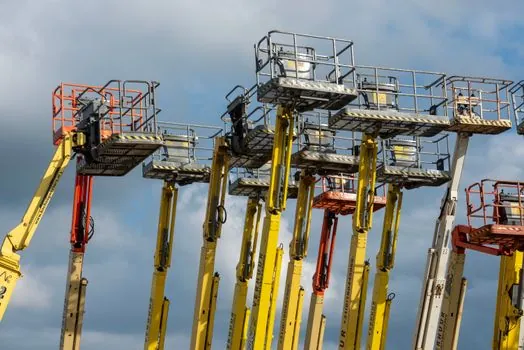
Operator stance is the primary configuration split: stand-up models dominate single-shift high-turnover picking operations, sit-down variants serve long-shift comfort, and universal-stance units accept both postures for mixed crews [S2][S5]. Raymond's 7500 Universal Stance and 7500 Dockstance both span 3,500 to 4,500 lbs at 444 inches maximum elevation on 36V batteries, while the 7700 Sit/Stand adds an enclosed cab option for cold storage [S5].
Multidirectional or 4-directional reach trucks, such as Raymond's 7310 rated 4,500 lbs at 270 inches, allow sideways travel for handling long loads in narrow aisles without turning the chassis [S2][S5]. High-capacity reach trucks, explicitly defined as units handling 4,500 lbs or more at extended lift heights, are the segment where capacity overlaps with concrete mixer truck payload figures only on paper, since the two machine classes solve completely different logistics problems [S2].
Standards, Compliance, and Use-Case Boundaries
Raymond's 7000 Series reach-fork trucks are explicitly certified to UL 583 and are rated as Type E and EE trucks under NFPA 505 for classified hazardous locations, a compliance path that matters in any facility storing flammable liquids or gases [S5]. General warehouse racking compatibility extends to selective, double-deep, drive-in/drive-thru, cantilever, pallet flow, and push-back rack systems, with Raymond claiming more than 200 combinations of heights, features, and capacities within its reach-fork lineup [S5].
Use-case fit is narrow by design: reach trucks are specified for indoor narrow-aisle pallet storage, high-rise retrieval, and precision load placement, but they are not the right tool for outdoor yards, rough terrain, or heavy bulk loads above the 4,500 lbs ceiling [S2][S4][S7]. Operators moving between indoor and outdoor applications should look at moving-mast reach variants with tilting cabs, which sacrifice some lift height for mixed-environment durability [S2]. For aerial work at comparable heights in outdoor settings, the aerial work truck class occupies an adjacent but mechanically distinct category.
Selection Criteria Comparison: Standard vs High-Capacity vs Multidirectional
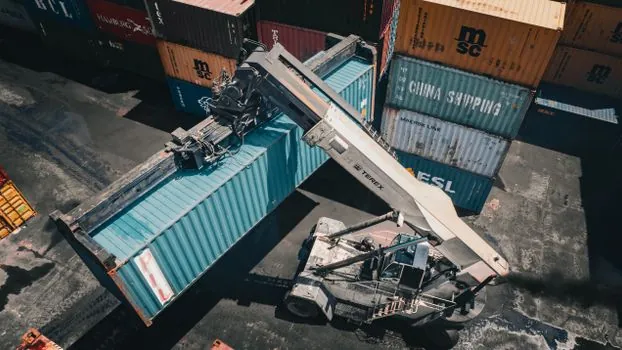
Three configuration tiers cover most warehouse specs. Standard single-reach units (Toyota 8-series, CLARK NPX) deliver 3,000 to 4,500 lbs at lift heights to roughly 366 inches on 36V batteries, suiting general narrow-aisle pallet storage. High-capacity reach trucks (Raymond 7530) hold 4,500 lbs nominal and still lift 2,000 lbs at 505 inches, targeting very-high-bay facilities where residual capacity at full elevation is the binding constraint. Multidirectional reach trucks (Raymond 7310) trade some lift height (270 inches max) for 4-way sideways travel at 4,500 lbs, fitting long-load narrow-aisle storage. [S5]
Decisive selection criteria therefore reduce to four axes: nominal capacity, residual capacity at maximum lift height, aisle width tolerance driven by turning radius, and battery voltage. Buyers should match the residual-capacity curve to the heaviest SKU stored at the top beam of the rack, not just the nominal rating, because capacity drops sharply above roughly 300 inches of elevation on most single-reach chassis [S5][S6].
Operating Limits and Failure Modes Engineers Flag
The most common specification mistake is overstating residual capacity at full lift height: a truck rated 4,500 lbs at 24 inches may only carry 1,500 to 2,000 lbs at 500 inches, and operators ignoring the load chart risk mast deflection and dropped loads [S5][S6]. Battery sizing is the second constraint, since 36V packs weigh roughly 2,000 to 3,000 lbs and consume counterbalance mass that the chassis was designed around, so retrofitting a 24V truck with a 36V pack without OEM approval shifts the load centre [S3][S5].
Mast extension also amplifies sway and reduces stability margin, which is why outriggers are mandatory on extended reaches and why reach trucks are not rated for the dynamic loads that a concrete pump truck boom or aerial work platform handles routinely [S2][S4]. Cold storage operation demands heated cabs and sealed control electronics, and Raymond maintains a dedicated cold storage test facility specifically to cycle equipment through freeze-thaw stress before certifying it for freezers and blast freezers [S5].
Trackable signals for buyers entering late 2026: watch for revised ANSI/ITSDF B56.1 safety standard updates affecting narrow-aisle truck operator training, monitor OEM lithium-ion retrofit announcements for 36V reach platforms, and confirm UL 583 certification status on any used high-capacity reach truck before commissioning it in a classified-location warehouse.
For related coverage, see Angle Grinder Inspection Checklist: Pre-Use, In-Service, and Post-Use Acceptance Criteria.