Rebar benders in the 2026 market are split into three practical form factors: portable hand-held hydraulic (16–25 mm bar, 900 W–1.5 kW), bench/tabletop electric rotary benders (16–32 mm, 1.5–3 kW), and CNC shop benders for stirrup and cage production (32–50 mm, 3 kW+). Capacities are universally quoted by bar diameter in millimetres and US imperial bar size (#3 through #11), and the price band stretches from $277 for a 900 W entry hydraulic to over $3,000 for a multi-axis automatic stirrup line [S2][S5].
Spec sheets from current US and Chinese OEM catalogues all converge on the same selection gates: maximum bar diameter at yield strength 400–500 MPa, bending angle range (most 0°–130°, premium 0°–180°), bending speed (seconds per bend), motor power, weight, and whether the machine handles a single bar or multiple bars in one cycle [S1][S3]. For context on the input material — what actually gets fed into these machines — see the deformed rebar sourcing guide.
Three Form Factors, Three Job Sites
Portable hand-held hydraulic benders like the 900 W RB16mm cover #5 (16 mm) rebar at 0°–130° on a 110–220 V supply, weigh 18–28 kg, and run off a single operator at the slab edge — best for foundation prep, column starter bars, and slab-on-grade tie beams [S2]. Bench/tabletop electric rotary benders such as the Fascut Model FR-800 handle larger diameters and are the workhorse of rebar fab shops; the FR-800 line is positioned as a portable electric bender for shop or job-site fab work [S1].
CNC production benders handle 32–50 mm bar in continuous automated cycles, run 3 kW+ servo motors, and feed into stirrup and pile-cage lines where one operator can replace three manual hands [S3]. For most general contractors and rebar fab shops, the decision gate is site power availability and average bar diameter, not brand — and that is a spec, not a marketing call.
Selection Criteria You Can Measure
Four criteria separate the three form factors cleanly: maximum bar diameter at 400–500 MPa yield, bending angle range, cycle time, and operator count. Entry hand-held units cap at 16 mm (#5) and 130°; mid-range electric benders reach 25–32 mm (#8–#10) at full 180°; CNC lines run 32–50 mm at 180° in 2–5 s per bend [S2][S3][S5].
Motor power scales predictably: 900 W hand-held, 1.5–2.2 kW bench, 3 kW+ CNC [S2][S3]. The OEM-published entry-level Bangcheng unit on Made-in-China shows a US$576 set-price with 600 sets/month production capacity and iron/wooden case shipping — a useful anchor for factory-direct negotiation [S4].
Who It Is For vs Who It Is Not For
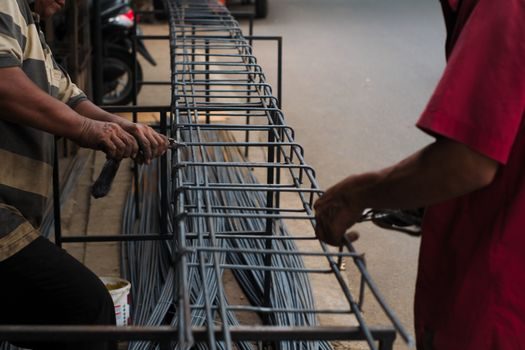
Hand-held hydraulic benders are built for foundation crews, residential contractors, and rebar tying teams that need a single operator to bend 16 mm bar on the deck — they are NOT for precast yards or bridge work where 25–32 mm bar is the daily norm. Bench rotary benders suit rebar fab shops, precast component plants, and mid-size commercial rebar fabricators running 16–32 mm bar at 400–500 MPa. [S1]
CNC stirrup and cage benders are the right answer only for high-volume precast, pile-cage, and bridge-beam production where the 32–50 mm bar diameter and multi-axis geometry pay for the $3,000+ capital. Buying CNC for under 50 tons/month of bent bar is a utilisation problem, not a productivity gain.
Side-by-Side Comparison: Hand-Held vs Bench vs CNC
Across the three form factors, the spec sheet looks like this: hand-held hydraulic 16 mm / 0°–130° / 900 W / ~20 kg / ~$278–$600 per unit / 1 operator / 6–10 s per bend; bench rotary 16–32 mm / 0°–180° / 1.5–3 kW / 80–250 kg / ~$1,000–$2,000 / 1 operator / 4–8 s per bend; CNC production 32–50 mm / 0°–180° / 3 kW+ servo / 800–2,000 kg / ~$3,000+ / 1 operator supervises 2–3 machines / 2–5 s per bend [S2][S3][S4][S5].
The RebarSmachine.com product line published 2026-06-23 shows the same three-tier breakdown in their main menu — rebar bending, rebar cutting, and straightening machinery — with electric motors sourced in-house at SHUANGLONG MACHINERY CO., LIMITED [S6]. That menu structure is the de facto industry taxonomy: any supplier that does not split the line this way is either a niche specialist or a trader without a real catalogue.
Real Use Cases by Bar Diameter

For #3–#5 (10–16 mm) bar at 400 MPa, the hand-held 900 W unit is the spec — typical on residential foundations, slab reinforcement, and small footings. For #6–#8 (19–25 mm) bar at 420–500 MPa, step up to a 1.5–2.2 kW bench rotary bender; the Fascut FR-800 line and equivalent Chinese OEM units both cover this range [S1][S3].
For #9–#11 (29–36 mm) and large-diameter bar in bridge, high-rise, and heavy civil work, a 3 kW+ CNC bender is the realistic minimum; anything smaller chokes on continuous cycle duty and burns out gearboxes. For the straightening step that runs upstream of bending — the third leg of the rebar fab triangle — the same OEM catalogues sell matched rebar straightening machines with the same power and capacity tiers [S6].
Power, Voltage, and Shop Integration
Hand-held units run on 110 V or 220 V single-phase to match site temporary power; bench rotary benders are usually 380 V three-phase in 50 Hz markets and 480 V three-phase in 60 Hz US industrial shops; CNC lines are almost always 380 V three-phase at 50–60 Hz, and that voltage is the binding constraint on overseas sourcing — a $3,000 CNC bender that arrives wired 380 V into a 240 V US shop is a step-down transformer problem on top of a customs problem [S3][S6].
OEMs like those aggregated on Made-in-China publish 1-piece MOQ for the most popular SKUs, with 600 sets/month capacity and iron or wooden case export packing — the packaging detail matters more than buyers expect because rebar bender gearboxes are precision-aligned and a crushed crate voids the warranty [S4]. For factory-direct negotiation, the published $576 set-price on the Bangcheng unit is a real anchor, not a placeholder, and FOB terms with T/T or L/C are standard for this category [S4].
Limitations and Failure Modes
Hand-held units overheat when run continuously above 30 bends/minute on 16 mm bar — the duty cycle on the spec sheet is real, not a marketing floor. Bench rotary benders suffer bending-pin wear at 6–12 month intervals on 25–32 mm 500 MPa bar; spare pin kits are not optional, they are consumables. CNC lines fail most often on the encoder and servo-drive, not the mechanical frame, and the mean time to repair is what separates a $3,000 bender from a $30,000 one — the cheaper one ships with a 30-day parts warranty and no field engineer. [S2]
Voltage mismatch is the single most common cross-border buying failure: ordering a 380 V three-phase CNC from a 240 V single-phase US shop means either a rotary phase converter or a step-down transformer, both unbudgeted line items. The safer path for low-volume North American buyers is to stay at 110 V/220 V single-phase hand-held or 240 V three-phase bench units and skip the CNC tier entirely.
Sourcing Standards and What to Verify
For rebar output quality, the bar itself must meet the relevant national rebar standard (ASTM A615/A706 in the US, BS 4449 in the UK, GB/T 1499 in China, EN 10080 in the EU) — a bender that claims 32 mm capacity at 500 MPa is only as good as the bar it is fed, and a bender specced for 400 MPa bar will deform 500 MPa bar at the bend apex. The bender itself does not carry an ISO standard number, but the OEM should publish a nameplate rating that states maximum bar diameter at a stated yield strength. [S3]
Buyer verification checklist before issuing a PO: nameplate capacity in mm AND in imperial bar size at a stated yield strength; bending angle range with tolerance; cycle time at full load; motor voltage and phase; net weight; export packaging standard (iron case is heavier but survives container shipping better than wooden case on multi-modal routes) [S4][S6]. The Made-in-China aggregated catalogue shows 4 main rebar tool product lines across manufacturers — bender, cutter, tier, and straightener — which is the right product mix to evaluate as a single supplier for spare-parts consolidation [S3].
Trackable signals for the rest of 2026: monitor OEM capacity announcements in the Shaanxi and Shandong rebar-tool clusters where most export units are built; watch for 240 V three-phase CNC SKUs entering the US distribution channel, which would close the current voltage-mismatch gap; track US rebar fab shop capex announcements through AGC and ABC chapter publications, since shop capex is the leading indicator for bench and CNC bender orders. Pricing across the three tiers is currently stable at $278 hand-held, $576–$1,500 bench, $3,000+ CNC factory-direct [S2][S4][S5].
For component-level specifications, see rebar bender, and linear guide.