
A field rebar bender on a landscaping or hardscape job sees dirt, moisture, and abrasive grit that cut machine life in half if the daily 2 minute inspection is skipped: pre-shift checks of power cords, hydraulic lines, fastening bolts, and the emergency stop, plus a duty cycle of no more than 2 hours continuous before a 15 minute pause, are the baseline that keeps a GW42-class bender productive [S2].
The work itself, bending rebar for retaining rings, tree-root barriers, edging anchors, and form stakes, drives the same equipment as on a structural slab, but the environment is wetter and dustier; stormwater BMPs call for never rinsing equipment into the street and always cleaning mowers, rakes, and shovels off-pavement, which means benders and cutters should follow the same rule and stay clear of washdown zones [S1].
Pre-Shift Inspection and Lockout/Tagout
Lockout/tagout is non-negotiable: disconnect and lock the power supply, fully depressurize the hydraulic circuit, and post a “Maintenance in Progress” sign before any tool touches the machine [S2]. The pre-shift walk-around is a four-item gate, inspect power cords and hydraulic pipelines for damage or leaks, verify that all fastening bolts are tight, test the emergency stop for response, and check the bending mold for cracks or excessive wear [S2]. For a complete power-down, the cord should be physically unplugged, not just switched at the wall, so a phantom start cannot energize the bend head [S3].
Acceptance gate before the first bend of the day: no visible hydraulic weep at fittings, E-stop trips the contactor within one button-push, and the mold sits with its central axis aligned to within 0.5 mm of the spindle centerline [S2]. If any item fails, the machine stays cold until the fault is cleared; bending a 25 mm rebar through a 20 mm mold, for example, is the classic over-capacity mistake that welds the machine to the bar and destroys the mold [S2].
Hydraulic System: Oil Grade, Change Interval, and Fault Map
Hydraulic oil for a GW42-class bender is specified as ISO VG46 anti-wear hydraulic oil, with a first change at 500 operating hours and subsequent changes every 2,000 hours or annually, whichever comes first [S2]. Transmission gears take a weekly charge of lithium-based grease to NLGI Grade 2, applied until the old lubricant is fully expelled from the bearings [S2].
Two faults dominate the hydraulic fault log: insufficient pressure, traced to an overflow valve misadjustment or a worn oil pump, corrected by re-setting the valve or replacing the pump; and high oil temperature, traced to a clogged radiator or wrong oil viscosity, corrected by cleaning the radiator and switching to the proper VG46 grade [S2]. Monthly, the filter element is replaced; quarterly, the electrical circuit gets an insulation resistance test; annually, the bending spindle gets fresh bearings [S2].
For winter work on cold-ground sites, swap to a low-temperature hydraulic variant such as an HV series oil, and run the machine at no load for 10 minutes to warm the system before bending [S2].
Mechanical Components: Molds, Spindles, and Wear Limits
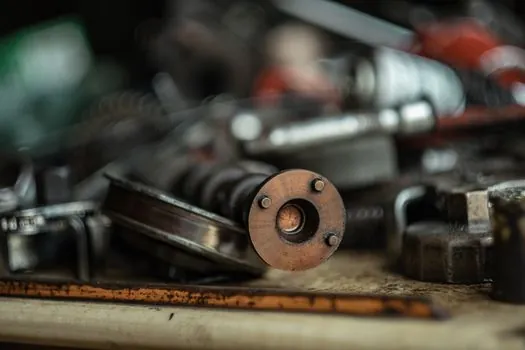
The bending mold is the wear part that ends a machine’s useful life if ignored: replace it once working-surface wear exceeds 3 mm, and during installation keep the central axis within 0.5 mm of the spindle [S2]. A worn mold produces inconsistent bend angles, slivers the rebar coating, and jams the mandrel pin, all of which show up as out-of-spec radii on the first inspection of the bent piece.
Lubrication on the turntable and bolt threads is the mechanical counterpart to hydraulic care, and excess oil should be wiped off with a clean cloth after greasing so grit does not stick to wet surfaces [S3]. Gearbox oil and transmission oil levels need a compartment-open check at the same weekly interval; any sign of milky oil or metallic swarf is a teardown signal, not a top-up signal.
Cover the machine with a canvas tarp when it sits outside between shifts, since the combination of UV, dew, and site dust is what corrodes the spindle and the limit-switch cam faster than any wear cycle inside the gearbox [S3].
Electrical System: Insulation, Contactors, and Overload
Motor insulation is the electrical gate that prevents a wet-site electrocution, and it is tested with a megohmmeter, with the acceptance threshold set at ≥ 1 MΩ insulation resistance [S2]. Below that value, the motor dries out or is replaced before the bender is plugged back into a landscaping-site GFCI feed.
Contactor contacts are polished every six months to keep contact resistance low, and an overload protector is installed and sized at 1.2 times the motor’s full-load current rating [S2]. For rainy-season storage, moisture-proof heating elements are fitted to the motor housing, and rust-prevention oil is applied to guide rails and exposed unpainted surfaces [S2].
Site Hygiene: Stormwater, Washdown, and Debris

Landscaping BMPs treat equipment washwater the same way they treat grass clippings: never rinse equipment into the street or gutter, and never blow or rinse lawn or landscape clippings into the storm drain, because catch-basin clogs and phosphorus loading both trace back to that habit [S1]. For a rebar bender, the practical rule is to wipe the machine down with a rag over a landscaped (permeable) area, and to sweep, not hose, the concrete pad where it sits.
Inspect sprinklers monthly so the site does not add water to an already wet machine, and avoid watering paving surfaces in the first place, since overspray onto a bender’s electrical panel is a common GFCI-trip path on hardscape jobs [S1].
Comparison: Maintenance Tasks by Interval
The following comparison lines up the four maintenance cadences that govern a landscaping-site rebar bender against the work done, the interval, and the acceptance value where one is defined [S2].
Daily: pre-shift inspection of cords, hydraulic lines, bolts, E-stop, and mold; duty cycle capped at 2 h continuous with a 15 min pause; no quantitative acceptance beyond visual and functional checks. Weekly: grease transmission gears with NLGI Grade 2 lithium grease until old lube is purged. Monthly: replace hydraulic filter element and check oil level; first oil change at 500 h, then every 2,000 h or annually. Quarterly: insulation resistance test on the electrical circuit, with ≥ 1 MΩ as the pass threshold. Annually: replace bending-spindle bearings. Six-month: polish contactor contacts. Per install: mold axis within 0.5 mm; replace mold once wear exceeds 3 mm [S2].
When Not to Repair, and When to Escalate

A bender is taken out of service, not field-repaired, when motor insulation drops below 1 MΩ, when the mold wear exceeds the 3 mm limit, or when hydraulic pressure cannot be restored by re-setting the overflow valve, all of which point to internal pump or seal failure [S2]. A bent or cracked spindle is a replace-the-spindle event, not a straighten-and-run event, because spindle runout directly drives bend-angle accuracy and the GW42-class tolerance stack collapses once the bearing journal is no longer true.
For the broader failure-mode map that covers cut-off saws and other rebar-shop equipment, the FMEA-style spec map for cut-off machines lines up the same daily-to-annual cadence against cutting and bending duty cycles. Hydraulic oil and grease selection on a bender overlaps with the pneumatic-tubing spec logic on contamination control, since both share the “keep ISO VG46 clean and capped” rule. Power-tool PPE and pre-drill checks, covered in the impact-drill safety guide, apply to the bender’s on-site operator whenever the same crew switches between drill and bend stations.
For an encyclopedia baseline on the machine class itself, the rebar bender reference covers bending-capacity tables and the matching rebar cutter and rebar coupler gear that share the same hydraulic service intervals; the broader rebar tool page indexes the full rebar-prep workflow, while rebar covers the bar grades and diameters that set the mold size in the first place.