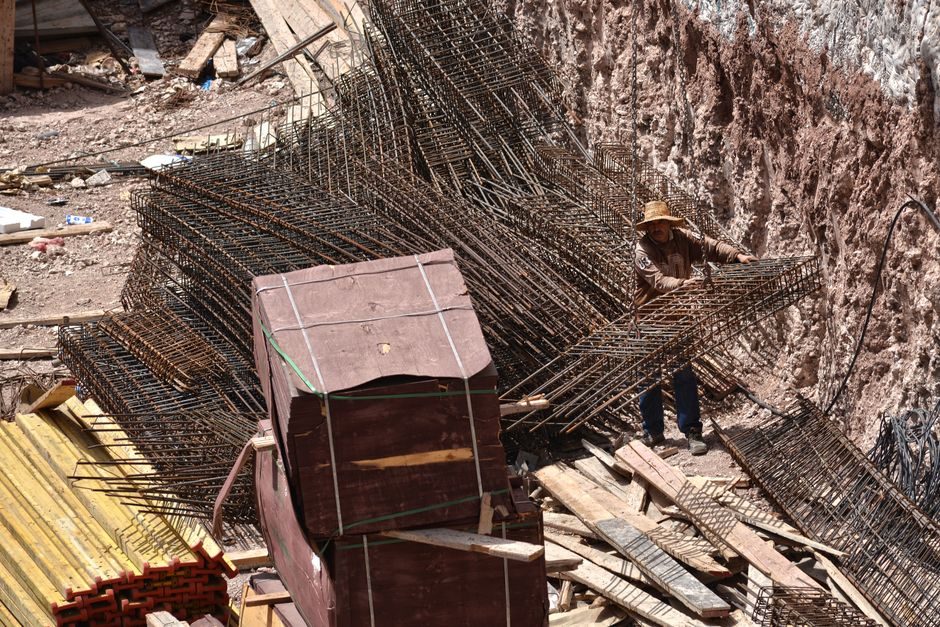
A rebar threading machine cuts parallel or tapered rolled threads on the cut end of deformed reinforcing bar so a rebar coupler can splice two bars end-to-end without lap welding, with the spliced joint typically rated to develop the bar's full ultimate tensile strength (often 1.0 fy or 1.25 fy design values under ACI 318 / JGJ 107 family codes).
The trade is well-defined: you trade higher machine capex, more rigid process control, and ongoing consumables (chasing dies, threading rolls, cutting wheels, threading oil) for faster cycle time per joint, less crane time, and reduced reliance on certified welders. The fit is conditional on bar size, job repetition, and site power.
What a Rebar Threading Machine Actually Does
Threading machines for rebar take a square-cut bar end and form a cold-rolled or cut parallel thread, most commonly the ISO metric coarse pattern, with thread lengths typically running 1.0× to 1.5× the bar diameter (so a 25 mm bar gets a 25–38 mm thread). The prepared end then receives a rebar coupler — a cylindrical sleeve with matching internal threads — and the two bars are torqued together. The cycle on a 16–32 mm bar with a bench-style unit usually lands at 30–60 seconds per end once the operator is in rhythm; on portable on-bar units fielded to the deck, 60–120 seconds is more typical. Capacity classes on the market cover 12 mm through 50 mm, with heavier parallel-thread upsetting machines picking up 50–75 mm rebar where standard rolling heads run out of cross-section. [S2]
Core Advantages on a Real Job Site
The clearest upside is cycle time: a single operator with a portable threading head can finish 200–300 ends per shift on 16–25 mm bar, against 60–100 lap welds a certified welder can lay down in the same window. That is the same throughput argument that shows up in any rebar pre-fab shop running rebar bender and threading cells back-to-back. Material savings are the second number that matters — a mechanical splice wastes no overlap length, so a 40-bar continuous bottom-mat pour that would consume roughly 1.2 m of overlap per joint (32× bar diameter × 0.7 factor) instead uses a single 60–90 mm coupler sleeve per joint, which on 25 mm bar is on the order of 1.0 m of saved steel per splice. Quality consistency is the third: torque-controlled threaded couplers fail at or above the parent bar in published tests, versus lap welds where slag, undercut, and dilution drive the failure rate of field welds above the parent-bar envelope far more often than threaded splices do [S2]. The fourth is logistics — no welder qualification card per joint, no shielding gas on the deck, and no hot-work permit on congested decks or near flammable form-release.
Where Threading Falls Short
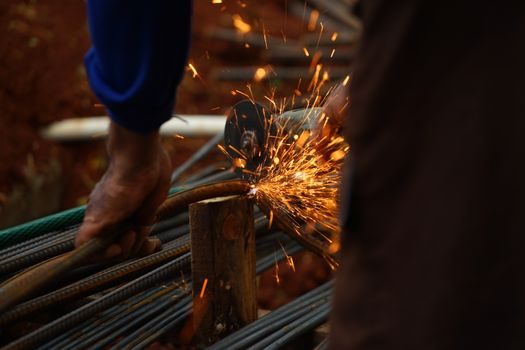
Capex is the first number to push back on. A bench-style threading machine for 16–40 mm capacity lands in the 4,000–10,000 USD band, a portable on-bar unit 2,500–6,000 USD, and a full upsetting + threading line for 32–50 mm bars starts north of 15,000 USD before dies and tooling [S2]. Consumables on top — thread-rolling dies last roughly 5,000–15,000 ends per set depending on bar grade and lubrication discipline, and cutting wheels are a recurring line item. Power is the second constraint: most production units need 380–415 V three-phase or a 5–7 kVA portable genset, which rules out the unit on a small residential pour fed off a 16 A single-phase site supply. The third limit is bar-end prep — a crooked cut, a heavily deformed tip, or rusty pitting will either scrap the end or force a re-cut; the bar is not as forgiving as a lap joint, which simply overlaps whatever is there. A fourth, often underestimated cost is QC: each thread needs visual and dimensional check, the coupler lot needs traceability, and many specifiers require pre-production sample splices destructively tested per batch. The comparison against other rebar-prep tools — including the always-handy rebar cutter and the rebar straightener that feed the threading cell — is that those two are forgiving, low-skill stations, while the threading cell is a metrology step.
Threading vs Welding vs Grouted Sleeve: Decision Map
For 16–40 mm deformed bar in a high-repetition column or shear-wall project, threaded splicing is the throughput winner and the most QC-defensible joint, and it is the only one of the three that can be fielded in cold weather without a welder's preheat chart in hand. For one-off, low-volume, or remote pours where pulling a threading machine and its power source to the deck is itself a 4-hour task, lap welding remains the lower-friction option. For very large bar (50 mm and up) or seismic details where slip under cyclic load is the controlling case, headed bars and grouted sleeves compete directly, and the rebar threading machine is only one of three or four viable routes. The crossover point is roughly when the project passes 1,000 splices in a single bar size — below that, the machine's mobilization, threading dies, and operator time exceed the labour premium on welding. Procurement-side data lines up with this: a rebar cutter total-cost-of-ownership study covering the 2026 cost bands shows that the per-cut consumable cost on cutting wheels scales with bar diameter, and threading inherits the same shape of curve one step downstream. [S2]
Who Should Specify One — and Who Should Not

Specifying a rebar threading machine pays back on: precast yards and rebar cut-and-bend shops running steady bar sizes; high-rise core walls with thousands of column verticals; bridge piers and large-diameter cage splices; and any deck where hot work is restricted. It is the wrong tool for: small residential foundations below 500 splices total, single-phase-only sites, projects with mixed bar sizes that would force constant die changeovers, and any crew without a thread-QC plan in writing. For those jobs, the rebar cutter plus lap detail or mechanical anchor remains the lower-risk build. [S2]
Limits, Failure Modes, and QC to Lock In
Real-world failure modes on threaded splices cluster around three buckets: under-torqued couplers that slip under service load; oversize thread pitch from worn dies that the coupler cannot fully engage; and bar-end eccentricity from a crooked saw cut that walks the thread out of concentricity. The fix is process, not machine: torque-wrench calibration, die-change logs tied to a bar-count threshold, and a go/no-go thread ring per bar size, plus a batch-destruction test (typically 3–5 splices per lot of 500, per ISO 15835 / JGJ 107 family requirements). Lubrication discipline on the threading oil also drives die life more than any other variable — running dry cuts die life by half or worse. None of these failure modes show up on the machine's nameplate; they show up six months into the pour, which is why the cell needs a written QC SOP rather than a verbal handover. [S2]
Sourcing and Standards to Anchor the Spec
The relevant spec umbrella for threaded mechanical splices is ISO 15835 (mechanical splices for reinforcing bars), with JGJ 107 the comparable Chinese code, ACI 318 Chapter 25 the US structural reference, and BS 8110 the legacy UK reference. Each jurisdiction classifies splices by performance — typically Type 1 (50% fy), Type 2 (100% fy), and Type 3 (125% fy) — and the threading machine and coupler combination must be qualified to the type called out on the drawings. For procurement, the on-bar portable unit class is dominated by Chinese and Korean manufacturers in the 2026 market, with the upset + parallel-thread line for larger diameters concentrated in fewer vendors [S2]. For an engineer weighing the broader rebar-prep equipment line, an industrial blower selection guide covering spec map and family comparison is the kind of side reference that anchors adjacent equipment decisions on the same yard.
Specifiers locking in 2026-Q3 procurement should pin die life and thread-ring gauge supply in the same PO as the machine; retrofit sourcing mid-project is the single most common schedule-killer on threaded-splice pours.