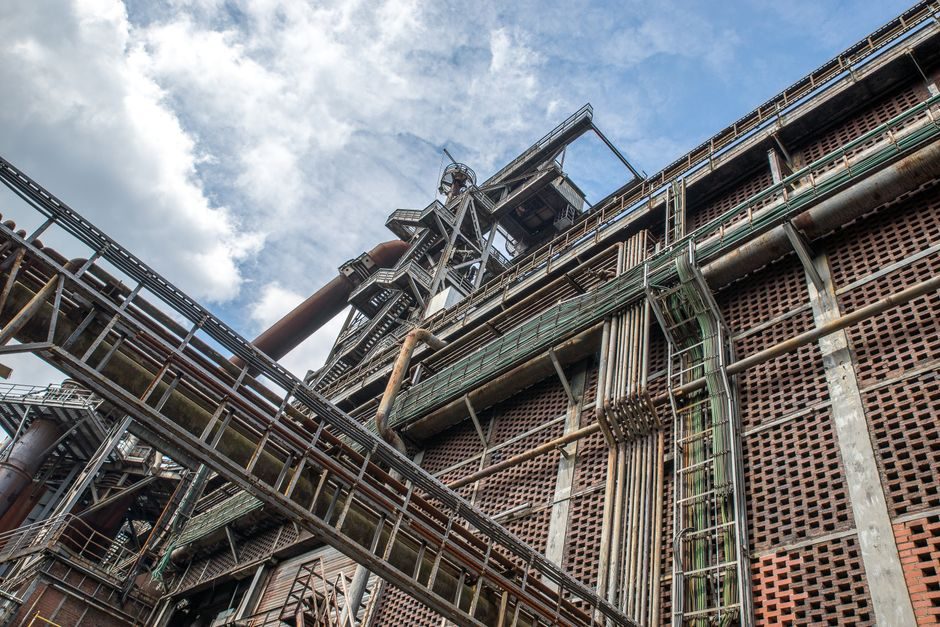
Rebar is a long-product rolled from semi-finished steel billet or bloom, and its upstream and downstream industries form a tightly coupled chain that begins with iron ore, scrap, and ferroalloy feedstocks and ends at concrete-reinforced infrastructure, precast elements, and engineered fasteners. Indian cold-finished bright-bar producers such as Steelmet Industries in Nagpur work to BS 970: Part 1 (1983/1991), EN 10025, EN 10083-2, and JIS spec sheets, supplying the precision bar stock that feeds fasteners, automotive shafts, and machinery components downstream of basic rebar production [S2].
Adjacent industries extend the same steelmaking footprint: QS Oman, established in 2012, serves upstream oil and gas operators and downstream process industries with inspection and technical services covering petrochemical plants, refineries, steel mills, and cement works, illustrating how the steelmaking cluster shares QA/QC, materials testing, and corrosion-control disciplines with hydrocarbon and cement value chains [S3]. On the construction-consumption side, rebar bending and cutting workflows and rebar threading for mechanical splices define the final link before concrete placement.
Upstream Feedstocks: Iron Ore, Scrap, and Ferroalloys
Upstream of the rebar mill, the dominant metallic inputs are virgin iron ore reduced in blast furnaces, steel scrap melted in electric arc furnaces, and ferroalloys such as ferromanganese and ferronickel added to hit the carbon and manganese targets specified in ASTM A615 Grades 40/60/75 and the weldable Grade 80 chemistry. Bright-bar producers like Steelmet cross-reference BS 970, DIN, EN 10025, EN 10083-2, and JIS grades against incoming billet, with low-carbon, medium-carbon, alloy, bearing, spring, stainless, and tool-steel families all requiring different ferroalloy additions and ladle treatments [S2].
Three data points anchor the upstream economics: (1) Steelmet's bright-bar portfolio explicitly includes carbon steels, alloy steels, CHQ and boron steels, stainless steels, and tool and die-mould steels — each family driving a different ferroalloy bill; (2) the company publishes cold-drawn bright bar size ranges and process notes alongside its raw-material cross-reference, signalling that feedstock traceability is a buyer's spec requirement, not a back-office detail; (3) cross-reference tables pair low-carbon mild steels, case-hardening steels, and heat-resisting steels against the same incoming feedstock codes, so a single heat of billet can be reclassified across product families depending on downstream draw ratio and finish [S2].
Midstream: Rolling, Cold Drawing, and the Long-Product Mill
Midstream, the continuous-cast billet is reheated to roughly 1100–1250 °C and hot-rolled through a sequence of roughing, intermediate, and finishing stands before being cut on a cooling bed; rebar is then typically quenched via tempcore or Thermex processes to produce a tempered martensite outer ring on a ferrite-pearlite core, giving Grades 500B/500C/500D their characteristic strength-ductility balance. Cold-drawn bright bars share the same billet input but skip the rebar deformation cycle, instead passing hot-rolled black bar through a descaling bath, a draw bench, and a straightener to hit tight dimensional and surface-finish tolerances. [S1]
The comparison is direct: hot-rolled rebar typically ships in 12 m straight lengths or coils with a black-mill scale finish and diameter tolerances on the order of ±0.5 mm at 12–32 mm bar size, while cold-drawn bright bar (per Steelmet's published portfolio) targets hex, square, flat, and profile sections with tighter tolerance, brighter surface, and improved machinability for fastener and shaft blanks [S2]. Downstream processing then diverges again: rebar feeds rebar cutting lines and mechanical coupler assemblies on the jobsite, while bright bar feeds CNC turning, cold heading, and heat treatment. For projects that need straightened bar at speed, a dedicated rebar straightener sits between the coil payload and the cut-and-bend station.
Downstream End-Use: Construction, Infrastructure, and Engineered Components

Construction absorbs the majority of rebar output — reinforced concrete for high-rise columns, beams, slabs, foundations, bridge decks, tunnels, and retaining structures — with seismic-grade bars (typically Grade 500D per IS 1786 or equivalent) specified where ductility and low-cycle fatigue drive design. Precast yards consume cut-and-bent bar or welded cages for beams, piles, and tunnel segments, while infrastructure programmes such as highways, metros, ports, and water-treatment plants pull large tonnages of straight bar in 12 m or 16 m lifts. [S2]
Beyond the concrete trade, downstream users include the bright-bar converter industry itself: Steelmet lists automotive and vehicle components, steering shafts, PTO shafts, electric motor shafts, defence/railways/aerospace parts, heavy-engineering and earthmoving components, and agricultural machinery among its application areas — all fed by cold-drawn bar stock that begins as the same billet feeding a rebar mill [S2]. Rebar threading and rebar coupler assemblies also serve bridge and high-rise splices where lap length is constrained, while bar offcuts and stampings from the bright-bar converter industry feed back into the scrap channel that closes the loop into the next EAF heat. Industrial steel-supply tightness upstream — visible in the galvanized-sheet squeeze mapped for Q3 2026 and the stainless-coil sourcing map — propagates downstream into the same mill allocation queues that feed rebar production.
Standards, Specifications, and the Common Spec Backbone
Rebar specs are governed regionally but converge on a small set of requirements: yield strength (typically 500 MPa minimum), ultimate tensile strength, elongation (often ≥ 12–16% depending on ductility class), bend and rebend test performance, and chemical limits on carbon (≤ 0.25% for weldable grades), sulphur, and phosphorus. Indian rebar typically follows IS 1786, US rebar ASTM A615 / A706, European BS 4449 / EN 10080, and Japanese JIS G3112 — and the same bar can carry dual certification where export markets require it. [S1]
Adjacent long-product specs borrow from the same metallurgy: Steelmet cross-references BS 970-1:1983/1991, DIN standards, EN 10025 for structural steels, EN 10083-2 for quenched and tempered alloys, and the JIS family across at least ten published grade sheets, with low-carbon mild steels, case-hardening steels, bearing steels, and tool/die steels all referenced to the same incoming heat codes [S2]. For the inspection and QA layer that crosses both steel and adjacent process industries, QS Oman's partner network covers third-party inspection from raw-material stage through finishing across petrochemical, refinery, power, cement, nuclear, and steel complexes [S3] — the same inspection discipline a rebar buyer applies for traceability, mechanical testing, and pre-shipment verification.
Selection Criteria: Matching Rebar Grade to Application
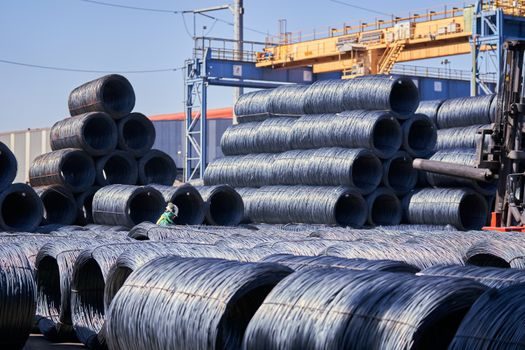
Four decision criteria govern most rebar procurement calls: (1) ductility class — Grade 500B for general RCC, 500C for higher-seismic and moment-resisting frames, 500D for ductility-critical members; (2) weldability — driven by the carbon equivalent (CE) and typically requiring CE ≤ 0.50 for field welding per IS 1786 and equivalents; (3) corrosion strategy — uncoated black bar for standard buried or interior concrete, epoxy-coated (ASTM A775) or galvanized (ASTM A767) for aggressive chloride exposure, or stainless-clad bar for marine and de-icing-salt zones; (4) connection method — lap splices for standard work, mechanical rebar couplers for congestion, continuity, or seismic detailing, and headed bars for anchorage at beam-column joints. [S2]
For the bright-bar converter downstream, selection is driven by (a) machinability — resulphurized free-cutting grades such as EN 1.0715 / 11SMn30 or AISI 1215 for screw-machine work; (b) hardenability — medium-carbon and alloy grades per EN 10083-2 for through-hardening shafts; (c) surface finish and tolerance — cold-drawn bright bar over peeled/polished bar where straightness and dimensional consistency drive downstream CNC uptime; and (d) downstream form — round for shafts and fasteners, hex for headed bolts, flat for pressings, square for forging stock, as catalogued across Steelmet's round/hex/flat/square/profile sections [S2]. Buyers who treat rebar, bright bar, and the rolling-mill QA layer as one interconnected spec problem — rather than three separate procurement silos — typically realise lower total cost through shared inspection, shared heat traceability, and shared mill allocation.
Limitations, Failure Modes, and Cross-Industry Constraints
Common failure modes for rebar in service include chloride-induced pitting that progresses to section loss and concrete spalling, carbonation-driven depassivation at low cover, stress-corrosion cracking in prestressing or high-stress members, and fatigue cracking at splices with poor concentricity. For threaded mechanical splices, the failure surface shifts from the parent bar to the threads and the coupler body, so rebar threading accuracy and coupler metallurgy become the spec bottleneck — and a bar that meets A615 chemistry but ships with damaged or out-of-tolerance threads will fail the splice before the concrete is ever poured. [S1]
Across the wider value chain, the same metallurgical logic applies: bright-bar stock that fails case-hardening depth or decarburisation limits fails downstream at the gear or bearing race, not at the bar supplier's outgoing inspection, and mill allocation squeezes in galvanised sheet and stainless coil feed back into the same hot-rolled coil pool that services rebar production [S2][S3]. One trackable signal is whether your mill publishes a unified spec table across rebar and long-product adjacent grades — if it does, the inspection and traceability chain is usually shorter, and the downstream threading, bending, and cutting stations receive a more consistent input.