Selection of a remote I/O module in 2026 starts with three field questions: where the I/O sits (cabinet, machine, or outdoor), what bus the controller expects (Modbus RTU, EtherNet/IP, PROFIBUS, or a vendor-proprietary fiber link), and whether any channel is safety-rated (Type 3, PLe, SIL). Drop any one of those and you re-spec the panel.
The 2026 market remains dominated by four duty classes: 22.5 mm wide modular adapters like the MEGMEET MR400 (32-point, 22.5 mm width) [S5]; ultra-slim card-style distributed I/O (Decowell RB, EX, and FS series with PNP 15–30 VDC inputs, IP40 to IP67) [S2]; fiber-mirrored utility I/O such as the SEL-2505 (8 DI/8 DO over two optical fibers, starting $754) [S7]; and safety-bus interlock modules like the Keyence GC-R48 (Type 3, 11 V/2 mA ON, max 100 m cable) [S3].
Variant Map: Block I/O vs Distributed I/O vs Fiber Teleprotection I/O
Block-style I/O modules are backplane-mounted bricks that snap onto a DIN rail next to the controller. A 16-input 5–11 V Weidmuller unit was listed at GBP 129.99 in 2025 [S9]; the M-System R3-DC16AS sits at 27.5 mm (1.08 in) module width and is a discrete 16-point sink output [S4]. These are the cheapest path per channel, but every point lands back in the same cabinet — wiring cost dominates above roughly 30 m of field run.
Distributed IP67 I/O moves the terminals to the machine. Decowell's SD Series carries IP67 sealing for washdown cells, and the FS series runs PNP inputs in the 15–30 VDC band with an IP40 cabinet rating for dryer areas [S2]. MEGMEET's MR400 trims the 32-point module to a 22.5 mm footprint, so cabinet depth is no longer the binding constraint [S5]. Expect a 2–4× price uplift per channel versus a block I/O brick, but the field-wire savings cover the delta once the average home-run exceeds 25–30 m.
Fiber teleprotection I/O is its own category. The SEL-2505 replaces 32 copper conductors between an outdoor bay and the control house with two optical fibers, supports SEL Mirrored Bits teleprotection, and lists from $754 [S7]. That is two to three times the price of a copper-only I/O brick, justified only when surge exposure, ground-potential rise, or copper-cost-per-meter makes fiber the cheaper conductor.
Safety-rated interlock I/O sits on a dedicated safety bus. The Keyence GC-R48 expects Type 3 contact or PNP safety devices, pulls ON at min. 11 V/2 mA and OFF at max. 5 V/1.5 mA, limits short-circuit current to ~3 mA, and caps cable at 100 m [S3]. Inputs and outputs are PNP transistor only — sourcing only, no sinking — so any NPN sensor on a GC-R48 simply will not work.
Protocol and Bus Selection
Modbus RTU on RS-485 is the universal fallback for instrumentation-grade I/O. The DAM124 ships with one RS-485 port, four analog inputs, four PT100/PT1000 RTD channels, and Modbus RTU on a metal EMC-hardened shell [S6]. The M730 signal conditioner offers three isolated temperature/mV/Ohm channels on RS-485 Modbus RTU with non-polarized diode-coupled AC/DC power terminals [S8]. Both are solid for low-speed SCADA, building automation, and engine-room data collection, and both are interoperable with any controller that speaks RTU.
EtherNet/IP and PROFINET dominate the PLC world. Decowell markets its EtherNet/IP multifunctional modules explicitly for that ecosystem (DC 24 V, IP40) [S2], while the RB Series is positioned as compatible with Siemens, Beckhoff, Phoenix Contact, and Schneider PLCs, indicating parallel PROFINET and EtherNet/IP support [S2]. Verify GSDML or EDS file currency with the vendor before ordering — older firmware revisions still ship on Chinese distributor lines and EDS mismatches are the single most common commissioning delay.
For substation and teleprotection duty, the bus is the proprietary mirrored-bits fiber protocol on SEL-2505 [S7] — that is not a generic Ethernet link, and you wire it point-to-point between two SEL relays or to an SEL protective relay's fiber port. Mixing it with a generic managed Ethernet switch is a non-starter.
Channel Density, Signal Level, and Environmental Specs
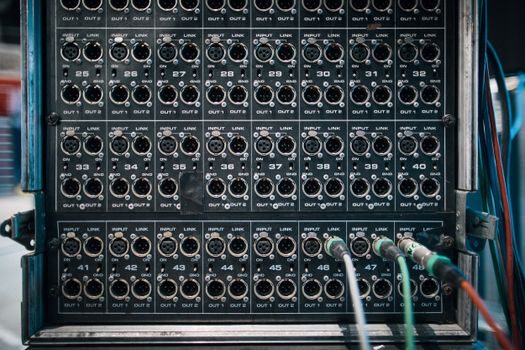
Channel density has compressed: 32 digital points in 22.5 mm (MR400) [S5] and 16 discrete outputs in 27.5 mm (R3-DC16AS) [S4] both reflect the 2026 norm. A 16-input analog brick at 5–11 V (Weidmuller 1315210000) [S9] is the lower-density path; you trade width for cleaner per-channel isolation.
Signal level is where most cross-vendor mistakes happen. PNP-only sourcing is the default for new IP67 modules (Decowell FS, SD) [S2]. NPN devices need an EX or RB variant or a signal inverter. The GC-R48's 11 V/2 mA ON threshold and 5 V/1.5 mA OFF threshold are Type 3-specific — passing any non-Type 3 sensor through that module voids the safety function [S3].
Environmental specs are the second disqualifier. IP40 covers dry control cabinets (Decowell EtherNet/IP, FS indoor) [S2]; IP67 covers machine-mount washdown (Decowell SD, Beckhoff-style field I/O) [S2]; metal-shelled EMC-hardened bricks (DAM124) are the right pick for engine rooms and variable-frequency-drive rooms where radiated noise is heavy [S6]. Do not mount an IP40 module on a valve manifold or a food line.
Comparison: Four Realistic Options on Four Decision Criteria
Use this as a shortlist filter rather than a winner-takes-all table:
1) Block-style DIN-rail I/O (M-System R3-DC16AS, Weidmuller 1315210000): per-channel cost lowest, but every wire home-runs to the cabinet. Suits retrofits, small panels, and skid builders [S4][S9].
2) Distributed IP67 (Decowell SD, FS, RB): per-channel cost higher (typical 2–4× block), but field-wire savings dominate above 25–30 m average home-run; IP67 allows mount-on-machine and valve-manifold proximity [S2].
3) Fiber teleprotection (SEL-2505): per-channel cost highest, but replaces 32 conductors and supports Mirrored Bits teleprotection; suits substations and any site with ground-potential-rise risk [S7].
4) Safety interlock I/O (Keyence GC-R48): dedicated Type 3, PNP-only sourcing, max 100 m cable, 3 mA short-circuit limit; required wherever the safety function sits on a remote bus rather than hard-wired to a safety contactor [S3].
Who Should NOT Pick the Mainstream (Block) Option

If your average home-run length is over 30 m, or your field devices are spread across more than two machine cells, a block I/O module will cost you more in copper, conduit, and labor than the IP67 distributed I/O premium. Likewise, do not pick a generic block module for any point that participates in a safety function: the SEL-2505 [S7] and GC-R48 [S3] are the only classes in the four-bucket map above that carry the certifications their applications require.
Do not pick a fiber teleprotection module like the SEL-2505 if your controller is a non-SEL PLC and you have no Mirrored Bits relay on the other end — the optical interface is not a generic Ethernet port and the module will look dead [S7].
Do not pick a safety interlock module (GC-R48) as your general-purpose I/O. ON at min. 11 V/2 mA, OFF at max. 5 V/1.5 mA, PNP sourcing only, and a 100 m cable ceiling are constraints that fit Type 3 devices only [S3].
Sourcing Signals and Standards Discipline
Spec discipline beats brand loyalty in this category. Three concrete checks before PO: (a) confirm the EDS or GSDML file revision matches the controller firmware and ships with the module; (b) confirm the signal level (PNP sourcing 15–30 VDC, NPN sinking, or analog 5–11 V) matches every field device on the drawing; (c) confirm the IP rating and EMC hardening matches the mounting location (IP40 cabinet, IP67 machine, metal shell for VFD rooms) [S2][S4][S6][S9].
Safety modules add a fourth check: confirm Type 3 / SIL / PLe certification scope matches the risk assessment — do not assume a "safety controller" badge extends to every I/O point [S3]. Substation modules add a fifth: confirm the teleprotection protocol (Mirrored Bits, IEC 61850 GOOSE, or vendor-proprietary) matches the relay on the other end [S7].
Two 2026 sourcing signals worth tracking: first, Chinese manufacturers (Decowell, MEGMEET, M-System equivalents) continue to compress wide-temperature and IP67 I/O pricing, with multi-PLC-compatible families like the Decowell RB Series positioned for Siemens/Beckhoff/Phoenix/Schneider drop-in [S2][S5]. Second, the fiber teleprotection segment remains a niche dominated by relay vendors such as SEL rather than generic I/O brands, so procurement teams standardizing on SEL Mirrored Bits will see a tighter second-source map than teams on plain Modbus RTU [S7].
For cabinet layout choices that sit beside the I/O block — such as a linear guide for a control-panel swing arm, a crossed-roller guide for a high-stiffness HMI mount, or a linear module for a sliding panel — the same selection rule applies: the I/O density, the cabinet depth, and the field-run length drive the spec, not the channel count on a single line of the BOM.
Background reading: SCADA Software Selection Criteria: 2026 Spec-Map for Plant Engineers.