
Retail distribution centers specifying autonomous mobile robots in mid-2026 are converging on three purchase drivers: a documented payload class up to 1500 kg per unit [S4], a SLAM-based navigation stack that survives mixed-aisle pedestrian traffic, and a fleet manager that exposes REST or MQTT APIs to the existing WMS [S4].
The segment is a measurable slice of a global AMR market projected to reach $14.40Bn by 2030 at a 21.4% CAGR (2023-2030) [S1], with E-Commerce and Retail listed as a primary end-use vertical alongside warehouse and distribution centers [S1]. Asia-Pacific leads regional expansion at a 22.6% CAGR through 2030, anchored by e-commerce warehouse deployments such as DHL Supply Chain's $150.00Mn commitment to deploy 1000 robots across Australian sites [S1]. For a U.S. or European retail DC, that regional data point matters because the same OEM platforms ship globally, so the unit cost, spare-parts pool, and software release cadence are shaped by APAC volume.
Three AMR Classes That Cover Most Retail DC Workflows
IndustryARC segments the AMR market into Goods-to-Person Picking Robots, Self-Driving Forklifts, Autonomous Inventory Robots, and Others [S1], and the retail-DC selection matrix maps cleanly onto those four types. Goods-to-person units move totes and bins from static shelving to stationary pickers, which suits apparel and hardlines replenishment where SKU velocity is high but item weight per pick is below 30 kg. Self-driving forklifts replace counterbalanced or reach trucks at pallet inbound and outbound docks, with rated loads typically in the 1000-1500 kg band matching the upper envelope quoted for current mobile platforms [S4]. Autonomous inventory robots combine a low-body mobile base with an RFID or depth-camera payload, executing cycle counts and empty-bin detection, which addresses the chronic retail-DC shrinkage problem of WMS records drifting away from physical stock [S3].
Goods-to-person units are not a substitute for forklifts at the dock, and forklifts are not a substitute for inventory robots in the pick aisle. Specifying all three under one fleet manager is now common in retail DCs above 50,000 sq ft, because each class attacks a different cost line: pick labor, dock labor, and inventory accuracy. A useful pre-spec filter is to map each candidate workflow to one of the four IndustryARC types [S1] before any vendor conversation, since the unit economics and integration cost differ by an order of magnitude between classes.
Navigation Stack: SLAM, LiDAR, and Depth Camera Trade-offs
Depth-camera plus 2-D LiDAR with a SLAM front end is the documented reference architecture for retail inventory AMRs, using a differential-drive chassis that processes sensor data in real time to navigate a warehouse environment and reach a target shelf [S3]. Object detection on the shelf side typically runs a deep-learning detector (Faster R-CNN or YOLO variants) to count cardboard cartons and reconcile against WMS records [S3].
For retail DCs, the practical selection criteria are: (1) does the platform expose a safety-rated 2-D LiDAR scanning layer independent of the navigation LiDAR, so safety stops meet ISO 3691-4 type expectations; (2) can the SLAM map be edited zone-by-zone, since retail DCs re-merchandise monthly and a frozen global map forces re-commissioning; (3) does the perception pipeline degrade gracefully when aisle lighting falls below 200 lux, which is common in back-of-store racks. Vendors that ship only a single front-facing LiDAR with no rear coverage are poor fits for two-way aisle traffic, even if their nominal payload is competitive. The Milvus SEIT series, for example, advertises payload coverage across small to 1500 kg classes with different attachments per application [S4], but the selection question for the retail DC engineer is whether the perception stack is independently documented and field-proven at the target aisle width, not whether the brochure lists the unit.
Fleet Management and WMS Interoperability
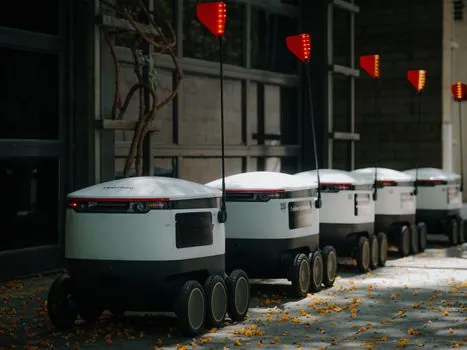
A fleet manager is mandatory once more than 4-6 AMRs share a workspace, and the Milvus Fleet Manager product is representative of the current generation: web-accessible, real-time coordination, designed to maximize oversight of a mixed-payload fleet [S4]. Practical procurement checks: confirm the fleet manager exposes task assignment via a documented API (REST or MQTT), supports traffic management at narrow-aisle pinch points, and persists map and task logs for at least 90 days to support incident review.
For retail WMS integration, the integration pattern is the AMR fleet manager calling the WMS for pick lists and then assigning tasks to the lowest-cost eligible unit; the WMS does not talk to individual robots. This keeps the WMS integration scope constant regardless of fleet size and avoids the brittle anti-pattern of one WMS adapter per robot vendor. The selection gate is therefore fleet-manager-first, robot-second: shortlist 2-3 fleet managers that have a live WMS adapter for your WMS platform, then evaluate the robot models those fleet managers support. A related spec gate worth checking is whether the fleet manager can throttle units during peak pedestrian windows, which is a hard requirement in retail DCs that share space with manual pickers during seasonal peaks.
Payload, Footprint, and Battery Specs That Decide Fit
Payload class is the single most overloaded spec in retail AMR marketing, and the engineer-side reading is to require three numbers: maximum rated payload, continuous payload at full speed, and payload derating on a slope. The published upper envelope for current mobile platforms is 1500 kg [S4], which is the right class for pallet-jack and self-driving forklift replacements, not for goods-to-person tote moving.
Footprint constraints are equally binding: a 900 mm wide unit does not fit a 1100 mm aisle with bidirectional traffic and a 100 mm pedestrian exclusion zone on each side, so the aisle survey must precede, not follow, the robot shortlist. Compare the AMR classes on a 4-criteria matrix: payload (kg), footprint (mm), navigation sensor count, and fleet-manager API openness. The output of that comparison is what feeds the WMS integration scoping and the dock-door reconfiguration plan; it is also what justifies the capex line to finance, because every cell of the matrix ties back to either labor displacement or throughput gain.
What AMR Is Not the Right Tool For
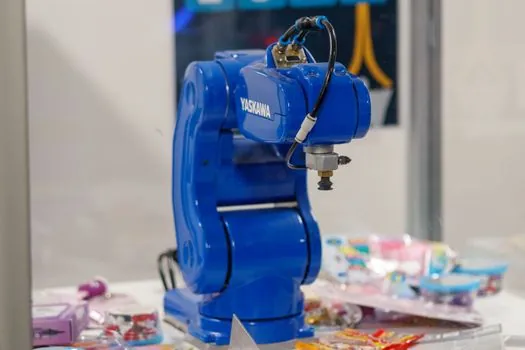
Autonomous mobile robots are not the right tool for case-pick operations above 1500 kg per move, for ambient retail DCs below 5000 sq ft where a single manual picker covers the workload, or for environments where the floor is not laser-flat (uneven concrete above 6 mm deviation over 2 m defeats most 2-D LiDAR localization). AMRs also are not a substitute for conveyor or sortation when the design throughput exceeds roughly 500 totes per hour at a single node, because AMR traffic management saturates before conveyor does at that density [S1].
Specifying an AMR where a fixed automation line is the correct tool is the most expensive mistake in this category: the unit economics flip once throughput targets exceed what a 12- to 20-vehicle fleet can deliver, and the engineer-side pushback should be a clear throughput-per-hour number on day one of the project. For the narrower retail use cases of cycle counting, low-velocity bin replenishment, and dock-to-stage pallet movement, AMRs are now a defensible default.
Sourcing, Standards, and Vendor Due Diligence
For standards, the relevant reference is ISO 3691-4 for driverless industrial trucks, which covers the safety-rated laser scanner and emergency-stop behavior that any retail DC AMR must satisfy; the engineer should require the vendor's declaration of conformity to ISO 3691-4 before site acceptance, not after. On the SLAM and perception side, the literature cites weighted range-sensor matching, VPH obstacle avoidance, and 2-D laser scanner characterization as the established techniques behind current retail-AMR navigation [S3]. For due diligence, require the vendor to deliver a reference customer in the retail-DC vertical, a documented mean-time-between-failures for the safety laser, and a software support window of at least 7 years from ship date, since retail DC automation assets depreciate over 7-10 years [S1][S3].
The Milvus Fleet Manager approach, accessible from anywhere with comprehensive tools for optimizing performance and coordinating robots [S4], and the MetraLabs retail-focused product positioning out of Germany [S2], illustrate the two sourcing archetypes: a fleet-software-first vendor versus a robot-hardware-first vendor. Retail-DC buyers typically end up with one of each in the final stack, and the procurement question is which vendor owns the integration risk contractually. For related reading on adjacent AMR deployments, see AMR selection for port logistics: 2026 spec gates and Apparel Distribution AMR Selection: 2026 Spec Gates, and for the broader AGV versus AMR comparison, the AGV robot reference covers the fixed-path cousins of these platforms.
A second signal is the APAC installed-base number from the DHL 1000-robot program, which will read out in 2027 and reset the per-unit cost benchmark that retail-DC buyers in other regions negotiate against [S1].
The underlying component specifications are covered under mobile crane, and distribution cabinet.