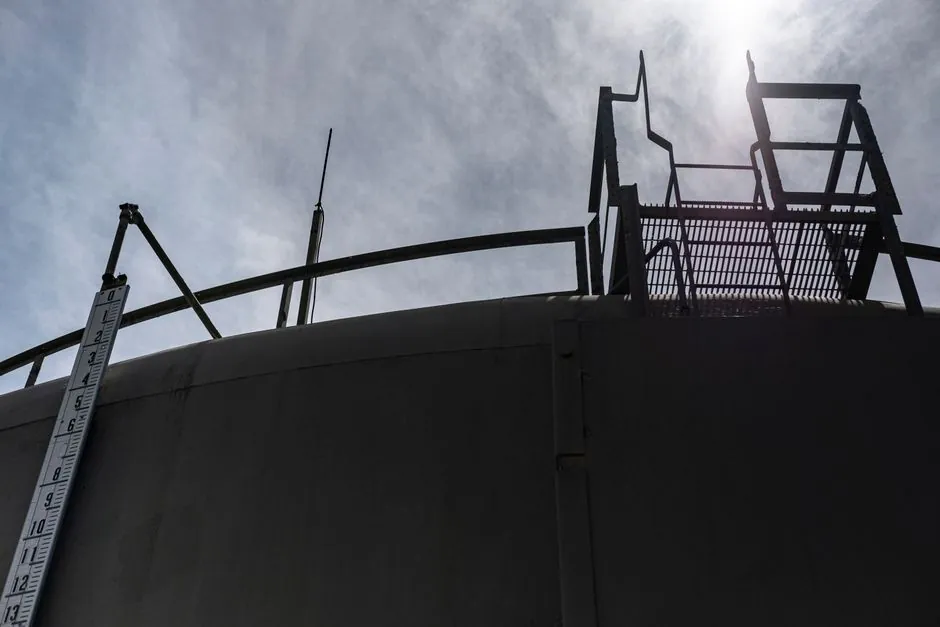
An outdoor tank-farm RF admittance level switch must combine hazardous-location approval (ATEX/IECEx), IP66 or NEMA 4X enclosure integrity, and Cote-Shield circuitry to ignore conductive coating buildup on the probe [S1].
For tank-farm duty, the binding design window is -40 to 85 °C process temperature, up to 1,000 psi process pressure, loop-powered 2-wire or line-powered options, and SIL 2 certification per IEC 61508-2 ed2, 2010 (EXIDA) for overfill prevention per API 2350 and 49 CFR 195 [S1].
What an RF admittance level switch actually measures
RF admittance level switches apply a low-energy radio-frequency signal between a sensing electrode and a reference (usually the tank wall or a ground rod) and detect the change in admittance, the vector sum of conductance and susceptance, as material contacts the probe [S1]. Unlike a simple capacitance level switch, the admittance method uses a shielded portion of the probe so that coating accumulation on the shield does not shift the trip point; this Cote-Shield design lets the same sensor handle water-based liquids, hydrocarbons, slurries, and granular solids with one calibration.
For outdoor service, the technology has two practical advantages over ultrasonic level and laser level devices: it is unaffected by foam, vapor, sun glare, or wind-driven temperature gradients above an open floating-roof tank, and it tolerates a wide process window of -40 to 85 °C at pressures up to 1,000 psi [S1]. Where the duty involves turbulent boiling liquids or cryogenic LNG, the upper temperature ceiling is the first spec to recheck against the OEM datasheet.
Hazardous-location approval, ingress, and materials
An outdoor tank farm almost always falls under hazardous-area classification. Specify ATEX-certified units for European sites and IECEx for international projects, with the housing rated to at least IP66 or NEMA 4X to survive driving rain, hose-down, and salt-laden coastal air [S1]. A 304/316 stainless steel or aluminum housing is standard; the probe itself should be 316L stainless with a PTFE or PFA insulator where the medium is aggressive (sour crude, caustics, methanol).
For overfill prevention on atmospheric and pressurized storage, API 2350 and 49 CFR Part 195 require a high-integrity point level switch, and SIL 2 per IEC 61508-2 ed2, 2010 (EXIDA) is the practical way to meet that requirement; the Safety IntelliPoint RF family explicitly targets this application with continuous AutoVerify self-test plus a manual Certify check of the self-test circuits [S1]. Buyers should ask the OEM for the FMEDA report and the proven-in-use figures before locking the SIL claim into a safety instrumented function (SIF).
Selection criteria mapped to outdoor tank-farm duty
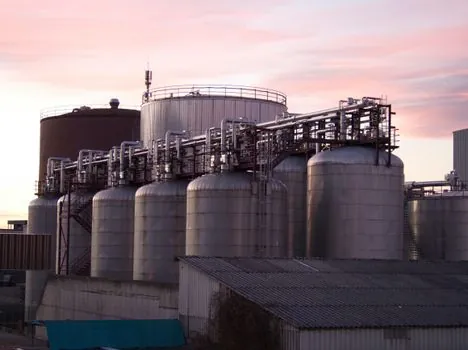
Six criteria separate a workable outdoor-tank-farm RF admittance switch from a parts-bin mistake: [S1]
1. Process connection and probe length. Threaded NPT 1" or 2", or flanged ANSI 150/300 RF; probe rigid or cable-suspended to bottom of cone-roof tanks up to 30 m tall. Cable versions are mandatory for tanks deeper than the rigid probe (typically 3-6 m) and must use a stable weight or anchor to prevent swing in pumped tanks.
2. Process temperature window. -40 to 85 °C covers crude, diesel, jet fuel, and most chemicals; for hot bitumen or steam-sterilized CIP tanks a high-temperature extension to 200 °C or 400 °C is required from the OEM [S1].
3. Process pressure. Up to 1,000 psi handles hydrocarbon separators and amine contactors; vacuum service (0.5 torr) on floating-roof tanks also needs confirmation because some probe seal designs outgas under vacuum.
4. Dielectric vs. conductive medium. RF admittance is the correct technology for conductive and high-coating media (black liquor, lime slurry, slop oil, sewage) where a plain rf admittance level switch outperforms infrared level and laser level devices that cannot see through foam or coating [S1].
5. Output and wiring. Loop-powered 2-wire 4-20 mA with HART, or line-powered relay (SPDT/DPDT) for direct pump cut-out; 24 VDC plant supply is most common. Confirm galvanic isolation if the switch sits on a segment with a pressure transmitter selection criteria for compressed air lines rack sharing the same 24 V bus.
6. Self-test and diagnostics. AutoVerify continuous self-check plus manual Certify meets the API 2350 / 49 CFR 195 overfill-protection expectation and gives the operator a testable proof-test interval rather than a blind annual trip test [S1].
Comparison: RF admittance vs the realistic alternatives
For an outdoor crude or chemical tank-farm high-high overfill trip, four options typically sit on the shortlist:
RF admittance switch: handles foam, vapor, and coating; -40 to 85 °C standard; SIL 2 capable; medium cost; works in conductive slurries; needs Cote-Shield for sticky media [S1].
Tuning-fork (vibrating-fork) level switch: very low cost, no calibration; fails in heavy coating and in very viscous media (tar, heavy bitumen); not for slurry service.
Ultrasonic level switch: non-contact, ideal for clean liquids; fails in foam, heavy vapor, or outdoor temperature gradients; best for indoor automatic level control of small chemical day-tanks, not outdoor crude terminals.
Float or conductance probe switch: low cost, simple; mechanical wear on floats; conductance probes fail in non-conductive hydrocarbons and in coating service.
For most outdoor tank-farm overfill and pump-control duties, the RF admittance switch wins on coating immunity, hazardous-area approvals, and the SIL 2 self-test path; vibrating forks and floats stay in clean-service day-tanks, and ultrasonic is reserved where no foam or vapor is present [S1].
Who should NOT pick an RF admittance switch

If the medium is clean, non-coating, low-viscosity and the budget is tight, a vibrating-fork switch gives the same high-high trip at roughly half the installed cost. RF admittance is also overkill on a small, indoor chemical day-tank where an automatic level float or optical switch is sufficient. For very low-density powders (cement, flour) at ambient conditions a guided-wave radar or capacitance paddle switch is usually a better match; RF admittance probes can be blinded by bridging in light bulk solids. [S1]
Finally, do not retrofit an RF admittance switch onto a tank that has no ground reference. Admittance measurement needs a return path: confirm the tank is bonded to plant ground, or order a probe with a dedicated ground rod if the vessel is lined or non-conductive (FRP, rubber-lined steel).
Installation, calibration, and standards traceability
Field install is two steps: mount the probe through the flange or NPT, apply power, and let the Auto-Ranging supply self-calibrate to the connected tank [S1]. For SIL 2 service, schedule a manual Certify test at the documented proof-test interval (commonly 1-5 years per the FMEDA), and record the AutoVerify diagnostic voltage trend to show the operator that the sensor has not drifted since last test.
Applicable standards and references: API 2350 for overfill protection of petroleum storage; 49 CFR Part 195 (DOT) for liquid pipelines and breakout tanks; IEC 61508-2 ed2, 2010 (EXIDA) for SIL 2 functional safety; ATEX directive 2014/34/EU and IECEx for hazardous-area approval; NEMA 4X / IP66 for outdoor ingress [S1]. Buyers should also confirm the probe complies with NACE MR0175/ISO 15156 for sour-service hydrocarbons if the tank farm handles H2S-bearing crude.
Trackable signals and next nodes
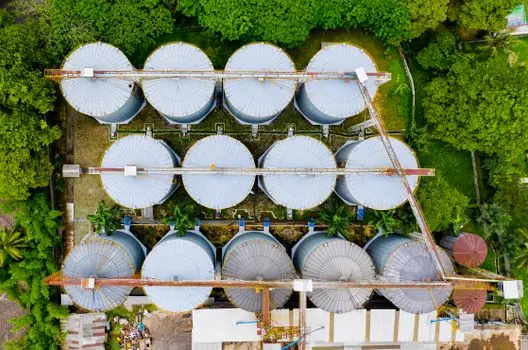
Watch for FMEDA updates and SIL 3 firmware variants from major RF admittance OEMs (AMETEK Drexelbrook, Endress+Hauser, Magnetrol, Vega) through 2026 H2, as IEC 61508-2 is in active maintenance and SIL 3 overfill switches are now on bid lists for greenfield LNG terminals. Confirm with the OEM whether the next-generation probe will accept 4-20 mA with HART, IO-Link, or wireless HART for brownfield tank-farm upgrades where re-wiring cost dominates. [S1]