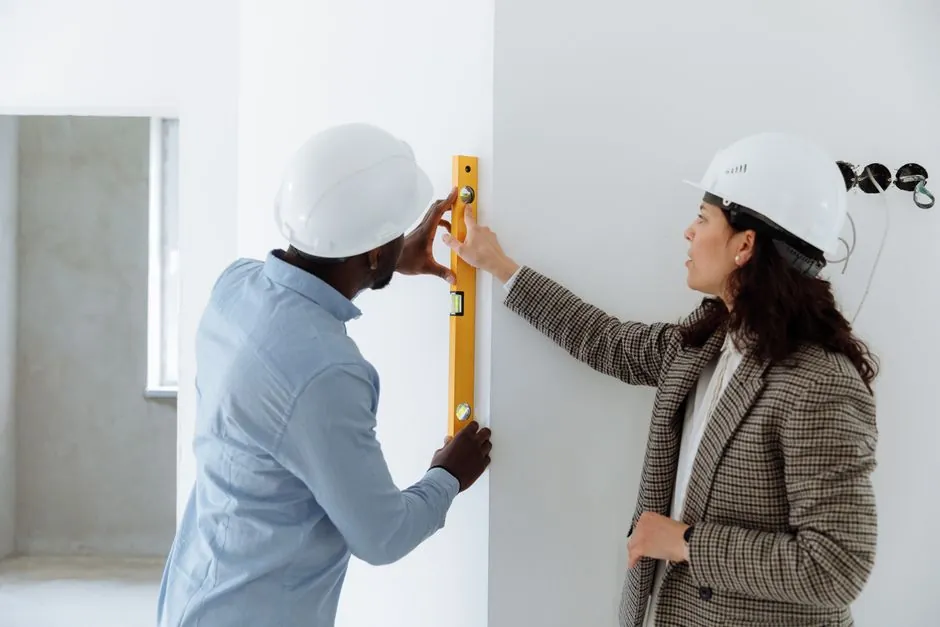
A spirit level is a gravity-referenced mechanical or electronic tilt instrument used for flatness, alignment, and inclination checks on machine bases, press rams, and structural steel; it does not measure level, position, or temperature, and any cross-use in a displacement sensor or temperature loop is a category error.
Process temperature control in a steam or hot-oil skid uses a temperature sensor at the heat exchanger outlet, with the electric actuator stroking a control valve to chase a setpoint; the level and the displacement chain serve the machine, not the thermal loop itself [S3].
What each instrument actually measures
A spirit level reports angle relative to gravity, typically 0 to 90 degrees on a vial or up to ±60 degrees on an electronic unit, with electronic versions outputting 4-20 mA, 0-10 V, or CANopen at resolutions near 0.05 degrees and repeatability in the 0.1 degree band. [S1]
A displacement sensor reports linear or angular travel, with non-contact laser displacement sensor heads covering 10 to 500 mm standoff at sub-micron resolution, and confocal displacement sensor heads rated for 40 to 200 degrees C target temperatures with nanometre-class repeatability.
Process temperature is covered by a temperature sensor, commonly a Pt100 or Pt1000 Class A RTD for -50 to 600 degrees C service, or a Type K / Type N thermocouple up to 1200 degrees C with mineral-insulated sheath; the choice is driven by accuracy budget, response time, and sheath material rather than by loop type [S3].
Decision matrix: which family fits which loop
On a steam heat exchanger skid, the primary loop is outlet temperature, so specify an immersion thermowell fitting (typically 50 to 150 mm insertion) with a Pt100 Class A element; the actuator position feedback, if needed, is a separate displacement sensor on the valve stem, often a 4-20 mA LVDT with 25 to 100 mm stroke [S3].
On a hydraulic press or injection moulding machine, the level of the ram head and the parallelism of the platens are checked with a spirit level or electronic inclinometer during setup, while tie-bar stretch under clamping tonnage is read by a laser displacement sensor fixed to the stationary platen; here temperature sensing is a secondary concern, limited to barrel-zone thermocouples upstream of the mould.
For bulk-solids storage, a non-contact acoustic level transmitter such as the APM 3DLevelScanner S series reports average volume with a 70 m maximum range, a process pressure window of -0.2 to 3 bar, and a process temperature window of -40 to 180 degrees C; this is a true level instrument, not a displacement sensor and not a temperature sensor, and it cannot be substituted for either [S1].
Where these three families meet, and where they must not

Thermal expansion compensation is the cleanest cross-use: a long machine bed grows by roughly 0.012 mm per metre per kelvin on carbon steel, so a frame-length displacement sensor reading a fixed target must be paired with a frame temperature sensor so the control software can subtract the thermal growth before flagging a positional drift. [S2]
A spirit level cannot replace a displacement sensor for sub-millimetre positioning, nor can it replace a temperature sensor for thermal-loop feedback; the glass vial has a typical resolution of 0.5 mm/m, which is two orders of magnitude too coarse for valve-stem or hydraulic-ram feedback.
Confocal displacement sensor heads tolerate up to 200 degrees C on the target surface and are used in semiconductor back-end and PCB stencil inspection, where the target is hot; process-temperature loops still use sheath-protected RTDs because the confocal head reports only displacement, not temperature, and is not a loop-controller input.
Selection criteria that actually move the decision
Five criteria drive the choice: required physical quantity (angle, distance, temperature), resolution budget, environment (IP rating, ambient temperature, vibration, contamination), signal type (analogue 4-20 mA, digital IO-Link, fieldbus), and maintenance access; the loop variable is fixed first because no spec value of a spirit level can satisfy a millikelvin temperature-control requirement. [S1]
For machine frames in stamping and moulding cells, an electronic two-axis inclinometer with 0.05 degree resolution, M12 connector, and IP67 housing is the standard spirit level upgrade; for press-position feedback a magnetostrictive displacement sensor with 0.01 mm linearity over 500 mm stroke is the usual pick, and the platen-zone temperature is handled by a separate Pt100 in a stainless thermowell.
On steriliser or autoclave lines, the saturated-steam loop at 121 to 134 degrees C is read by a mineral-insulated Pt100 with a 4-wire Class A output, while chamber door-to-frame alignment is checked with a spirit level or a calibrated jig; a related buyer's view for the steam side is in the dry-block calibrator spec map for steam sterilisation lines, which covers the calibration bench rather than the loop sensor itself.
Failure modes and common mis-specs
Spirit-level mis-specs usually trace to ignoring the curvature of the Earth on long machine bases: a 30 m lathe bed is a 0.12 mm earth-curve offset across its length, so a spirit level alone is insufficient for precision align boring of a long bed without a laser reference. [S1]
Laser displacement sensor mis-specs come from ignoring target surface finish: specular aluminium at 60 degrees incidence can flip the reading by the triangulation geometry, and dirty glass in the optical path drops S/N ratio by 30 to 50 percent before the analogue output drifts [S1].
Temperature-loop mis-specs come from thermowell lag and from undersized immersion length; a thermowell immersion of less than 10 times the sheath diameter can read 5 to 15 kelvin low in a fast transients loop, and the temperature sensor element alone cannot compensate for conduction along the well unless the displacement sensor feedback on a valve actuator is also re-tuned [S3].
Sourcing and standards to anchor the spec
Process temperature elements and thermowells are normally specified to IEC 60751 (Pt100/Pt1000) for RTDs and IEC 60584 for thermocouples, with the installation rule of thumb of 10-times-sheath-diameter immersion; these standards govern the element tolerance class, not the loop architecture. [S1]
Level and volume transmitters used in hazardous-area silos are commonly specced to ATEX 2014/34/EU or IECEx, with the dust-penetrating acoustic units such as the 3DLevelScanner S rated for -40 to 180 degrees C and -0.2 to 3 bar process envelopes [S1]; these are the standards to look for on the datasheet, not rules invented in this article.
For load frames, hydraulic test benches, and torque tooling, the surrounding selection logic is covered in the load cell selection guide, the torque wrench tester vs force gauge decision map, and the pressure switch spec map for hydraulic test benches, each of which pairs a mechanical or pressure instrument with its electrical interface in the same spec style.