
Ringlock scaffolding is a modular access system built around vertical standards with welded rosette discs at 0.5 m intervals, into which wedge-head horizontals, ledgers, and diagonal braces lock at eight radial positions; standards come in two principal outside diameters — Ø48 mm and Ø60 mm — and the choice between them is the first specification gate a buyer must clear [S2].
Factory-gate ledger pricing on the open market sits in a US$3.00-20.00 per piece band for hot-dip galvanized horizontals, with the Allround-style heavy-duty ledger (Layher-pattern) typically quoted at US$4.87-16.87 per piece and the conventional multidirectional lock at US$3.87-12.87 per piece at FOB Tianjin, both for 100-piece minimum orders [S1][S4]. The two-decade service life claimed by Chinese mills and the eight-way node geometry are the technical reasons a procurement engineer can justify ringlock over cuplock or frame-system alternatives on irregular industrial sites [S2][S5].
Ledger and Standard Diameter: Ø48 mm vs Ø60 mm
The two-outer-diameter split — Ø48 mm and Ø60 mm — is the single most consequential selection decision because rosette spacing, ledger length, and bracing compatibility are tied to the chosen tube size; mixing Ø48 horizontals onto Ø60 standards is a fabrication tolerance gamble, not a spec variation [S2]. Most North American and European refinery and process-plant projects continue to call out Ø48 mm because that is the diameter Layher Allround and its OEM licensees have standardized on for decades, and the global supply of compatible accessories — base collars, U-head jacks, swivel couplers — is correspondingly deeper at Ø48 [S5].
Ø60 mm ringlock is mainly a Chinese-domestic and India-market variant, sold by mills including Eastman Industries (Ludhiana) at 500-pair MOQ and targeted at concrete formwork support rather than refinery access [S3]. For a buyer running petrochemical or marine work, Ø48 mm is the default safer pick because the scaffolding system accessory ecosystem and engineering manuals are written to that diameter. For formwork-shoring on box culverts and slab pours where the load is purely vertical, Ø60 mm delivers higher axial capacity per standard at lower per-tonne cost and is the more rational spend [S2][S3].
Galvanizing, Steel Grade, and Service Life
Hot-dip galvanizing to an average 50-85 µm zinc thickness is the default corrosion specification on export-grade ringlock and the single most reliable indicator that the ledger will hit the 20-year service-life claim made by Chinese suppliers [S2][S4]. A pre-galvanized tube (zinc strip dipped before forming) reads cheaper on invoice but exposes the weld at the rosette disc to early red rust — this is the commonest field failure mode and the reason refinery buyers reject anything not batch-galvanized after welding.
Tube steel grade is normally Q235 / S235 in the 3.0-3.5 mm wall range for Ø48 mm standards; heavy-duty Allround-pattern verticals use 3.25 mm Q345 for higher leg-load capacity on tall birdcage scaffolds [S2]. SGS third-party test certificates for weld shear at the rosette-to-vertical joint, combined with a galvanizing-thickness certificate, are the two documents an EPC quality plan should require before goods are unloaded [S1][S4]. Powder-coat over pre-galv is a third tier used in low-corrosion interior fit-out work and should be specified only when no weather exposure is expected.
Component Checklist: Standards, Ledgers, Diagonals, Base Hardware
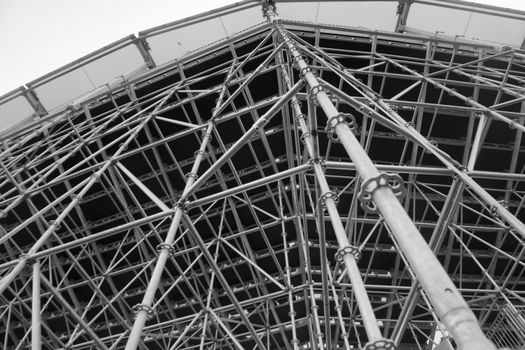
A complete ringlock scaffolding inventory breaks into seven component families: vertical standard with welded rosettes (in 0.5 m, 1.0 m, 1.5 m, 2.0 m, 3.0 m lengths), horizontal ledger, diagonal brace, base collar, U-head jack (top) and adjustable screw jack (base), toeboard, and steel plank with hooks [S2][S3]. The base collar is the small spigot sleeve that connects one standard to the next vertically without a spigot-on-spigot slip, and it is the part most often left out of budget quotes — a 200-tonne ringlock order without base collars is not erectable.
Diagonal braces are the optional-but-mandatory-for-tall-towers component that locks the bay into a rigid shear panel; without them the eight-way rosette node still articulates and the tower will rack. U-head jacks on top carry formwork beams; adjustable screw jacks at the base compensate for uneven ground. East-Indian suppliers package these as a system MOQ rather than by the piece, while Chinese mills quote per piece at FOB Tianjin with a 3000-tonne-per-month aggregate supply capability [S2][S3]. A shortlist for a 30 m³ ringlock buy should always price all seven families together, or the unit ledger price of US$3.00-20.00 becomes meaningless.
Load Class, Bay Geometry, and Site Geometry
Doka's published Ringlock positioning frames the system around high load capacity and irregular-geometry adaptability — both claims are real but only when the bay plan and diagonal density are engineered to match duty class [S5]. Standard ringlock duty classes run from light-duty access (1.5 kN/m² working load) through medium (3.0 kN/m²) to heavy-duty shoring (4.5-6.0 kN/m²); the higher the class, the smaller the permissible bay footprint and the denser the diagonal brace pattern.
For a petrochemical turnaround with heat exchangers and pipe-rack penetrations, expect 1.8 m × 1.8 m bays with one diagonal per bay, while concrete slab shoring often pushes to 1.5 m × 1.5 m with diagonals every other bay to control sway. Industrial sites with curved vessels, spherical tanks, and tight nozzle clearance benefit most from the eight-direction rosette, which lets the crew angle a horizontal to any 45° increment without a swivel coupler — a productivity gain that justifies ringlock's premium over cuplock on irregular work [S5].
Compliance, Inspection, and Documents to Demand

EN 12810 / EN 12811 is the European harmonized standard for facade scaffolds and the document an EU-based EPC will request on every ringlock shipment; for North American work, the equivalent reference is OSHA 1926 Subpart L plus ANSI/ASSE A10.8, with the manufacturer expected to supply a documented leg-load test per bay configuration [S1][S4]. Third-party inspection certificates — SGS, TUV, or Bureau Veritas — covering weld shear, zinc coating weight (typically 600 g/m² for batch-galvanized tube), and dimensional tolerance of the rosette spacing (500 mm ± 1.0 mm) are now standard on export orders and the line item a quality manager should not waive.
For projects with process instrumentation and control panels in the work zone, ringlock's all-steel construction introduces a low-impedance path that must be bonded to site ground; the same crews erecting pressure transmitters and flow meters on the adjacent pipe rack will flag any ungrounded metal scaffold as a measurement-loop noise risk. A documented continuity test on the erected scaffold is cheap insurance and is increasingly written into EPC inspection-and-test plans on hydrocarbon sites.
Price Bands, MOQ, and Sourcing Channels
Wholesale ledger pricing for export orders in 2026 sits in a US$3.00-20.00 per piece band on horizontals, US$3.87-12.87 per piece on conventional lock systems, and US$4.87-16.87 per piece on heavy-duty Allround-pattern locks at 100-piece MOQ from Chinese mills shipping FOB Tianjin [S1][S4].
Sourcing channels split cleanly between Chinese mill-direct (Tianjin, Yangzhou, Renqiu clusters) for price-led volume buys and German/European licensees (Layher, Peri, Doka) for engineering-supported jobs where the documentation cost is part of the spec [S1][S4][S5].
Who Should NOT Pick the Mainstream Ø48 mm Allround

Buyers running a short-duration, low-rise residential block in mild climate should not specify premium Allround Ø48 mm ringlock — the eight-way rosette is wasted capability when a 1.8 m frame scaffold or cuplock system at half the per-piece cost erects in the same time. Likewise, owners needing a permanent outdoor access stair or grandstand seating should not buy ringlock as a primary structure; the system is designed for temporary works and the rosette welds are not fatigue-rated for sustained cyclic loading. [S2]
For buyers pairing scaffold work with PLC commissioning and instrument-loop work on a live plant, the right move is to rent rather than buy: a one-off refinery turnaround burns through scaffold faster than the rosette coating can be inspected, and rental fleets arrive with documented EN 12810 leg-load ratings already on file [S1][S4].
For readers comparing scaffold-spec work to adjacent heavy-equipment decisions, the same duty-class-and-load-chart logic that drives concrete pump truck vs vibrator selection shows up in scaffold bay sizing — match the tool to the load curve, not to the cheapest unit price. Verification signals to watch: a mill's willingness to share SGS weld-shear certificates, the presence of a documented Ø48/Ø60 compatibility statement, and an EN 12810 system test report are the three line items that separate a buy-grade ringlock shipment from a commodity roll-off.