
Ringlock scaffolding is a modular, multidirectional system that uses a rosette-and-wedge-head node welded every fixed interval onto a Q235/Q345B vertical, with standards typically sized D48×3.5 mm and a rosette disc of 133 mm diameter and 10 mm thickness [S2]. Generic scaffolding, in the EN 12810/12811 sense, is the catch-all for tube-and-clamp, cuplock, frame, and system scaffolds that meet a duty class but do not share a single common node geometry.
For process and site engineers choosing access for concrete-pour support, façade work, shipbuilding, offshore modules, and industrial maintenance, the practical question is which geometry, node, and steel grade deliver the needed bay load at acceptable lead time and re-use rate [S1][S5]. On that metric, ringlock sits in the same duty class as other modern system scaffolds but is distinguished by the 8-hole rosette that accepts up to eight connections per node in multiple planes [S2][S7].
What "Ringlock" Actually Specifies
Ringlock scaffolding, also called modular or multidirectional scaffolding, is a welded-rosette system in which a 10 mm-thick disc is fixed to a D48×3.5 mm vertical at standard bay intervals, and horizontal ledgers, transoms, and diagonals are locked into that disc with a hammered wedge head [S2]. The node is the same 133 mm disc with 8 holes, so each plane accepts up to four ledger/diagonal connections plus perpendicular horizontals, allowing bays to be built at 0°, 45°, and 90° without separate fittings [S2][S7].
Material is Q235 for general verticals and Q345B where higher yield is required for shoring legs and rebar falsework; standard options are φ48 and φ60 series, with 3.0/3.2/3.25/4.0 mm wall thickness available from Chinese mills [S6][S7]. Surface treatment drives corrosion life: hot-dip galvanizing is the default for shipbuilding and offshore, with electro-galvanized, zinc-plated, powder-coated, and painted variants offered for shorter-cycle building sites [S3][S8]. Standards typically cited on supplier datasheets are EN74, BS1139, ISO 9001, and CE-marked configurations, with DIBt certification and additional local certification available on premium OEM lines such as Doka [S1][S6].
Ringlock vs Cuplock, Frame, and Tube-and-Clamp
On a criteria-based comparison, ringlock wins on geometry flexibility and re-use rate, cuplock matches it on vertical speed, frame scaffolds win on low up-front cost for simple façades, and tube-and-clamp wins only on irregular heritage structures where a fixed node cannot land. The Doka Ringlock datasheet claims 80% of its components are reusable across applications, which is the headline cost-efficiency number published for that OEM line [S1].
Quantitatively, a typical Chinese mill run offers a 90-piece minimum order at a published supply capability of 20,000 pieces per month from Ningbo, with payment in TT or LC [S2]. Vertical options are D48×3.5 mm in Q235 or Q345B, with the rosette welded every 500 mm or 1000 mm depending on bay geometry [S2][S6]. For shoring, the same rosette node is paired with U-head jacks and base collars, so the same kit that builds a façade scaffold also forms a 1.0–1.5 m grid falsework for slab pours [S2][S7]. The practical effect is fewer SKUs on site and faster reconfiguration between trades.
Who Ringlock Is For, and Who It Is Not For
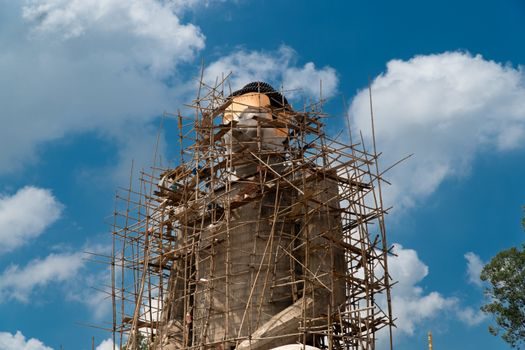
Ringlock suits sites that need irregular geometry, frequent reconfiguration, or both shoring and access from the same kit: shipyards, offshore module yards, power-plant boiler work, rebar falsework, and birdcage access inside industrial plants [S1][S5]. It is also a fit where the OEM holds DIBt plus local certification, since the certification footprint of the rosette system is wider than the typical cuplock catalogue from low-cost mills [S1].
Ringlock is the wrong tool for a single-storey residential façade under 10 m where a frame scaffold or tower on castors is faster to erect and recover; the kit's strength is geometric complexity, and that strength is wasted on a flat plane. It is also a poor fit for heritage masonry where every lift needs a custom tube-and-clamp solution, because forcing a rosette to land on an irregular stone face adds cost without benefit. For indoor industrial maintenance, a ringlock birdcage can replace a full tube-and-clamp structure, but the trade-off is floor loading and headroom — the same kit that handles a 50 kN/m² shore tower is heavier than a 3 kN/m² access tower.
Standards, Steel Grades, and What Certifies What
Ringlock systems sold into Europe typically carry EN 12810/12811 performance classes and the EN74 coupling standard on the wedge-head ledger ends, while UK projects often reference BS1139, and US projects use OSHA 1926.452 and the corresponding ANSI/SSFI SC100 standards on the supplier datasheet [S6]. For steel, the base grade is Q235 with a yield of 235 MPa, and Q345B with 345 MPa yield is used for verticals and shores that take higher axial load; both are common Chinese mill grades covered by GB/T 700 and GB/T 1591 respectively, though the supplier page lists the material name without a mill standard in this case [S2][S6].
Surface treatment, not the node, is the long-life decision: hot-dip galvanizing to EN ISO 1461 gives the typical 50–80 μm coating for shipbuilding and coastal sites, with electro-galvanizing and painted variants cut to 20–40 μm for inland building cycles [S3][S8]. The Doka OEM datasheet highlights that on top of DIBt approval, the Ringlock line is "LOCAL CERT" certified for individual markets, which is the reason the same SKU is accepted in EU, UK, Gulf, and Australian projects [S1]. For the project engineer this means certification, not mill origin, is the acceptance gate. A wider look at the broader scaffolding equipment class — from rosette systems to suspended platforms and stair towers — is covered in the scaffolding reference entry.
Use Cases and On-Site Trade-Offs

Shipbuilding is the canonical ringlock use case: the rosette accepts curved-bay geometry around hull blocks, and Q345B verticals with HDG finish survive salt-spray cycles that eat painted cuplock in two seasons [S3][S5]. Offshore module yards use ringlock for the same reason, plus the ability to skin the same bay with plywood decks and convert it from access to a load-out shore in the same kit [S5]. Concrete-pour support, especially slab falsework on a 1.0–1.5 m grid, is a strong fit because the rosette pairs directly with U-head jacks and base collars without a separate forkhead fitting [S2][S7].
For building façades, ringlock competes head-to-head with cuplock and frame: ringlock wins on re-use rate (the 80% re-use claim sits above the typical 60–70% claimed for cuplock in OEM literature [S1]), cuplock wins on erect speed for a flat plane, and frame scaffolds win on first-cost for low-rise residential. The supplier datasheet confirms ringlock is "easy to assemble and dismantle" because only a hammer is needed for the wedge-head lock, with no bolts, screws, or torque tools required [S1][S2]. On a tight site, the practical trade-off is hoisting: ringlock's rosette node is heavier per vertical than a cuplock cup, so crane picks per bay are higher, but the reduced fitting count on the ground offsets this on a multi-storey build.
Limitations, Failure Modes, and Sourcing Reality
The main ringlock failure modes are weld defects at the rosette-to-vertical interface, especially on low-cost mill runs that skip the post-weld galvanizing step and leave a heat-affected zone without zinc; HDG after welding is the proper sequence and should be specified on the PO [S3][S8]. A second failure mode is wedge over-driving: the wedge head is designed to lock under a single hammer blow, and crews that re-strike the wedge to chase tolerance can crack the ledger end, which fails in fatigue under cyclic slab loads [S1].
Sourcing reality in mid-2026 is that the bulk of ringlock output is Chinese mill capacity (Ningbo, Jiangsu, Tianjin clusters) at 90-piece MOQ and 20,000-piece-per-month run-rates, with European OEM lines such as Doka priced at a premium but carrying DIBt plus local certification [S1][S2][S6]. Engineers comparing ringlock against cuplock, frame, and tube-and-clamp on a 6-month build should weight certification and HDG coating first, node geometry second, and price-per-tonne third, because the cost gap between a CE-marked HDG rosette system and a painted no-name system is typically recovered in one re-use cycle on a multi-phase project. The detailed ledger, rosette, and galvanizing selection logic is broken down in Ringlock Scaffolding Selection: Ledger Size, Galvanizing, and Duty Class.
Spec-level background on the components involved: pressure transmitter, and flow meter.