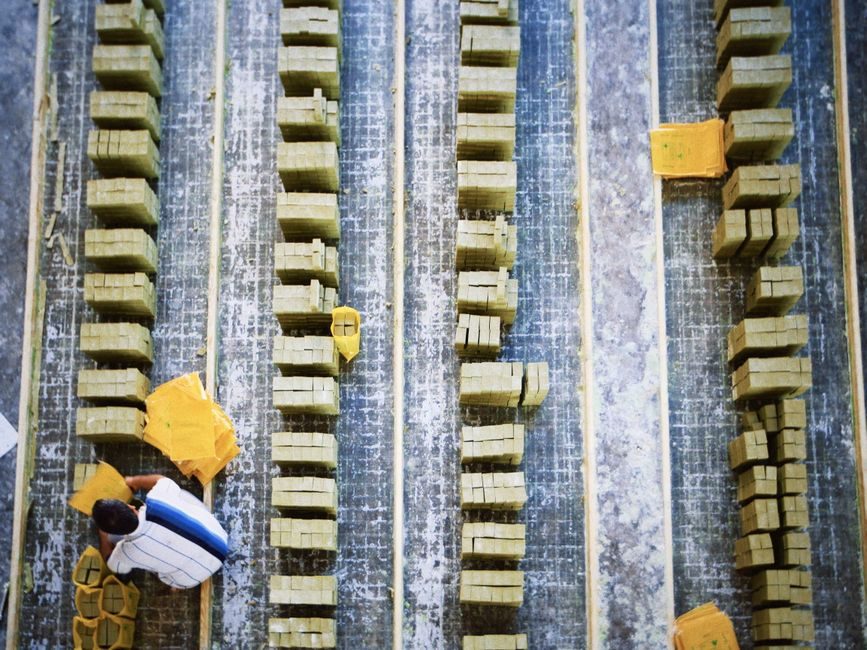
Rock wool is a manufactured mineral fibre spun from molten basalt and diabase, classified primarily by physical form, density, and end-use certification [S7]. Commercial product lines fall into six canonical form factors: insulation slabs, rigid boards, wired blankets, pipe sections, loose granulate for cavity fill, and sandwich-panel cores laminated between steel facings [S2][S5].
Measured bulk density on commercial rock-wool products ranges from roughly 30 kg/m³ for acoustic ceiling batts to 200 kg/m³ for structural board used in flat-roof traffic decks; thermal conductivity at 25 °C mean sits between 0.034 and 0.040 W/(m·K) depending on density and fibre orientation [S7]. The Sogou Baike entry on the SHIKEDA product line records a measured density of 180 kg/m³, thermal conductivity of 0.039 W/(m·K), shot-ball content (particles > 0.25 mm) of 3.8 %, hydrophobicity of 99.9 %, and an acid index (SiO₂ + Al₂O₃ / CaO + MgO ratio) of 2.0 — a value tied to long-term fibre durability [S7].
Classification by Form Factor and Density
Form factor is the first spec a buyer pins, because it determines the manufacturing line, the installation method, and the achievable R-value per unit thickness [S2]. Slabs (semi-rigid batts) are the general-purpose format used inside wall cavities, above ceilings, and in roof spaces per the ROCKWOOL Asia product-type page [S2]. Boards are higher-density rigid panels engineered for external wall insulation systems and flat-roof assemblies, with the SHIKEDA external-insulation board specified at 1200 × 600 mm and 50 mm thickness at 180 kg/m³ density [S7].
Wired blankets (mattresses faced with galvanised wire mesh) serve high-temperature pipe and vessel insulation up to roughly 700 °C; pipe sections are pre-formed half-shells split longitudinally for hot-service plumbing; loose-fill granulate is blown into cavity walls and complex geometry. The fifth canonical form, the sandwich-panel core, is laminated continuously between two steel skins on automated lines such as those engineered by FinMach GmbH, which delivers turn-key lines producing PIR/PUR, mineral wool, and EPS cores in a single process [S1].
Performance Properties and Test Boundaries
Rock wool's spec sheet reads against three engineering axes: thermal, fire, and acoustic, with hydrophobicity and acidity coefficient as secondary quality markers [S7]. On the SHIKEDA lab sheet, fire performance achieves the Chinese A-grade classification (non-combustible), average fibre diameter measures 4.3 µm against a 7.0 µm ceiling, and tensile strength reaches 15.2 kPa versus a 7.5 kPa minimum [S7].
Compressive strength at 10 % deformation registers 77.6 kPa against a 40 kPa minimum — the figure that gates rooftop and floor-slab use where foot traffic or ballast load is expected [S7]. Hydrophobicity of 99.9 % versus an 98.0 % threshold reflects the silicone-oil water-repellent treatment applied during curing, a critical parameter for external wall and pipe applications where moisture ingress degrades R-value. Engineers specifying rock wool for façade or rooftop work should treat density and compressive strength as a coupled spec, not independent dials.
Selection Criteria: Where Each Type Fits and Where It Fails
Selection starts with the operating temperature envelope, then narrows on density for mechanical duty, then on form factor for installation geometry [S2]. The ROCKWOOL product line extends into passive fire-protection formats including fire-penetration seals, designed to close gaps around piping, cables, and wall penetrations where flame and smoke would otherwise migrate between compartments [S6].
For plant engineers the practical decision table runs along four criteria. Temperature: slabs and boards cover building service from −50 °C to roughly 250 °C, while wired blankets extend continuous service to 700 °C and short-duration exposure past 1000 °C. Density: 30-50 kg/m³ for acoustic-only partitions, 80-120 kg/m³ for wall-fill insulation, 150-200 kg/m³ for structural board under load. Fire rating: A-grade non-combustibility is universal across all rock wool — unlike cellulose or EPS — and the product line also includes dedicated fire-stop formats [S6]. Water exposure: hydrophobicity above 98 % is the published spec, but the silicone treatment is a surface effect and the material is not rated for submerged or steam-saturated service without an additional vapour barrier [S7].
Product-Format Comparison for Specifiers
The table below lines the six form factors against the criteria a spec engineer normally weighs: target service temperature, bulk density, fire rating, and a typical use case drawn from the research corpus. [S2]
Insulation slab (semi-rigid batt): 30-80 kg/m³, non-combustible, used in wall cavities, ceilings, and roof spaces per the ROCKWOOL Asia slab range [S2]. Rigid board: 80-200 kg/m³, non-combustible, used for external wall insulation systems and flat-roof assemblies; the SHIKEDA board at 180 kg/m³ is the cited reference point [S7]. Wired blanket: 60-120 kg/m³, non-combustible, used for high-temperature pipe, duct, and vessel insulation where temperatures climb past the slab's envelope. Pipe section: 80-150 kg/m³, non-combustible, used for hot-service plumbing and steam lines where pre-formed geometry cuts install time. Loose fill: 30-60 kg/m³, non-combustible, blown into complex cavities and irregular geometry where batts cannot be fitted. Sandwich-panel core: 80-150 kg/m³, non-combustible, laminated between steel facings on continuous lines producing structural insulated panels for industrial buildings [S1].
Limitations, Failure Modes, and Misconceptions
Rock wool does not contain asbestos — modern stone-wool production uses basalt and diabase without the magnesium silicate minerals that defined legacy asbestos products [S4]. The shot-ball content (unfibrous particle residue > 0.25 mm) is a primary quality marker because high shot content degrades thermal performance and indicates inadequate fibre-forming; the SHIKEDA line shows 3.8 % shot against a 10 % ceiling [S7].
Failure modes the spec sheet does not flag: mechanical compression during installation can permanently reduce thickness and R-value in low-density slabs; moisture saturation in a non-hydrophobic grade destroys thermal performance until the material is dried; and the silicone hydrophobic treatment is a surface condition that can be compromised by cutting or abrasion on site. Above its service temperature, the binder — not the fibre — fails first, typically around 250 °C for standard phenolic binders, well below the fibre's own melting point. For high-temperature applications engineers should specify the binder grade explicitly rather than rely on the base form-factor description.
Manufacturing and Supply-Chain Context
Production of rock wool sandwich panels is capital-intensive: a FinMach continuous line integrates mineral-wool web formation, orientation, and lamination between two steel coil facings in a single in-line process, replacing the older batch lamination route [S1]. The same vendor's track record — eight tailored projects delivered to a single customer in three years — illustrates the engineering depth these lines now require, as panel cores move beyond commodity PUR/EPS into higher-density mineral-wool formats for fire-rated industrial buildings [S1].
For process engineers building or retrofitting a fired heater, an industrial boiler house, or a chemical-plant pipe rack, the practical purchase order lists three lines: form factor and dimensions, density (kg/m³) and thermal conductivity (W/(m·K) at 25 °C), and fire rating plus shot content and hydrophobicity — the same five parameters shown on the SHIKEDA published test report [S7]. For broader industrial spec work, similar density-driven classification logic governs fired clay bricks, while panel-format trade-offs are a useful counterpoint when weighing rock-wool sandwich panels against lightweight partition systems. Treat any vendor claim below 0.034 W/(m·K) at standard density with caution; published independent test data for commercial stone wool clusters in the 0.036-0.040 band [S7].
Spec-level background on the components involved: pressure transmitter, and flow meter.