
Industrial shock absorbers on pulp and paper lines are sized first by energy per cycle, not by stroke length: a German paper producer running a new roll conveyor specified an ACE MAGNUM MA6450 at 2,275 Nm/cycle and an adjustable effective mass range of 220–50,000 kg, with a 48.6 mm stroke, to stop paper rolls without damaging adjacent measuring instruments [S3].
That single spec sheet captures the whole problem class: high moving mass, tight envelope, and an acceptance window measured in millimetres of brake travel. The same input parameters (effective weight, propelling velocity, cycle rate, propelling force) drive every selection in stock prep, the fourdrinier/wire section, presses, dryers, reel, and converting, whether the supplier brand is ACE, Enidine, or another hydraulic line [S2][S3][S6].
The four inputs that govern every shock absorber selection in a paper mill
Every reputable manufacturer reduces the application to the same four numbers before proposing a unit: effective weight W_e in kg or lb, propelling velocity v in m/s or in/s, cycle rate N in cycles per hour, and the propelling force F in N or lb [S6][S7]. Absorbed energy per cycle is then E = W_e × v² / 2 (or per the SMC form E = E1 + E2 when a counter-pressure term applies), and an equivalent effective mass M_e = 2E / v² is back-calculated for catalog cross-reference [S7].
Cycle rate is the gate that pushes you up a frame size. The Taylor Devices design guide rule, still quoted across the industry, is unambiguous: for cyclic rates above 240/hour, apply a 30% safety factor on energy capacity; for 240/hr and below, derate is not required [S4]. In a reel or winder, 240 cph is a slow line, so most reel and rewinder stops end up safety-factored by default. Pair this with the standard 4-1/2-rule on effective mass (W_e within 25%–400% of the catalog value) and you can usually bracket a candidate unit in two passes [S6].
Adjustable hydraulic vs. non-adjustable vs. heavy-duty: a criteria comparison
On a pulp line, the first fork is whether the input parameters are stable. ACE's MAGNUM family (MA33–MA64ML) uses progressive adjustment at both ends of the unit, allowing on-site tuning of deceleration profiles without changing the orifice stack; that is what let the German paper producer take the line from "spec" to "running" without re-machining brackets [S3]. Enidine's OEMXT and Large Bore Series offer the same pattern with a low-profile adjustment knob in imperial or metric thread, stroke lengths from 1 to 6 in., and a Low Range (LROEMXT) variant that holds a useful curve down to 3 in/sec with propelling forces up to 4,000 lb [S2].
Non-adjustable hydraulic units are the cheaper choice when the input is well-defined and tamper-proofing matters (vandalism, untrained operators, food-grade paper), because the orifice is fixed at the factory and the unit cannot be mis-tuned in service [S2]. For large-bore applications such as pulp-mill oscillating screens, log conveyors, and roll-storage turntables, heavy-duty series with bore diameters up to 4 in. (100 mm) and strokes over 60 in. (1,524 mm) are the working envelope; the HDA adjustable variant in this class goes to 12 in. (305 mm) stroke, while the HDN custom-orificed variant is computer-simulated to a target damping curve [S2].
Compared against four selection criteria, the three families line up as follows. Adjustable hydraulic: highest flexibility, medium cost, medium envelope, suitable for unknown or varying inputs. Non-adjustable hydraulic: low cost, small envelope, fixed (optimal) damping, best for OEM volume and tamper-proof retrofit. Heavy-duty (HD/HDN/HDA): largest envelope (up to 4 in. bore, 60+ in. stroke), custom-orificed or adjustable, highest unit cost, and the only option for very high effective mass or long stroke. Air springs sit in a different category (isolation and actuation media such as air, water, nitrogen, anti-freeze) and are usually specified for vibration isolation on dryer sections and reel spools, not for end-of-stroke stopping duty [S2].
Where shock absorbers actually live on a pulp and paper line
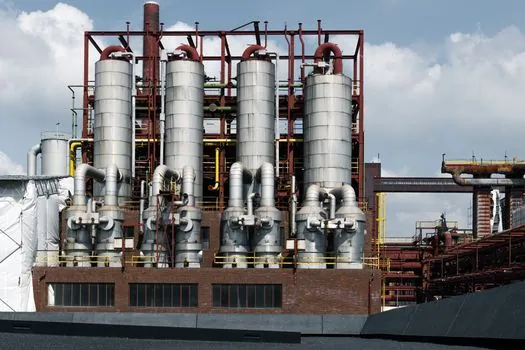
Enidine's case-history map of the process is a useful inventory: pulp and paper machines, roll storage equipment, roll automation, and roll conveyors all have critical components that sit in the path of high-impact motion, so they take the bulk of the energy-absorption hardware [S2]. Inside stock prep, the slow-speed, high-mass applications (chip conveyors, drum deckers, refiners) tend to land in the heavy-duty HD/HDN family because effective mass can exceed what an OEM-class unit is rated for. At the reel and winder end, the moving mass is the roll itself plus the spindle, so catalog effective-weight ranges in the 220–50,000 kg band of an MA6450 are not unusual [S3].
For the roll conveyor stop described in the ACE case, the failure mode being designed against is the classic spring/bumber problem: springs and elastomeric bumpers deliver most of their stopping force at the end of the stroke and rebound a portion of the input energy, which is why a mis-sized elastomeric stop on a 5-tonne paper roll will eventually crack a frame member or a measurement head [S3]. A hydraulic shock absorber, by contrast, dissipates energy across the full stroke, so peak braking force drops and the deceleration curve becomes roughly trapezoidal instead of spike-shaped [S3][S6]. A useful side benefit: the annealed guide bearing and integrated positive stop on units like the MA6450 act as a mechanical hard-stop in case of a hydraulic failure, so a maintenance team has a single component to inspect rather than a separate crash block [S3].
Standards, ambient factors, and the sizing math to keep on hand
There is no single ISO or IEC standard that defines industrial shock absorber ratings the way API 610 defines pump nozzle loads; the closest you get is manufacturer-published test data, the Hydraulic Institute's data tool approach for fluid systems, and the in-house calculation bases that vendors publish [S5][S9]. The Hydraulic Institute's pulp-loss data sheet, rooted in TAPPI TIS 408-4, covers stock consistencies from 2 to 6 percent oven-dried and addresses pipe frictional losses for pulp suspensions in systems using centrifugal pumps, but it is a fluid-friction reference, not a damping reference.
On the safety factor side, the 30% rule for cyclic rates above 240/hour is the most-cited single number, and the 25%–400% effective-mass window is the most-cited envelope rule [S4][S6]. When neither published rule matches your cycle profile, ACE's online calculator and SMC's catalog formula (E = E1 + E2, with M_e back-calculated as 2E/v²) will normally bracket a part number, and the final pass is always a bench test with the real moving mass and the real propelling force [S6][S7][S9]. For comparison of related process equipment engineering, see the broader coverage in [shock absorber selection for pulp and paper lines]( /encyclopedia/shock-absorber.html) and the [process instrument reference]( /encyclopedia/checking-and-testing-apparatus.html), and for the upstream stock-prep fluid side, the [pulp and paper machinery reference]( /encyclopedia/construction-machinery-and-equipment.html) catalogues the equipment classes these dampers mount onto.
Common failure modes and what they tell you about the spec
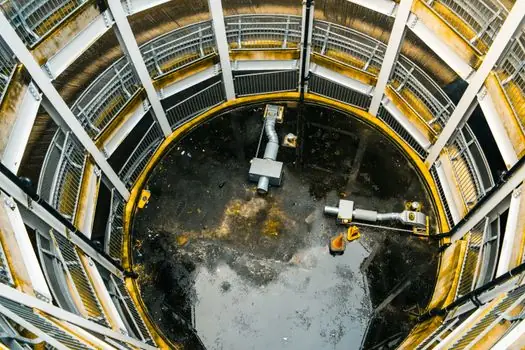
Three failure patterns show up over and over on mill audits. (1) Rod seal blow-by on adjustable units that have been left at the soft end of the adjustment range for months, because the soft setting lets the unit cycle beyond its rated stroke. (2) Hard-stop impact marks on the rod, which mean either the positive stop has been reached under normal cycle (undersized) or the propelling force exceeds the catalog envelope (mis-classified input). (3) Overheating on high-cycle applications, which is usually a 240/hour or higher cycle rate that was spec'd without the 30% derate [S4][S6]. Each of these is a spec error, not a component defect, which is why a sizing workbook in the maintenance system is worth more than any single brand choice.
A second class of failures traces back to the mounting, not the unit. Pivot brackets that constrain the rod's angular motion will side-load the seal, which is why the German conveyor case notes "specially designed pivot brackets to help support the paper rolls' rotary motion" as a parallel deliverable to the MA6450 itself [S3]. On heavy-duty rolls, a misalignment of more than a few millimetres between the rod centerline and the load vector will cut seal life by an order of magnitude, regardless of how generous the energy rating is. For related cross-industry work on equipment life extension and sensor selection on similar lines, see [Sink vs Source Wiring for PNP and NPN Sensors on Remote I/O]( /news/sink-vs-source-wiring-for-pnp-and-npn-sensors-on-remote-i-o.html), which covers the instrumentation side of the same maintenance problem.
Closing reference points: track the OEM-published cycle-rate derate (240/hour threshold, 30% energy derate) [S4], the catalog effective-mass window (25%–400% of nominal) [S6], and the published bore/stroke envelope for your chosen family (e.g. 4 in. bore, 60+ in. stroke for HD-class; 48.6 mm stroke and 220–50,000 kg for MA6450) [S2][S3]. If any of those three numbers falls outside the published envelope, the right next step is a vendor calculator pass and a bench test, not a field trial.
Detailed specification references: shock absorber, checking and testing apparatus, and construction machinery and equipment.
Background reading: Mechanical Seals: Advantages, Disadvantages, and Where They Beat Packing.