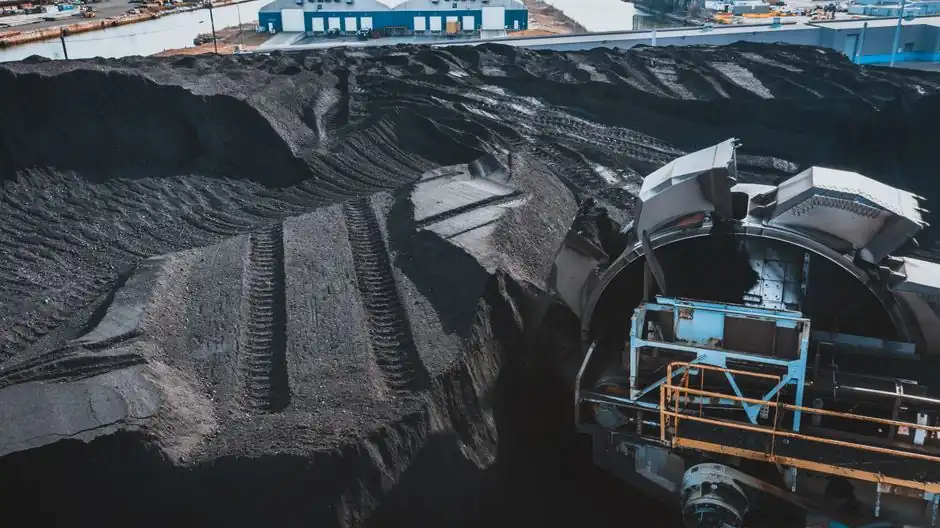
Mining-duty roller chain sizing follows a fixed five-step flow used across ANSI B29.1 transmission chain: classify the driven load (uniform / moderate / heavy shock), apply a service factor of 1.0 to 1.7 depending on input power and load class, multiply to get design HP, then pick chain pitch and small-sprocket tooth count from the manufacturer's horsepower table [S1].
The step that decides almost every downstream trade-off is the load class, because a heavy-shock mining conveyor driven by an internal-combustion engine with mechanical drive lands on a 1.7 service factor, while the same conveyor on an electric motor drops to 1.4 [S1]. That single number changes the required chain pitch and frequently pushes the spec from a single-strand standard series to a double-strand or heavy series.
Five inputs the chain maker needs before any pitch number
Before any calculation, the specifier must lock down input power type, driven equipment, transmitted HP, fast-shaft RPM, slow-shaft RPM, driver/driven shaft diameters, shaft center distance (or its adjustment range), and the drive envelope including any idlers or unusual conditions such as abrasive dust, corrosive water, or widely fluctuating loads [S1]. For mining, "unusual conditions" are not unusual, so a flagged note in the spec that abrasive and corrosive environments are present is what triggers a heavy-series or coated recommendation rather than a standard series [S1][S2].
Variable-speed drives require the HP to be tabulated at each setpoint, not just at nameplate, because mining conveyors and feeder breakers often run at reduced speed under load and the worst-case HP at the worst-case RPM is what the chain has to survive [S1]. This is also where the shaft center distance answer matters: chain life is sensitive to whether the center distance is fixed or adjustable, with adjustable centers allowing take-up of chain elongation over service life [S1][S4].
Service factor table and design HP calculation
Renold's service factor matrix crosses three load classes (uniform, moderate, heavy shock) against three input power types (electric motor or turbine, ICE with hydraulic drive, ICE with mechanical drive), giving nine values from 1.0 to 1.7 [S1]. Design HP is then Design HP = transmitted HP x service factor, and that product is what gets read against the strand-column and RPM grid in the chain-pitch quick selector [S1].
For a representative mining case, a feeder breaker driven by an electric motor in heavy-shock service sits at 1.4, while the same feeder breaker driven by a diesel with mechanical drive jumps to 1.7, so the same nameplate motor can require a different chain size purely on the input-power side of the matrix [S1]. The same matrix also shows why hydraulic-driven mining equipment often avoids the worst-case 1.7 factor, since the hydraulic coupling damps torque spikes before they reach the chain [S1].
Pitch and strand count: standard vs heavy series
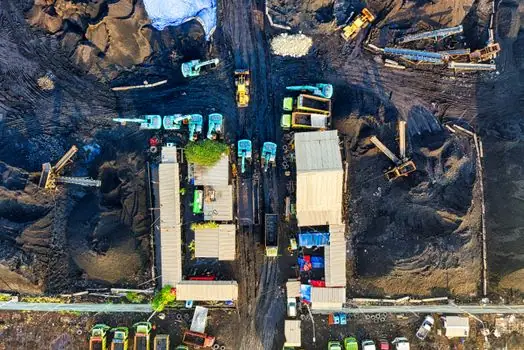
Chain pitch selection in the Renold flow uses a quick selector chart that crosses design HP against small-sprocket RPM, and the first strand column the design HP lands in sets the strand count, with the rule that the fewest strands gives the most economical selection [S1]. For higher loads, the spec moves from single-strand standard series into multiple-strand or heavy-series chain, and Diamond-Drives (Timken) explicitly lists large-pitch roller chain, multiple-strand roller chain, and heavy series chain as the three options it offers for mining and aggregate duty [S2].
The construction difference matters: heavy-duty roller chains use thicker side plates than standard series, which raises fatigue life and shock-load capacity for mining, construction, and heavy-machinery service, and they are commonly identified as the right pick when an application is described as "high-load" or "mining" in supplier literature [S3][S5]. Conveyor-oriented chain, by contrast, is built for long pitch, large roller diameter, and tensile strength rather than fatigue life, which is why long-pitch conveyor chain runs at low speed and is not interchangeable with transmission chain in a high-RPM mining gearbox [S4].
Comparison: standard vs heavy vs double-pitch vs self-lubricating
Lining the four common mining candidates against four decision criteria, standard ANSI roller chain is the lowest-cost option for uniform or moderate loads on electric-motor-driven equipment, but it has the thinnest side plates and the shortest fatigue life under shock [S5]. Heavy-duty roller chain shares the same pitch family but uses thicker side plates, giving higher shock and fatigue resistance at higher cost and weight, which is the typical spec for high-load mining drives [S3][S5]. Double-pitch roller chain has longer links, lower weight, and lower cost, but is restricted to low-speed, long-distance conveyor service and is not a substitute for heavy series in a high-torque gearbox [S5]. Self-lubricating chain uses oil-impregnated sintered bushings, carries the same load as standard chain, and is rated for continuous operation up to 300 to 450 °F, which fits hot, dusty, or relube-inaccessible mining locations [S5].
For corrosion or wash-down service, stainless or nickel-plated chain is the usual call, with nickel plate adding a layer beyond what stainless alone provides in moderate corrosive environments, and this is the path used for underground or wet-mining exposure where standard carbon steel would pit [S3][S5]. Where the spec also needs long relube intervals, o-ring or x-ring sealed chain from the corrosion-resistant and self-lubricating families is the usual extension [S3].
Mining-specific failure modes and selection traps
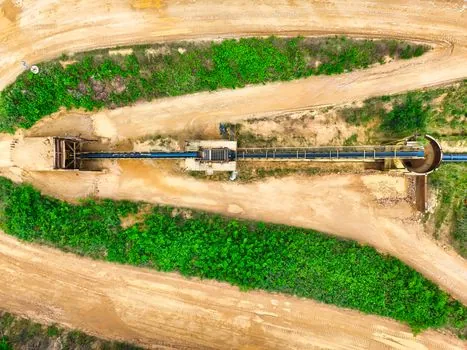
The four failure modes that drive chain selection in mining are abrasive wear from dust and ore fines, corrosive attack from water and chemicals, shock overloads from crusher and feeder-breaker stalls, and stretch from inadequate service factor on diesel-mechanical drives [S1][S3]. Each one pushes the spec in a different direction: abrasive wear pushes toward heavy series and sealed chain, corrosion pushes toward stainless or nickel-plated chain, shock pushes toward higher strand count or higher service factor, and stretch pushes toward larger pitch and adjustable center distance [S1][S3][S5].
A common trap is using standard series chain on a heavy-shock diesel-mechanical drive because the nameplate HP looks small, then finding the chain stretches within weeks because the 1.7 service factor was never applied [S1]. Another is specifying conveyor chain (long pitch, high tensile, low fatigue) in a high-RPM transmission role, which fails in fatigue rather than tensile break and is a documented misuse in the chain family tree [S4]. The third is ignoring center-distance adjustment, because chain elongates in service and a fixed center turns adequate take-up into a premature replacement [S1][S4].
Standards governing the spec
ANSI B29.1 is the governing standard for the American (ANSI) range of transmission roller chain, and it sets the mathematical basis for component proportions across the standard and heavy series [S4]. The European or British Standard range grew out of earlier ISO/BS work, with DIN 8187 and BS 228 as common reference points, and is broadly interchangeable in pitch family but not in exact component geometry with the ANSI range [S4][S5]. The chain maker's horsepower tables (Renold pages 6-19 and equivalent OEM tables) are derived from these standards and are the document the engineer actually reads against when picking pitch and tooth count [S1].
For corrosion-resistant and stainless variants, the base dimensional standard is still ANSI B29.1 or ISO 606, with the material spec layered on top, so a mining spec should cite both the dimensional standard and the material/finish requirement rather than treating them as alternatives [S4][S5]. See the reference page on roller chain for the dimensional families and pitch conventions behind these standards, and the related entry on roller bearing for the bearing-side considerations that apply when a chain drive is mounted on a shaft supported by rolling-element bearings.
Who this is for, and who it is not for
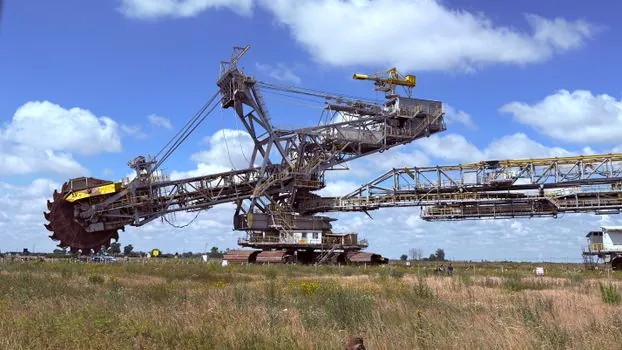
This flow is for engineers sizing a new chain drive or re-specifying a failed one on a defined mining asset: conveyor drives, feeder breakers, crusher feed drives, and similar high-load, low-to-medium-speed service where the five inputs above are known [S1][S2][S3]. It is not for hydraulic-system component sizing, for belt conveyor cover selection, or for any application where the input is a hydraulic motor with a downstream gear reducer that already absorbs the shock, because in those cases the chain is downstream of the shock absorber and a lower service factor applies [S1].
It is also not a substitute for the chain maker's own engineering review on severely abrasive, corrosive, high-temperature, or widely fluctuating-load applications, where the OEM explicitly asks to be looped in rather than having the specifier work from the catalog alone [S1]. Mining operations sit on that boundary often enough that the practical rule is: run the five-step flow to a tentative selection, then send the inputs to the chain maker for confirmation when any of the unusual-condition flags are raised [S1][S2].
Trackable signals to watch over the next planning cycle are OEM updates to the heavy-series horsepower tables (Diamond-Drives, Renold, Tsubaki, DAIDO), any revision activity around ANSI B29.1 fatigue-rating methodology, and the spread of nickel-plated and o-ring sealed chain into mainstream mining MRO catalogs as standard stocked SKUs rather than special-order items [S2][S3][S4]. For a related decision on the vehicle side of a mining fleet, see AC vs DC wheel motors on mining dump trucks, and for a fixed-install gas-detection spec that often rides alongside conveyor control panels, see fixed vs portable gas detection 2026.
For component-level specifications, see mining dump truck.