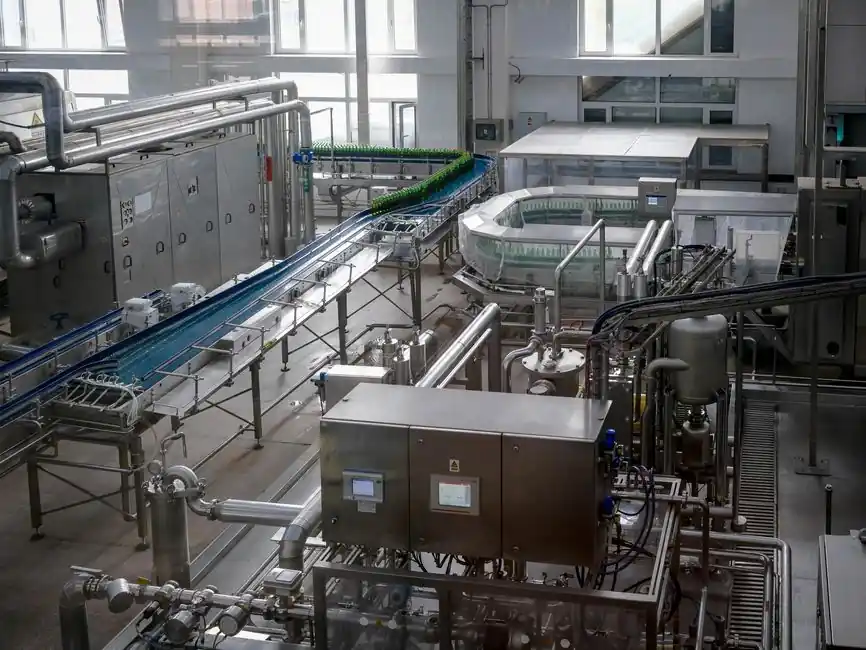
Roller conveyors move unit loads on idle or motorised tubes at belt speeds from 5 m/min up to 60 m/min, while conveyor chains drag pallets, slats, or attached fixtures through metallurgy, cement, sugar, and automotive lines where temperatures, oils, or point loads rule out rollers [S2][S4].
Both product families are still in active OEM catalogues in 2026, with dedicated roller plants such as Huzhou Jiutong in Zhejiang and chain specialists including FB Chain, GIDI, and Hengjiu Group refreshing product lines in July and August 2026 [S1][S4][S5][S7].
Load, Speed, and Drive Principle
Gravity roller conveyors cap individual roller static load at roughly 250 kg per roller when fitted with precision bearings, and Advance Equipment's powered roller range in Mumbai is rated for the same 250 kg-plus threshold using pressed bearings for lighter cartons [S2]. Belt on a friction-driven bend (AEC 100) is limited to 50 kg at 5-60 m/min on the same vendor's range, and the same speed window of 5-60 m/min is what specifiers should anchor roller line calculations against [S2].
Conveyor chains move by positive engagement: the chain is the pulling element, and the load rides on slats, attachments, or directly hooked fixtures. Large conveyor chain from Hengjiu Group is built for industries where belts and rollers cannot survive, including automobile manufacturing, metallurgy, cement, sugar factories, mines, power generation, and port machinery [S4].
Roller chain, in turn, is the underlying power-transmission element, with double-row roller chain couplings cited as the most widely used chain coupling configuration in industrial practice [S10]. Where rollers rely on friction or motorised drums, chains engage sprockets and tolerate hostile conditions that would quickly wear roller surfaces.
Layout Geometry: Straight, Curved, Vertical
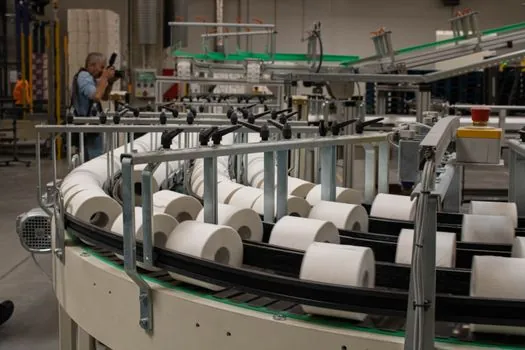
Roller conveyors can be configured straight, curved, or in flexible "S-type" arrays; Youngsun's flexible powered roller unit has 8 rollers per section, can run alone or combined, and reaches up to 180 degree transport direction changes in a compact footprint [S8]. That geometry flexibility is what makes roller lines the default for parcel handling, e-commerce sortation, and end-of-line packing.
Chain conveyors serve a different geometry book. Slat chain conveyors from Changshuo in Wuxi cover straight, side-flex, and vertical lifter variants, with stainless steel top chains and modular belts as standard options in their 2026 catalogue [S3]. Flexible chain conveyors in the same Changshuo line are pitched at the food, daily chemical, pharmaceutical, and lithium battery industries where wash-down, low noise, and tight radii matter more than the long straight runs of a parcel hub [S3].
For specifiers, the rule of thumb is: if the line has many curves under 180 degrees and accumulates product, powered rollers with zero-pressure accumulation win; if the line includes lifts, steep inclines, or high-temperature zones, chain-driven slat or table-top chain is the correct baseline [S2][S3].
Materials, Bearings, and Wear Parts
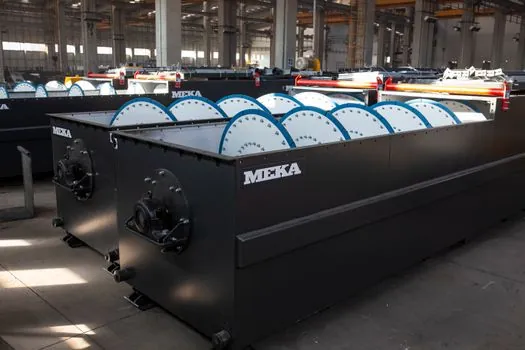
Roller conveyor performance is set by tube diameter, tube material (galvanised steel, stainless, PVC), and the bearing choice. Precision deep-groove ball bearings are standard for heavy-load rollers above 250 kg per station, while pressed metal bearings cover lighter duty at lower cost [S2]. The roller bearing family inside the tube is therefore the hidden cost driver, and operators should spec sealed-for-life or stainless variants in wash-down or corrosive sites rather than carry greased-for-life units as the universal default.
Conveyor chain selection turns on pitch, attachment style, and material. GIDI's product family splits into roller chain, conveyor chain, double pitch chain, and hollow pin chain, with each family aimed at a different speed, load, and attachment requirement [S7]. FB Chain's industrial chain range adds leaf chain, chain anchors, and the RotaLube automatic lubrication line that addresses the chronic maintenance pain point on ash conveyors and similar dirty environments [S5].
The coupling between chain and sprocket is the equivalent critical interface: Hengjiu's large conveyor chain is matched to purpose-built sprockets, and chain wear gauges are a stocked spare-parts item at FB Chain, which suggests that chain-line maintenance is dominated by predictable elongation rather than catastrophic failure [S4][S5]. For an overview of chain geometry and pitch logic, the conveyor chain encyclopedia entry is the right starting point.
Application Fit by Industry
Roller conveyors dominate where the load is a discrete carton, tote, or pallet with a flat bottom, and the duty cycle is light to medium. Changshuo lists food and beverage, daily chemical, lithium battery, pharmaceutical, logistics, packaging, tyre, and general automation as its served industries, with most of those lines built on roller or modular belt rather than slat chain [S3].
Chain conveyors are the default where the load is hot, oily, sharp-edged, or attached. Hengjiu's large conveyor chain application list covers automobile manufacturing, metallurgy, cement, sugar factories, mines, power generation, and port machinery, which is essentially the heavy-and-harsh envelope where a rubber belt would perish and a steel roller would gall [S4]. Slat conveyors from Advance Equipment use wood or metal slats on a single or double strand chain, and can double as a travelling work platform, which no plain roller line can offer [S2].
For a deeper comparison of roller line variants (gravity, powered, flexible, accumulation), see the spec-first selection map on roller conveyor types and applications, and for the chain side, the encyclopedia entry on chain conveyor lays out the slat, table-top, and drag variants in more detail.
Selection Criteria: A Side-by-Side Comparison
The decision matrix below summarises the four criteria that matter most in 2026 capex spec sheets. Roller conveyors win on noise, energy per conveyed kg, and curve density; chain conveyors win on temperature ceiling, point load capacity, and ability to push rather than carry the product [S2][S3][S4][S5].
Cost per metre, as a single number, cannot be quoted without knowing roller diameter, chain pitch, and drive package, but indicative roller conveyor sections from Chinese OEMs sit in the low hundreds of USD per metre for gravity units, while engineered chain conveyors with drives are typically 2-4x that figure once the drive, guard, and take-up are included. For buyers comparing like-for-like, insist on a bill of materials that splits frame, rollers or chain, drive, and controls.
Limitations and Failure Modes
Roller conveyors fail in three predictable ways: bearing seizure in wet or gritty environments, roller deformation under point loads above the rated kg-per-roller figure, and belt-slip or motor overload on accumulation lines when the zero-pressure logic is mis-tuned [S2]. For a more general view of how rollers integrate into a powered roller conveyor line, including drive-roller versus tandem-drive topologies, the linked encyclopedia page is the cleaner reference.
Conveyor chain failures tend to be elongation, attachment wear, or sprocket tooth wear, all of which FB Chain addresses with stocked chain wear gauges and the RotaLube auto-lubrication accessory [S5]. In ash-handling and cement duty, missed lubrication is the dominant root cause, which is why chain vendors now bundle automatic lubricators as a first-class option rather than an aftermarket extra.
For the roller-bearing assemblies inside a roller conveyor, the roller bearing page covers sealed, shielded, and stainless variants, and for the chain side, the chain conveyor page covers slat, table-top, and drag configurations including their typical pitch ranges.
Standards, Sourcing, and Trackable Signals
No single ISO or DIN number governs "roller conveyor vs chain conveyor" as a system; instead, the underlying elements carry their own standards (chain to ISO 606, bearings to ISO 15 and ISO 492, roller surface treatment often per customer spec). Indian vendors such as Advance Equipment in Thane (established 1992) and Chinese OEMs including Huzhou Jiutong (registered 2015), Suzhou Junling, and Changshuo in Wuxi are the recurring 2026 sources for both product families, and each lists roller, chain, and modular belt in the same catalogue, which makes cross-quotation straightforward [S1][S2][S3][S6].
For comparison shopping, send identical RFQs to at least one Chinese OEM and one Indian or European vendor, ask for the kg-per-roller or chain-pitch data sheet, and require the wear-part list with part numbers. Track next-quarter signals including the next FB Chain catalogue update (King's Award for Enterprise 2025 for international trade holder) and Hengjiu Group's large-size chain line extensions, since both tend to telegraph the next generation of attachment and pitch options before the smaller vendors follow.