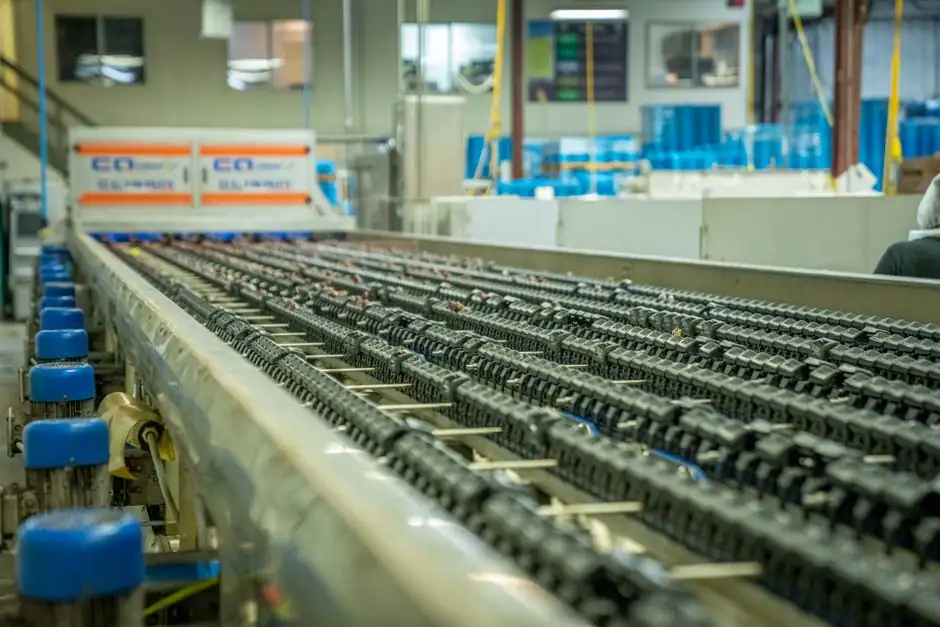
Roller conveyors split into three functional families (gravity, line-shaft/motorized-drive, and belt-driven idler) with shell diameters spanning 63 mm for light workstation duty to 219 mm for heavy bulk mining service, and CEMA bearing classes C through F governing speed and load envelope [S2].
For 2026 procurement, the decision is not "which roller" but "which roller family matches load profile, ambient corrosivity, and duty cycle," because the wrong combination produces belt mistracking, premature bearing failure, and stoppages within months [S2]. Chinese OEM export data from 50+ countries confirms gravity, drive, and impact variants are the top three SKUs shipped [S7].
Roller Families: Gravity, Drive, and Idler Compared
Gravity rollers are unpowered, run on internal radial ball bearings, and depend on a pitch of 3–6% to move cartons, totes, and pallet loads; they are the lowest-cost line and the workhorse of parcel handling [S2]. Motorized drive rollers (MDR) embed a 24 VDC or 400 VAC motor inside the tube, with zero-pressure accumulation controlled by photo-eyes, and they dominate zero-pressure accumulation zones in distribution centers [S8]. Belt-driven idler sets (carrying, return, and impact) support long-run belt conveyors and require CEMA Class D/E/F bearings when belt speed exceeds 3.5 m/s [S2].
Selection rule: choose gravity when slope and load are sufficient, MDR when accumulation is required on flat or slightly inclined sections, and idler sets for any belt conveyor carrying bulk tonnage. Roller conveyor is the umbrella category; roller bearing selection is the dominant reliability variable within it.
Bearing Class, Load, and CEMA Class Mapping
Conveyor bearings fall into CEMA classes C (light intermittent), D (standard continuous to 3.5 m/s), E (heavy continuous, high speed or load), and F (extreme duty, underground mining) [S2]. In tropical 80–95% RH service, CEMA E or F is standard for palm-oil mills and bulk port handling, while semiconductor cleanrooms run lighter C/D classes with stainless or zinc-plated shells [S2]. Khodiyar's 6206ZZ, 6205ZZ, and 6204ZZ flat-top return rollers map directly to CEMA C/D classes for 800–2000 mm belt widths, listed at US$18–30 per piece on 50-piece MOQ [S3].
For tropical bulk handling, sealed 6204–6206 deep-groove ball bearings in pressed-steel end caps remain the default construction; failures trace to seal failure and water ingress, not bearing fatigue, when units are correctly CEMA-classed [S2].
Material and Shell Construction by Environment
Shell materials map to ambient corrosivity: zinc-plated or painted mild steel for dry indoor service, hot-dip galvanized for outdoor and washdown, HDPE or UHMW for chemical and food contact, and stainless 304/316 for sanitary or marine exposure [S2]. Diameter is driven by load: 63 mm for light workstation, 89–108 mm for general carton, 127–159 mm for pallet, and 159–219 mm for bulk ore, coal, and aggregate [S2]. HDPE idler rollers for chemical service price at US$5–30 on 50-piece MOQ; 6206ZZ mining idlers price at US$6–50 in the same MOQ band [S3].
Anti-buildup rollers use a polyurethane disc or spiral wing profile to shed sticky material (fertilizer, wet clay, filter cake) that would otherwise compact onto a flat return roller, causing belt tracking loss and shell wear [S2]. Spec them in any application where carryback exceeds 1% of throughput.
Idler Geometry, Trough Angle, and Load Capacity
Carrying idlers are arranged in 3-roller troughing sets with wing angles of 20°, 35°, or 45°; a 35° trough at 1,200 mm belt width carries roughly 3.2× the cross-sectional material of a flat arrangement, per CEMA tables cited in DNC's engineering guide [S2]. Impact idlers, with rubber or polyurethane rings, are placed at transfer points where lump size and drop height concentrate load; they are the highest-wear item in a bulk conveyor and are typically rated for 10–20% of belt length. Return idlers are flat or rubber-disc and support the empty side of the belt; rubber-disc types reduce belt damage from stray material and from misalignment events.
For long-run belt conveyors carrying mining aggregate, return roller pricing from Indian OEM Avismatic sits in the US$3,500 per gross (144-piece) band for stable-running rubber-shell design, a useful budget benchmark for quarry-scale retrofits [S3][S4].
Application Segments: Parcel, Pallet, Bulk, and Food
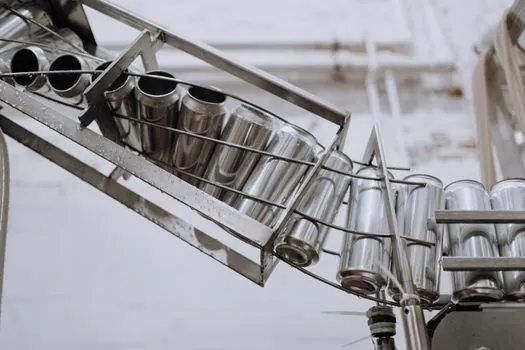
Parcel and e-commerce: 50–89 mm gravity rollers, 75–100 mm pitch, MDR accumulation in sort zones, throughputs to 2,000 cartons/hr. Pallet handling: 89–108 mm steel or galvanized rollers on 150–200 mm pitch, often chain-driven live roller (CDLR) for heavier loads. Bulk mining/quarry: 127–219 mm diameter, hot-dip galvanized or rubber-lined, CEMA E/F, trough angle 35–45° [S2]. Food and pharma: 304/316 stainless or HDPE, IP66/IP69K sealed bearings, easy-clean geometry; Avismatic's India-built systems also bundle bucket elevators and cross-feeders in the same hygienic line [S4].
Drive roller pricing from Chinese OEM Huzhou Jiutong, which produces 1,000+ SKUs and ships to USA, UK, EU, Canada, and Australia, runs on bulk MOQ with 24-hour quote turnaround and 100% roller run-out testing [S7][S8]. For accumulating zero-pressure lines, motorized rollers from Rollcon Engineers (India) integrate with slat, chain, and screw conveyor lines for sugar, cement, and bag-handling plants [S6].
Failure Modes, Limits, and Sourcing Risk
Three failure modes dominate field data: (1) seal failure and water ingress in tropical and washdown service when IP rating is below IP65, (2) belt mistracking from using flat return rollers where rubber-disc or training idlers are specified, and (3) bearing fatigue when CEMA C bearings are fitted to high-speed or high-load applications that demand Class E or F [S2]. Cross-check roller chain drives on CDLR lines against crossed-roller guide and tapered roller bearing selections where side loads or thrust loads are present.
Lead-time risk for heavy bulk idlers (159–219 mm) is the dominant 2026 procurement variable, with Indian and Chinese OEMs quoting 4–8 weeks on galvanized mining idlers versus 1–2 weeks on standard 89–108 mm units; bulk aggregate and palm-oil operators in Southeast Asia should hold safety stock of return and impact idlers, not just carry rollers [S2][S3]. A useful spec cross-reference for material-handling engineers is the broader conveyor sourcing map in Vibrating Conveyor Selection for Food and Beverage Lines, and for adjacent moving-parts selection see Linear Bearing vs Ball Bearing: Spec-First Selection Map.