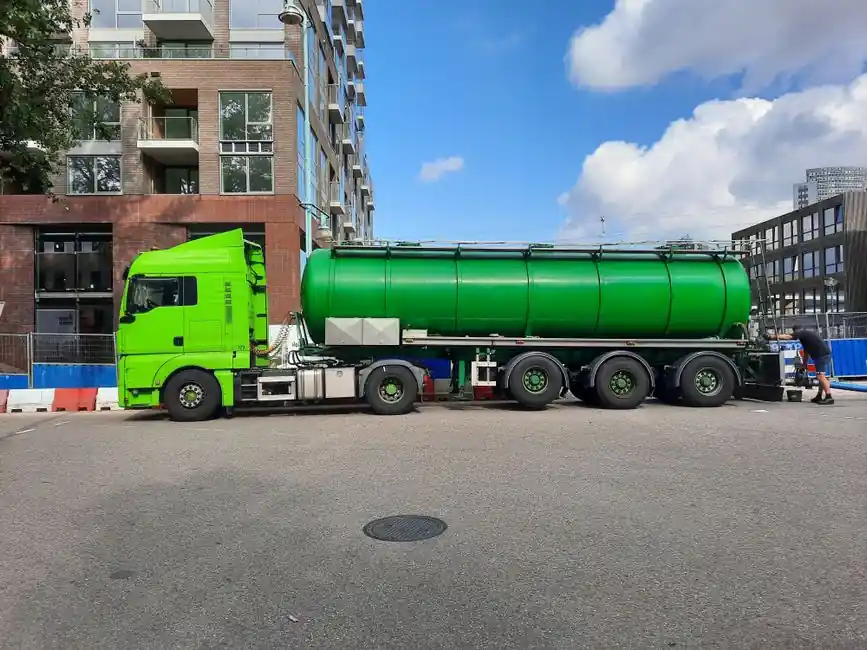
A municipal tank cleaning program stands or falls on three choices made before any nozzle is ordered: the cleaning media (water, air, or chemical), the pressure class (low, medium, or high), and the geometry of the vessel being cleaned, which dictates whether a tank cleaning machine rotary spray head, an in-line eductor, or a manually fed lance is even feasible [S1].
Urban assets in scope for 2026 procurement range from 275 L to 17,600 L PE water tank systems on carrier vehicles, fixed potable and wastewater tanks, drainage sumps, and elevated water-tower reservoirs that increasingly rely on drone-assisted, no-shutdown cleaning [S2][S3].
Cleaning vs Silt Management: Two Distinct Equipment Trains
Municipal drain cleaning is not a single equipment category; it is a chain of drain cleaning machines, desilting units, silt collection systems, sludge handling equipment, dewatering units, silt transport vehicles, and specialized drain-maintenance vehicles, each performing one link [S1].
The Open Drain Silt Carrier (ODSC) workflow formalizes this chain as Drain Cleaning, Silt Collection, Filtration, Containment, Transportation, Controlled Unloading, treating cleaning as one node in a material-handling loop rather than a standalone task [S1]. Specifying a tank cleaning machine without specifying the downstream silt path is the most common reason municipal tenders end up with roadside sludge accumulation, spillage, and manual re-handling [S1].
Pressure Class, Media, and Tank Material Compatibility
PE water tank systems rated for -40 °C to +60 °C in RAL 2011 municipal orange define the material baseline for urban carrier-vehicle water tanks; pump packages are selected separately as low, medium, or high-pressure systems to match hose-reel and swivel-arm configurations [S3].
Compatibility logic: a stainless rotary spray head driven by high-pressure water is the default for closed potable tanks; chemical CIP (clean-in-place) loops are reserved for process tanks where residue chemistry justifies the cost; air-driven eductors and lance-fed manual cleaning are the fallback for sumps, digesters, and large-diameter stormwater chambers where nozzle insertion geometry is the binding constraint. Wrong pairing shows up as PE tank fatigue, gasket blow-by, or pump cavitation inside one operating season.
Tank Volume, Geometry, and Carrier-Vehicle Layout
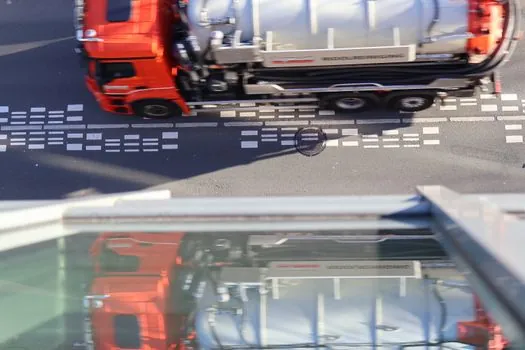
FIEDLER's municipal range runs from 275 L up to 17,600 L total capacity in a cascade design with integrated baffles, mounted on roll-off tippers, swap bodies, ball mounts, fixed superstructures, RoRo systems, flatbed bodies, semi-trailer plates, or skip tippers [S3].
Flat tank geometry lowers the centre of gravity and maximises flatbed width usage, but every configuration is custom-engineered to the carrier's axle-load envelope; C-connection fill ports and water suction filters are standard, while VDI 2700 lashing points and crane straps are mandatory on all loading platforms [S3]. For static municipal reservoirs the comparison shifts to IBC tank and tank container footprints, where pallet-friendly footprints and stackability compete against fixed welded steel tanks of equivalent volume.
No-Shutdown and Drone-Assisted Cleaning for Elevated Assets
Drone-based industrial cleaning of storage tanks, water towers, bridges, and wind turbines is a documented 2026 service offering in New York that operates without shutdowns, an approach that removes the biggest operational cost in elevated-reservoir maintenance [S2].
The trade-off: drone cleaning handles external biofilm, scale, and atmospheric residue on accessible surfaces, but cannot replace internal rotary spray head CIP for potable-water vessels. Procurement language should therefore separate external drone cleaning of towers and silos from internal tank cleaning machine cycles, and budget each on its own line.
Decision Matrix: Which Configuration Fits Which Urban Asset
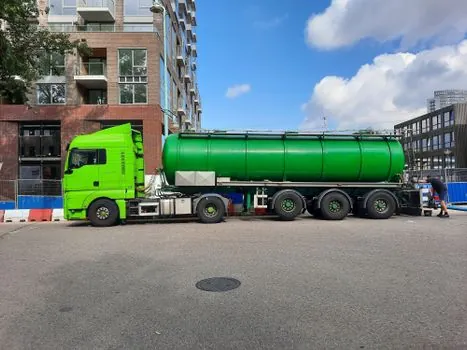
For drainage sumps and open drains under 2 m³, the ODSC silt-carrier chain with manual or lance-fed cleaning is the lowest-capex option and aligns with the Indian Urban Local Body (ULB) equipment list [S1]. For carrier-vehicle water tanks between 275 L and 17,600 L, PE cascade tanks with low-, medium-, or high-pressure pump packages on roll-off or fixed superstructures set the municipal baseline [S3]. For elevated water towers and large-diameter reservoirs, drone external cleaning is paired with an internally deployed tank cleaning machine rotary head for sediment removal, with no shutdown on the external pass [S2].
Equipment explicitly NOT a fit: portable high-pressure washers used alone on silt-heavy drains, which solve the cleaning step but leave the silt uncollected and produce the roadside dumping problem; stainless rotary heads on PE tanks without verifying nozzle inlet pressure versus PE liner rating; fixed-installation CIP skids on shared or rented carrier vehicles where axle load and VDI 2700 lashing cannot be engineered per build [S1][S3].
Failure Modes, Standards, and Filter Pairings
The two most common field failures in 2026 municipal tenders are pump cavitation from undersized suction piping on mobile tank systems, and secondary pollution from uncontrolled silt dumping when the cleaning step is procured without the collection step [S1][S3].
Filtration on the carrier side is handled by an integrated water suction filter at the C-port fill; for silt-bearing drain flows, in-built filtration and dewatering inside the ODSC hopper is the documented baseline [S1][S3]. On the process-instrumentation side, closed-tank cleaning loops that include flow verification typically pair a flow meter on the CIP return line and a pressure transmitter on the spray head supply, both sized to the low-, medium-, or high-pressure class selected at build. Load securing on the carrier vehicle follows VDI 2700 lashing-point practice as cited in the FIEDLER specification [S3].
Trackable signals for the next procurement cycle: municipal tenders that combine drain cleaning, silt collection, and transportation into a single line item rather than separating them; growth of no-shutdown drone external cleaning as a contracted line item alongside internal CIP; PE cascade tank capacity requests above 10,000 L paired with high-pressure pump packages on swap-body carriers [S1][S2][S3].