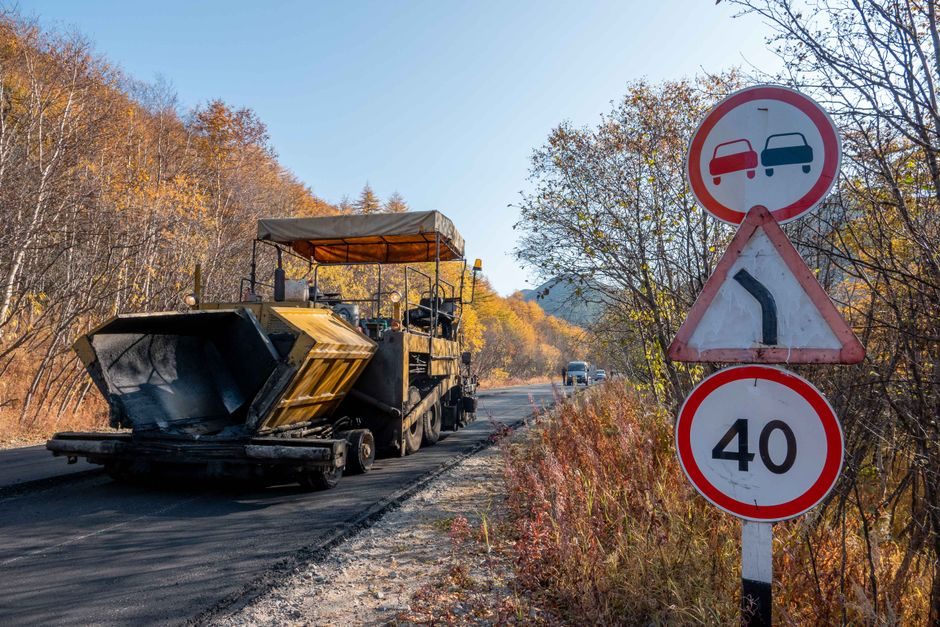
Road-maintenance crews should default to 8 kg-class rotary hammers with SDS-Max chucks, single-stroke impact energy around 12 J, and a drill-plus-chisel dual-mode switch, because patched asphalt, cured-concrete expansion joints, and cast-iron drainage frames each punish under-rated tools within a shift [S1].
The decision hinges on three numbers: chuck system (SDS-Plus vs SDS-Max vs spline/hex), single-stroke impact energy (J), and weight class (kg); substrate (asphalt, reinforced concrete, brick, or steel-embedded iron) sets the minimum on all three, not the brand label [S1][S2].
Chuck Systems and Why SDS-Max Dominates Road Work
SDS-Max chucks are the de-facto standard for 8 kg-class and larger rotary hammers, accepting drill bits from roughly 12 mm up to 52 mm diameter for concrete and the larger chisel shanks used in pavement breaking [S1]. For patch drilling of 16-25 mm anchor holes in cured concrete deck slabs, an SDS-Max tool is overkill; SDS-Plus tools (5-10 kg class) handle 6-32 mm bit ranges, but their chippers underperform when the operator has to scale 30 mm of bituminous overlay or break out a failed pothole patch [S1]. For purely vertical chiselling on manhole frames and kerb stone, hex/SDS-hex tools around the 5 kg class drop the operator's fatigue load without sacrificing break rate, provided the impact energy is rated for masonry, not steel. Spline-drive chucks still appear on heavier breaker-class machines, but in the rotary-hammer category SDS-Max and SDS-Plus cover the road-maintenance envelope [S1].
Impact-Energy and Weight-Class Bands Road Crews Actually Use
SPARKY's BP 860CE sits squarely in the 8 kg impact class at 8 kg (17.637 lb) tool weight, with two operating modes (hammer drilling and chiselling), electronic speed pre-selection, constant electronics with soft start, and a maximum single-stroke energy of 12 J in its "High Power" mode — a useful reference point for specifying the lower bound on road-class tools [S1]. Pneumatic rotary hammers such as the Ingersoll Rand 119MAX series run from a compressed-air supply instead of mains electricity, which matters on remote patch jobs where a 5-7 kVA generator is impractical and air-driven pavement breakers already feed from a compressor truck [S2]. Below 5 kg, impact energy typically falls under 4 J — fine for tile or plaster, marginal for anything harder than 30 MPa concrete. Above 10 kg, vibration and operator fatigue force a two-person lift or a cart-mount for anything more than short bursts; the 8 kg class is the practical sweet spot for hand-held road maintenance [S1].
Substrate Mapping: Asphalt, Concrete, Brick, Steel-Embedded Iron
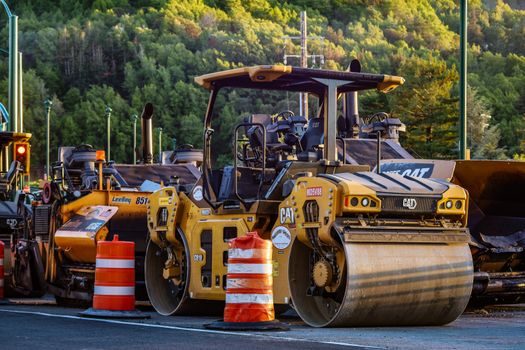
Asphalt patching to 50 mm depth rarely justifies anything heavier than a 5 kg SDS-Plus chipper, because the bit slices through bituminous material with low reaction force; a road-class rotary hammer wastes its energy budget as heat in the chuck. Cured concrete deck slabs, kerb edges, and bridge expansion-joint seats demand the 8 kg / 12 J class: impact energy below ~10 J forces operators to dwell, which overheats the piston and trips thermal cut-outs on most name-brand machines [S1]. Reinforced sections require eye protection and a bit-stop strategy because striking rebar at full impact energy shears SDS-Max shanks above ~15 J. Brick and clay-paver kerbs sit between the two: a 6-7 kg tool with 6-8 J covers most repair work without spalling the surrounding units. Cast-iron drainage frames and manhole rims are an edge case where a dedicated demolition hammer (chisel-only) outperforms a dual-mode rotary hammer, because rotary drilling mode is unused and the added gear train adds weight without adding break rate.
Electric vs Pneumatic vs Cordless: Power Source Trade-offs
Mains-electric rotary hammers in the 8 kg class draw 1,200-1,500 W and tolerate 230 V generator power with a 3 kVA rating, which is the common road-gang setup [S1]. Pneumatic models such as the Ingersoll Rand 119MAX-series trade the cable for an air hose at 6-7 bar (90-100 psi) working pressure, which suits long-run trench work where the compressor is already on site for road roller ballast-water refills or jack-hammer dust suppression [S2]. Cordless 18 V / 54 V platforms now reach 9-12 J class, but sustained impact at full energy drops the pack to 8-12 minutes of continuous chiselling — adequate for one or two patch sites per battery, marginal for a full shift. The honest split: specify mains-electric for depot-based crews, pneumatic where the compressor is the constraint, and cordless only for spot repairs where cable-laying time exceeds the gain in impact energy.
Selection Criteria in a Side-by-Side View
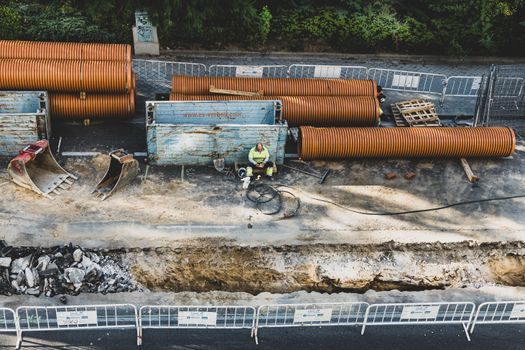
Three decision criteria separate road-maintenance rotary hammer classes: impact energy per stroke (J), power source (electric / pneumatic / cordless), and operating modes (drill+chisel dual vs chisel-only demolition). Below 6 J, no class handles cured-concrete kerb work; 6-10 J covers brick and patch concrete; 10-15 J is the road-maintenance band; above 15 J belongs to breaker-class machines. Dual-mode (drill + chisel) is mandatory where anchor holes precede bolt installation; pure chiselling tasks are better served by a dedicated demolition hammer to save weight. Power source selection follows site logistics, not impact class: generator-fed 230 V is the default, pneumatic follows the compressor, cordless fits short-duration spot jobs only [S1][S2].
Failure Modes, Vibration Hazards, and When to Escalate
The three most common rotary-hammer failures on road work are: chuck seizure from dust ingress (cure: blow out with 4 bar airline after each shift), brush wear below 8 hours of accumulated run-time (the BP 860CE carries an LED 8-hour brush indicator precisely to flag this), and bit shank fracture from rebar strikes at full impact energy (cure: downshift to drill mode and pulse-cut the steel) [S1]. Hand-arm vibration syndrome (HAVS) exposure in the 8 kg class exceeds the British HSE daily action limit of 5 m/s² A(8) inside 2-3 hours of continuous chiselling; the SPARKY BP 860CE counters this with anti-vibration mounts on rear and side handles, but no anti-vibration system replaces a rotation schedule on the gang [S1]. Escalate to a cart- or rotary drilling rig-mounted breaker when impact-cycle counts exceed ~3,000 per shift, because operator fatigue and bit wander both rise sharply past that point. For site selection context beyond hand-held hammers — chuck geometry, single-stroke energy ranges, and SDS-Max bit families — the steel-construction rotary hammer selection map covers overlapping criteria and is worth a cross-read.
Trackable next signals: OEM-published single-stroke impact energy curves (J vs bit diameter) for the 8 kg SDS-Max class, and the IEC 60745-2-6 vibration-total-value declarations for current production models — both determine whether a tool stays inside HAVS exposure limits at the operator's typical duty cycle [S1].