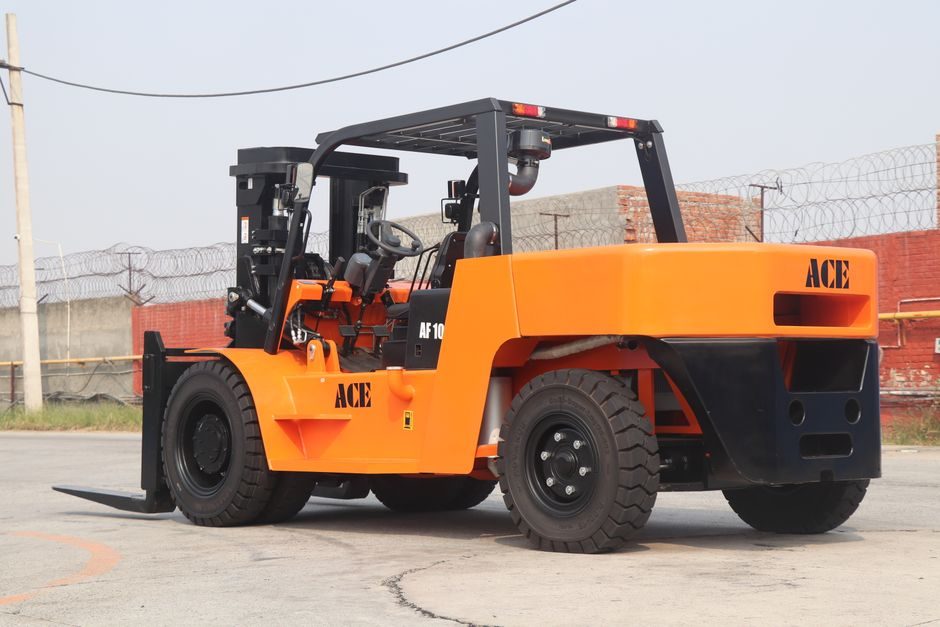
A 2026 rough terrain forklift is specified first by lift capacity band — 1.5-3.5 t, 5-10 t, and 10-12.5 t — and second by powertrain, with the 5-10 t segment now offering a high-voltage Li-ion option alongside legacy diesel [S8]. Buyers who skip the capacity band and go straight to brand usually overpay by 15-30% for a chassis that is either oversized or underbuilt for the site.
This guide is written for procurement engineers, site-fleet managers, and rental-yard owners comparing 4WD masted forklifts on construction sites, lumber yards, masonry yards, and agricultural loading bays. It is not aimed at warehouse buyers — a standard forklift on cushion tyres is the wrong tool on broken ground, and a rough terrain forklift is wasted capital on smooth concrete.
Capacity bands and what each one is actually for
The 2026 market has consolidated into three working bands. The 1.5-3.5 t band covers masonry yards, landscaping supply, and smaller tree-care operations, with lift heights typically 3000-6000 mm for the 1.5-1.8 t class and 2700-6500 mm for the 2.5-3.5 t class [S8]. Hangcha's XF series sits in this band with a 1.5-1.8 t variant and a 2.5-3.5 t variant sharing the same chassis family but with different mast and counterweight packages [S8].
The 5-10 t band is the workhorse for construction supply yards, timber terminals, and large agricultural cooperatives, with 3000-7000 mm lift heights and the widest model spread on the market [S8]. Above 10 t the market thins out: Harlo's 10-FIVE and 12-FIVE are 10,500 lb (≈4,763 kg) and 12,500 lb (≈5,670 kg) class machines respectively, marketed at the Imperial-rated North American capacity ceiling [S4]. For buyers who routinely handle 5,000 kg coils or 6,000 kg concrete blocks, the 8,500 lb HP8500 and the 10,500 lb 10-FIVE bracket the practical decision point [S4].
Buyers should ignore "1T-5T" range headlines (a common Chinese export listing style — see [S2] XCPCY 50) unless the dealer breaks out the load chart at full lift height with the mast tilted forward. A machine rated 5,000 kg at 600 mm load centre is not the same machine as one rated 5,000 kg at 1,200 mm load centre, and the latter loses roughly 25-35% of its capacity at full lift.
Diesel vs high-voltage Li-ion: the 2026 powertrain split
Diesel remains the default for rough terrain work because of high torque at low rpm, mechanical simplicity, and the ability to refuel in 5 minutes versus a 1-2 hour DC fast-charge window on Li-ion. JCB, Hangcha XF, Manitou, and Ausa all continue to ship diesel-first product lines in 2026, with Kubota and Cummins small-displacement engines (2.5-3.8 L, 4-cylinder, Tier 4 Final / Stage V) dominating the under-5 t segment [S6][S8].
Hangcha's XH Series high-voltage rough terrain forklift covers 1,500-3,500 kg at 3000-6000 mm lift height and is the clearest 2026 signal that Li-ion has moved from warehouse to off-highway [S8]. The trade-off is real: high-voltage packs add roughly 400-600 kg of chassis mass, which costs some residual capacity and raises the centre of gravity, but they eliminate diesel exhaust on indoor-outdoor sites (vegetable cold stores, livestock barns, covered timber halls) where a diesel forklift is either banned or requires expensive fume extraction.
For most outdoor construction and yard work the diesel 4WD is still the right answer. For mixed indoor-outdoor sites with 4-6 hours of continuous operation per shift, the Li-ion XH-class has a credible payback case at 1,800-2,400 operating hours per year when diesel fuel and AdBlue are priced in.
Drivetrain, tyres, and ground clearance: the under-spec'd levers
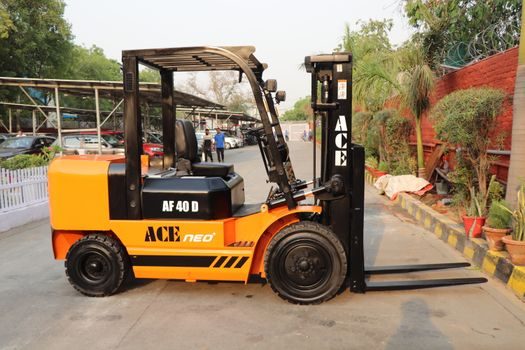
Three drivetrain specs separate a real rough terrain forklift from a paved-yard forklift with knobby tyres: 4WD with differential lock, portal axles or high ground clearance (typically 250-350 mm), and aggressive lug tyres (12.0-16.5 or larger). JCB's rough terrain range explicitly markets 4WD and high ground clearance as baseline features, not options [S6]. Without portal axles, a 2.5 t machine high-centres on a 200 mm kerb and becomes useless on a rough site.
Two more under-spec'd items: turning radius and gradeability. JAC's military-pattern rough terrain forklift lists max speed 80 km/h and gradability 45% (≈24°) [S7]. Those numbers are best-in-class and not what a yard forklift will give you — a standard 2.5 t diesel rough terrain typically delivers 20-30 km/h and 25-35% gradability. Buyers who actually climb unmade quarry access roads should write 30%+ gradability into the spec, not just "4WD".
For a like-for-like decision, the skid steer loader competes on the same jobsites below 1,500 kg lift and beats a forklift on bucket work, but loses on palletised load speed and lift height — a useful boundary check before you commit the budget.
Mast, fork carriage, and hydraulic attachments
Two-stage masts (3,000-6,000 mm) cover 80% of yard work. Three-stage full-free-lift masts (4,500-7,000 mm) cost roughly 8-15% more and earn their money in container-loading and high-rack warehouse-edge yards. Hangcha's 5-10 t class offers 3000-7000 mm lift, with the upper end of the range almost always a three-stage mast [S8].
Side-shift and fork positioner are standard on Hangcha XF/XH and on most JCB rough terrain builds; they should be spec'd as standard, not as costed options, because adding them later typically means a new carriage and a recalibrated hydraulic valve block. Quick-change hydraulic couplers for buckets, jibs, and clamps are increasingly common on the 2.5-3.5 t segment — relevant for buyers cross-shopping with telehandlers and wheel loaders.
For a side-by-side on how a rough terrain forklift compares to a telehandler-style aerial work platform on the same site, the rough terrain forklift vs aerial work truck 2026 spec cut is a useful reference when the lift height goes above 6 m and people start asking why you didn't just buy a telehandler.
Sourcing, standards, and total-cost check
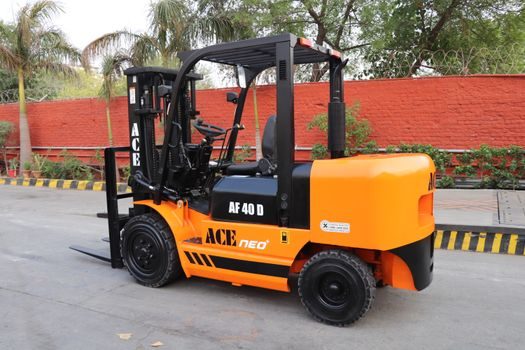
Three sourcing channels dominate 2026: OEM direct (JCB, Manitou, Hangcha, Ausa), North American specialty builders (Harlo, Hummerbee for compact/articulated), and Chinese export (XCPCY, Goodsense, MASTER) [S2][S3][S4][S6][S8][S9]. Chinese export pricing for a 2.5 t 4WD diesel sits roughly 30-45% below JCB/Manitou list, but parts lead time, emissions documentation for EPA Tier 4 Final / EU Stage V, and residual value on a European or North American job site are the real cost gap. MASTER's listing claims 10,000 units per year supply ability across diesel, gasoline, LPG, electric, and rough terrain classes [S3] — useful as a scale sanity check on the export channel.
For EPA-bound machines, insist on a Tier 4 Final emissions plate and the corresponding EU Stage V plate for cross-border resale; a Tier 3 / Stage IIIA export machine cannot be registered in a regulated market without a repower. For CE-marked machines, EN 1459 (industrial trucks — safety, rough-terrain variable-reach trucks) and ISO 5053-1 (terminology) are the two standards that show up on the EU declaration of conformity. Operator training in most regulated markets now requires a recognised rough-terrain forklift certificate separate from a standard counterbalance ticket.
Two trackable signals to watch in the second half of 2026: Hangcha's XH high-voltage rollout beyond Europe into North America (currently 3000-6000 mm lift, 1,500-3,500 kg) [S8], and any Tier 5 / Stage VI emissions revision that would reset the residual-value curve on 2024-2026 diesel builds. For buyers sizing a new yard fleet, a 5-10 t diesel XF and a 2.5-3.5 t XH Li-ion covers the majority of mixed construction-yard duty cycles at the lowest 5-year total cost of ownership.
For component-level specifications, see linear guide.