
Skid steer loaders in the 2026 retail channel span a 1,311 kg to 6,448 lb (2,925 kg) operating-weight envelope, with rated operating capacities from 345 kg on the Bobcat S70 to 940 kg on the Zhejiang Hero Time HT65A [S2][S3].
Selection in 2026 hinges on three engineering decisions before price: matching operating weight to the heaviest attachment's rated load, confirming hydraulic auxiliary flow against the demanding tool (breaker, cold planer, auger), and locking the coupler interface so existing fleet tooling fits. Buyers who skip those gates end up with a machine that either cannot lift its own attachment or cannot run the work tool they actually need.
Operating Class and Tonnage Bands
The compact end is anchored by the Bobcat S70 at 2,892 lb (1,311.8 kg) operating weight, 760 lb (345 kg) lifting capacity, and a 23.5 hp Tier 4 engine — a footprint designed for landscaping crews, indoor demolition, and backyard hardscape work where a full-size machine cannot enter [S2]. Above it sits a mid-band exemplified by the KATO IMER AS28 at 6,448.5 lb (2,925 kg) operating weight and 64.58 hp, a class that pairs a 2,130 mm sweeper attachment width with road-building auxiliary capability [S1][S4]. The Chinese-market HT65A slots in at 2,072.3 lb (940 kg) with a 63.9 hp Perkins 804D-33 at 2,500 rpm and Sauer-Danfoss hydraulics, illustrating the lightweight tracked segment now being exported [S3].
For buyers cross-shopping platforms, the wheel loader class table is the correct reference for the next size up; skid steers remain the right tool below roughly 100 hp because of their zero-radius turning and attachment density. Class also dictates transport: anything under about 2,200 kg can run on a 7,000 lb GVW tag trailer without a CDL in most US states, while the 2,925 kg AS28 crosses the threshold that triggers DOT commercial licensing.
Rated Operating Capacity vs Operating Weight
Rated operating capacity (ROC) is the figure that should drive purchase, not operating weight. The S70 lifts 345 kg against a 1,311.8 kg chassis (26.3% of operating weight), while the HT65A lifts 940 kg against 940 kg of chassis — a 1:1 ratio [S2][S3].
Bucket pricing in 2026 ranges from roughly US$280-385 per piece at 50-unit MOQ for general-purpose shells out of Shandong, up to US$19,500-54,250 for heavy-duty units out of Anhui — and the bucket mass itself eats into the ROC envelope [S9]. Buyers should always ROC-check the heaviest attachment (breaker, snowplow, sweeper) plus a 75 kg operator, then add 10% margin for uneven load distribution. The backhoe loader comparison sheet is the right cross-reference when the jobsite demands dig depth the skid steer cannot deliver.
Engine Tier, Powertrain, and Hydraulics
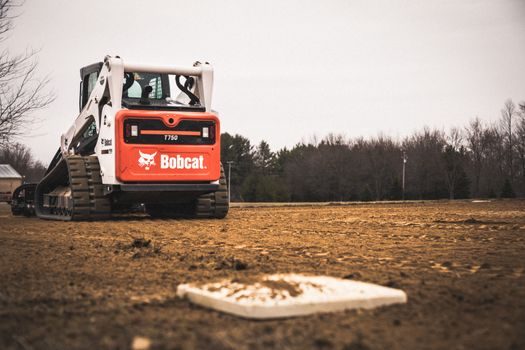
All four OEM data sheets published in 2026 specify Tier 4 diesel packages: 23.5 hp on the S70, 63.9 hp on the HT65A, and 64.58 hp on the AS28 [S2][S3][S4]. The HT65A pairs its Perkins 804D-33 (3.3 L displacement) with Sauer-Danfoss hydraulic components sourced from the US, and offers an additional pump option for high-flow attachments [S3].
High-flow auxiliary hydraulics are a separate line item on most quotes. A standard-flow circuit at roughly 60-70 L/min runs a 24-inch auger or a light sweeper; a cold planer, trenching head, or hydraulic breaker typically demands 90-115 L/min. The AS28 datasheet explicitly lists a hydraulic breaker, crusher bucket, concrete bucket, and trenching head as in-range options — confirmation that the platform's standard and high-flow circuits were sized for demolition tools from the factory, not retrofitted [S4]. Buyers should request the published flow-vs-pressure curve, not just the peak figure, because continuous-load attachments derate on the curve's flat section.
Coupler Interface and Attachment Ecosystem
Coupler standard is the single most common retrofit cost. Bobcat's Bob-Tach system remains the de facto industry interface, and the S70 explicitly uses it to allow fast attachment changes [S2]. The KATO IMER AS28 datasheet confirms compatibility with a wide range of dedicated buckets, snowplow blade, sweeper-with-bucket, brushing attachment, hydraulic breaker, crusher bucket, concrete bucket, grippers, pallet forks, bale fork, and trenching head [S4].
For mixed-brand fleets, hydraulic quick- couplers (skid-steer pattern) are now near-universal among Chinese OEM attachments, and buckets ship at scale: 50-piece MOQ at US$280-385 puts a general-purpose bucket under US$10/kg of steel [S9]. Buyers running mixed-brand fleets should still confirm auxiliary circuit flat-face face-seal vs pioneer couplings, because cross-brand leaks at the hydraulic disconnect are the most common field complaint on rented attachments. The wheel loader 2026 buyer's spec table is useful for sizing the next-step-up bucket class once ROC is exhausted.
New vs Used and Total Cost of Ownership
The 2026 used market carries 46+ Bobcat skid-steer listings on Construction Equipment Guide alone, anchored by the S86 model [S8]. New 2026 retail listings on the secondary channel include tracked mini skid steers at 13.5 hp (Briggs & Stratton) and 22.1 hp (Honda) from RMB 23,733 to RMB 47,476 — these are the entry-level tracked units aimed at rental fleets and owner-operators [S5]. The Bobcat Company 2026 retail site offers a Classic-or-Pro split across the new skid-steer range, with Build & Quote configurators exposed for both lines [S6].
For 2026 model-year retail, expect Tier 4 final emission hardware (DOC + DPF, no SCR on sub-75 hp platforms) as standard. Used pricing is driven by hours and emission tier: pre-Tier 4 machines (pre-2014 in most cases) trade at 40-55% of original list because they cannot be sold into Tier 4-regulated sites. Total cost of ownership on diesel skid steers is dominated by fuel (roughly 30-35%), scheduled service (20-25%), and DPF regeneration cycles on Tier 4 units (an often-overlooked 5-8%).
Decision Matrix by Job Site
Landscaping, fence-line work, indoor demolition: sub-1,500 kg class, 23-30 hp, standard flow, Bob-Tach — the S70 footprint [S2]. General construction, road work, sweeper duty: 2,500-3,500 kg, 60-75 hp, high-flow hydraulics, sweeper widths up to 2,130 mm — the AS28 envelope [S1][S4]. Light export and rental fleet: 940 kg tracked, 63.9 hp, Sauer-Danfoss hydraulics, 1:1 ROC-to-weight ratio — HT65A segment [S3]. Demolition-only sites: add hydraulic breaker compatibility verification, high-flow circuit confirmation, and DPF service interval check before any quote is signed.
For buyers also sizing earthmoving equipment, the backhoe loader vs road roller spec cut is the right next reference once the skid steer's reach becomes the constraint. Similarly, the excavator 2026 price and cost guide is the correct cross-reference for dig-depth work the skid steer cannot perform.
Market Context and 2026 Sourcing Signals

The global skid steer loader market was estimated at US$10.2 billion in 2024 and is projected to grow through 2035, with North America, Europe, and Asia-Pacific as the primary regional demand centers [S7]. The Bobcat Company — which invented the skid-steer loader — now offers more than a dozen models across the lineup, a 50-year lineage that the 2026 retail site emphasizes through its Classic and Pro split [S6][S8]. Bobcat's parent organization also continues to merchandise dedicated sweepers with working widths spanning 1,120 mm to 2,130 mm, which signals the attachment-tier demand is growing alongside the machine base [S1].
For 2026 sourcing, two signals are trackable: first, monitor Chinese OEM exports of 940 kg-class tracked units (Rippa RS03, RS04, RS06, RS07, RS10, RS20 are visible in the 2026 retail channel [S10]); second, watch Bobcat's Classic-vs-Pro configurator rollout, which is the clearest 2026 indicator of how the OEM is segmenting the small-frame buyer from the cab-comfort buyer [S6][S10]. Both are verifiable on manufacturer sites within the same week of publication.
For component-level specifications, see skid steer loader.