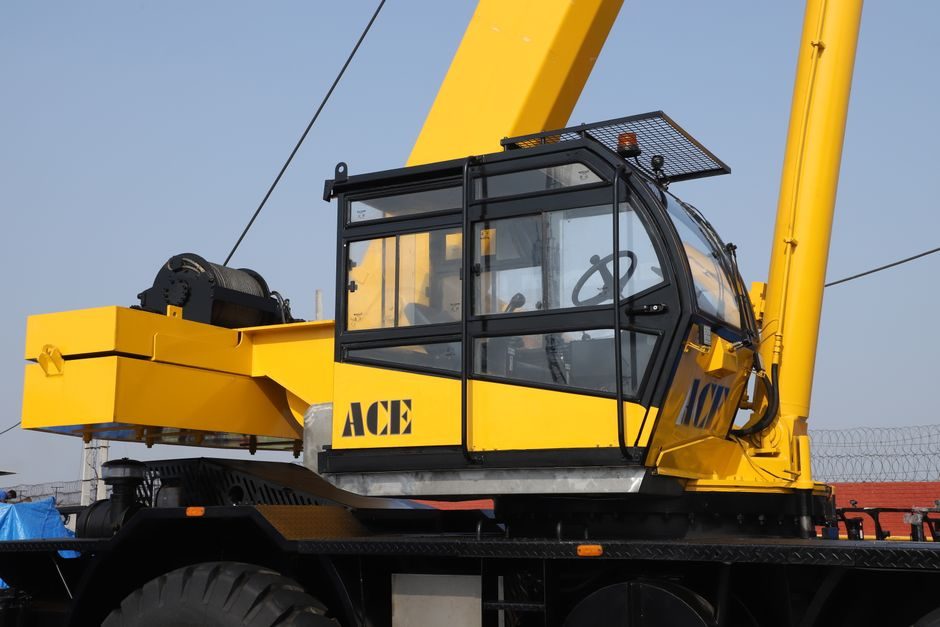
Rough terrain forklifts are 4WD diesel machines built for 1.5-10 t loads on mud, gravel and slope, with 3,000-7,000 mm mast lift and gradeability commonly quoted at 30-45% [S5][S6]. Aerial work trucks — articulated or telescopic — are mobile elevating work platforms (MEWPs) engineered to position workers at 6-30+ m platform height, with chassis platforms that often resemble a rough terrain forklift in 4WD and tire spec but serve a fundamentally different load: people plus tools, not pallets.
The selection mistake I keep seeing on industrial sites is buying an aerial work truck when a forklift is needed (or vice versa) because both share a yellow 4WD chassis aesthetic. The 2026 supplier catalogs in front of me make the divergence concrete: Hangcha XF/XH rough-terrain series run 1,500-10,000 kg load capacity with 2,700-7,000 mm lift, while Harlo's rough-terrain forklift line steps through 5,000 / 6,500 / 8,500 / 10,500 / 12,500 lb capacity points (≈2.27-5.67 t). On the boom side, XJ Machinery lists rough-terrain cranes, truck cranes, and aerial work platforms as a single product family, but rated for reach and platform, not pallet forks [S4].
Load Capacity vs Working Height — The Two Spec Axes
Rough terrain forklifts are specified on two numbers: load capacity at the mast in kilograms/pounds, and lift height in millimetres. Hangcha's XF 1.5-1.8 t series tops out at 6,000 mm lift, the XF 2.5-3.5 t at 6,500 mm, and the XF 5.0-10.0 t at 7,000 mm. The XH high-voltage variants cover 1,500-3,500 kg at 3,000-6,000 mm. The lower-capacity XCPCY 50 mini rough-terrain model from Okorder sits at 1-5 t load, 4,000 mm max lift, 210 mm min lift, with 1,300 mm forks — a useful data point because it shows the small-class machines still use the same physics envelope [S2].
Aerial work trucks are specified on platform height, outreach, and basket capacity (typically 200-400 kg of crew + tools, not tonnes of pallet). The JAC military off-road forklift data point of 80 km/h max speed and 45% gradability [S5] is a useful tell: a rough-terrain chassis is engineered to travel between work points carrying a load, whereas an MEWP is engineered to stabilise and elevate once on station. In practice this means an aerial work truck should be cross-checked against MEWP standards (e.g. ANSI A92.20 / EN 280 family) for boom deflection, platform load and emergency lowering, not against mast-load curves.
Tire, Drivetrain, and Ground Pressure
Rough terrain forklifts are characterised by high ground clearance, deep-lug pneumatic tires, and four-wheel drive with differential locks. Thompson Lift Truck's 2026 comparison describes them as built for "mud, gravel, slopes, and construction sites" with "high ground clearance, deep-tread tires, and four-wheel drive", versus large pneumatic tire forklifts that "handle moderately uneven outdoor surfaces such as asphalt, packed dirt, and scrapyards" [S6]. The Goodsense 3.0-3.5 t listing pitches the same envelope: "flexible hydraulic steering system" and "security to meet off-road conditions" [S5].
The Joyall 315/80R22.5 A888+ truck-tire SKU is illustrative of the kind of commercial-vehicle tire the rough-terrain forklift segment draws from: TBR-class, drive-position tread, designed for mixed on/off-road. Aerial work trucks typically spec narrower high-speed radials (closer to light-truck or van pattern) and a lower-profile chassis, because their stabilisers carry the vertical load at extension, not the tires. Specifying a rough-terrain forklift tire on a boom truck is wasted budget; specifying a road tire on a rough-terrain forklift is a stuck-machine waiting to happen.
Powerpack: Diesel, LPG, Gasoline, and the New High-Voltage Tier
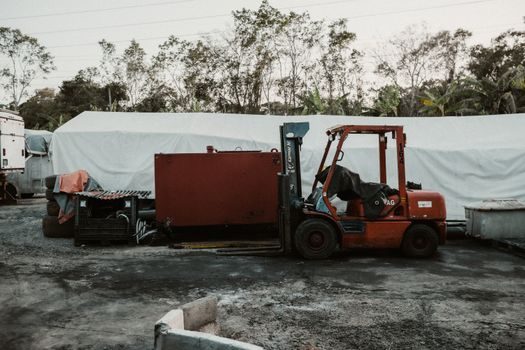
The 2026 China-side supplier mix on the forklift side is overwhelmingly diesel, with LPG/gasoline and electric options. SNSC's catalog page splits its line into "Diesel Engine Forklift / LPG Gas Forklift / Rough Terrain Forklift / Electric Forklift / Electric Reach Truck / Electric Stacker Truck / Telescopic Forklift / Telehandler / Backhoe / Wheel Loader / Skid Steer Loader / Electric Pallet Truck / Telescopic Boom Lifts / Aerial Working Platform" — meaning one factory covers both product families from a shared parts bin [S3]. MASTER Mini on eCVV lists fork lift, diesel, gasoline, LPG, electric, work platform and rough terrain forklift as parallel main products, with 10,000 units/year supply ability and 1-unit MOQ [S1]. The Fujian-based heavy-duty EPA-forklift supplier (Made-in-China factory #2 listing) likewise bundles "Heavy Duty Forklift, EPA Forklift Truck, Diesel Forklift, LPG Gasoline Forklift, Electric Forklift, Warehouse Equipment, Forklift with Attachments, Rough Terrain Forklift, Telescopic Forklift" — same factory, multiple SKUs.
Hangcha's XH high-voltage line — 1,500-3,500 kg at 3,000-6,000 mm — is the rough-terrain segment's clearest 2026 electrification signal, with the existing XF diesel line staying in production alongside. For aerial work trucks, electrification is also a 2026 theme (battery-driven booms), but it lives in the MEWP product family, not in the rough-terrain forklift tree. Buyers should keep the two powertrain decisions separate even when a single OEM quotes both.
Use-Case Selection: Which Machine for Which Job
Pick a rough terrain forklift when the unit load is on a pallet, in a stillage, on a pipe rack, on a block stack, or on a tow-hook, and the site is unpaved or partially graded. Pick an aerial work platform — including truck-mounted booms — when the work is performed by people, on a platform, with both hands free and a fall-arrest tie-off. The Hangcha XF 5-10 t class at 7,000 mm lift and the Harlo HP8500 / 10-FIVE / 12-FIVE 8,500-12,500 lb (3.86-5.67 t) class cover the heavy end of the rough-terrain forklift spectrum; the Goodsense 3.0-3.5 t [S5] covers the mid-rack lumber-yard / construction-yard use case.
For a balanced 2026 buying view of boom selection, the related Aerial Work Truck Buying Guide 2026 breaks down the same height/capacity/boom-type trade-off on the MEWP side. Cross-referencing it is worthwhile because boom type (articulating vs telescopic vs scissor) drives chassis and tire choices in a way that is invisible on a rough-terrain forklift spec sheet.
Comparison: Rough Terrain Forklift vs Aerial Work Truck on Four Criteria
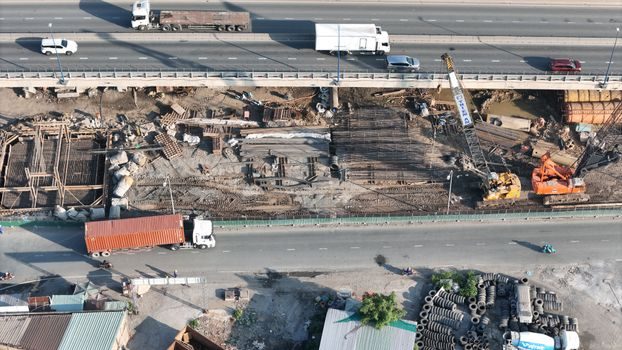
On a side-by-side decision matrix the four hardest criteria to reconcile are: (1) rated load — 1,500-10,000 kg palletised cargo on rough-terrain forklifts versus ~200-400 kg crew+tools on boom platforms; (2) working height — 3,000-7,000 mm mast lift on forklifts versus 6,000-30,000+ mm platform height on MEWPs; (3) chassis/tyre envelope — high-clearance 4WD with deep-lug pneumatic on forklifts [S6] versus stabiliser-dependent, road-biased tyres on boom trucks; (4) duty cycle — forklift duty is drive + lift in a 1:1 mix, MEWP duty is drive + park + elevate + hold + descend. Hangcha's XH high-voltage telehandler variant sits at the intersection: it uses the rough-terrain chassis but adds telescopic reach — useful when you need to place a load forward of the wheels onto a trailer or scaffold, not lift a person.
The XCPCY 50 [S2] and the Goodsense 3.0-3.5 t [S5] are at the small end of the rough-terrain forklift range and are the right reference units when comparing to compact MEWPs; a common procurement error is sizing a compact boom against a forklift's load capacity instead of against its platform rating, which results in a machine that can elevate the basket but cannot lift the pallets.
Limitations, Failure Modes, and What the Spec Sheet Hides
Rough terrain forklifts derate heavily with lift height and with slope: the headline 10,000 kg Hangcha XF 5-10 t capacity is at a low mast position; the actual capacity at full 7,000 mm lift is a fraction of that and is plotted on the truck's load chart, not the marketing spec. The 45% gradability quoted for the JAC military off-road forklift [S5] is typically a stall grade, not a continuous travel grade; continuous rating is roughly 60-70% of the stall figure, depending on surface.
Aerial work trucks fail in two modes the forklift operator rarely thinks about: (a) outrigger settling on soft ground during boom extension, and (b) platform swing/sway causing a fall-arrest event. Neither mode is captured by capacity-in-kg. A standard MEWP chassis (e.g. conforming to EN 280 / ANSI A92.20 family) requires wind-rating, manual force, dynamic and static load tests on the platform — none of which appear on a rough-terrain forklift datasheet. XJ Machinery's combined listing of rough-terrain cranes, truck cranes and aerial work platforms [S4] is a reminder that an "aerial work" chassis is a lifting platform, not a reach truck with a basket bolted on.
Standards, Sourcing Signals, and 2026 Verification Points
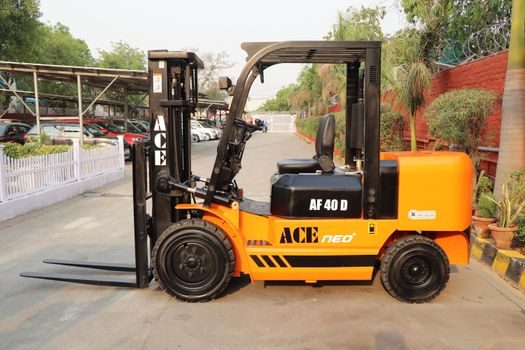
For procurement in 2026, three cross-checks against the cited catalogs are the highest-leverage verifications: (a) confirm the load chart matches the serial plate on Hangcha XF/XH units before shipment; (b) for EPA / EU-yard use, the Fujian "EPA Forklift Truck" SKUs carry the relevant engine-tier certification, and this should be requested as a paper document not a logo; (c) for boom platforms, request the MEWP conformity declaration (e.g. EN 280 / ANSI A92.20) and the stability test certificate — a paper trail XJ Machinery, as a manufacturer/Factory + Trading Company with ISO 9001 registration [S4], is set up to provide. Independent of the supplier channel, the rule of thumb is: rough-terrain forklift certifications prove lift and drive; MEWP certifications prove elevate-with-people, and the two stacks are not interchangeable.
Finally, on the buying-guide side, if the work has any dump-truck or haul-truck component (a common rough-terrain site), the Mining Dump Truck 2026 Buying Guide covers the payload/engine/frame/tire levers that complement, rather than overlap with, this cut. The two machine families — material handlers and elevated platforms — should be specified in parallel against the same site, with separate load charts, separate chassis decisions, and separate conformity stacks.