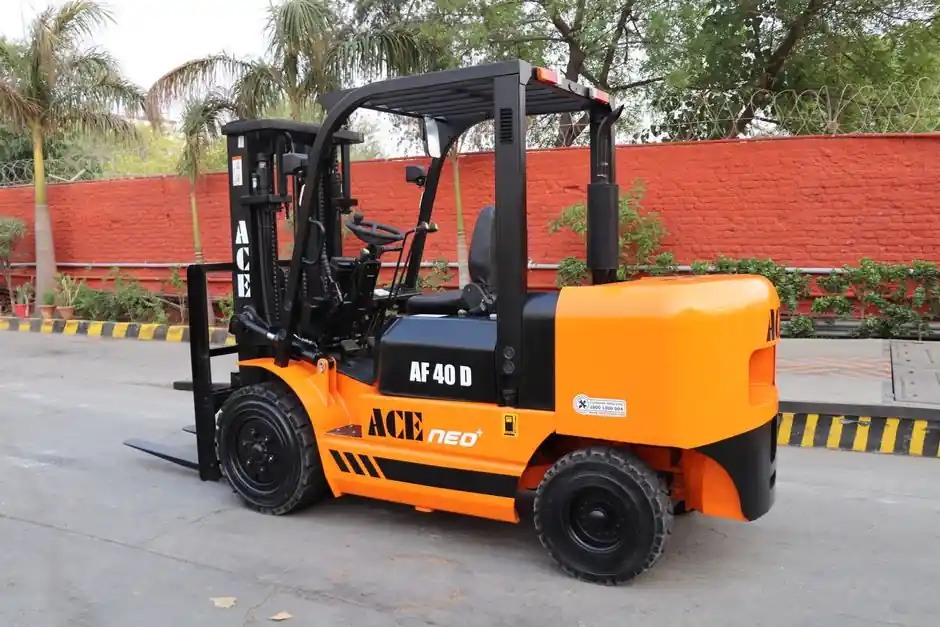
Rough terrain forklifts fall under Class VII in the OSHA/Industrial Truck Standards Development Foundation (ITSDF) 7-class system, and are further split into three sub-architectures: vertical mast, variable reach, and truck/trailer-mounted [S1][S3].
They are defined as heavy-duty outdoor machines with large flotation or oversized pneumatic tires, high ground clearance, and 4-wheel-drive capability, purpose-built for construction, lumber, agricultural, and military-yard work where paved surfaces are absent [S3][S4][S8]. Class V pneumatic-tire counterbalance trucks overlap them on construction sites, but only Class VII models carry the structural and drivetrain provisions for sustained off-road duty [S5].
Class VII vs the other 6 classes
OSHA 1910.178 and the ITSDF scheme sort powered industrial trucks into seven classes based on power source, operator position, and tire/environment, with Class VII reserved for rough terrain trucks and telehandlers, while Class I covers electric motor riders, Class II narrow-aisle reach trucks, Class III hand/rider pallet jacks, Class IV IC cushion-tire, Class V IC pneumatic-tire, and Class VI electric tow tractors [S5].
Training is class-specific under OSHA 1910.178(l)(3) and CSA B335-15, so a Class I or V operator certification does not legally cover a Class VII machine, a frequent audit finding on multi-fleet contractor sites [S5]. The 7-class framework is the same on both sides of the US-Canada border, originating from ANSI/ITSDF B56.1 in the US and adopted by reference in CSA B335-15 [S5].
3 rough terrain subtypes: mast, reach, mounted
OSHA's Powered Industrial Trucks eTool lists three basic rough terrain architectures: vertical mast, variable reach, and truck/trailer-mounted, the first two being self-propelled and the third designed to ride on or be carried by a host vehicle [S1].
The vertical mast type behaves like a traditional forklift, with a fixed upright and a vertical-travel carriage, while the variable reach type uses a telescoping boom (the same architecture as a telehandler) to extend loads forward and up; both run on oversized pneumatic or flotation tires with high ground clearance for uneven ground [S3][S8]. Truck/trailer-mounted units are typically deployed in military logistics, rail yards, and remote field camps where the host truck or trailer supplies prime-mover duty and the forklift is a stowable work module [S1].
Spec criteria: 4 dimensions to compare
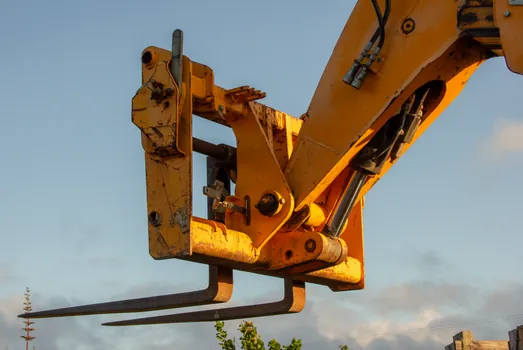
Four criteria separate the Class VII options in practice: lift capacity (typically 2,500-8,000 lb / 1,100-3,600 kg for vertical mast units, higher for telehandlers), maximum lift height (vertical mast commonly 10-30 ft, variable reach 15-55+ ft), powertrain (diesel dominant, with LPG and select electric options emerging), and tire/axle configuration (2WD vs 4WD, single vs dual front, pneumatic vs solid versus polyurethane-tread flotation) [S4][S5][S7].
On a criteria-based comparison, a vertical-mast rough terrain forklift scores best on tight-yard maneuverability and lower acquisition cost, a variable-reach telehandler-style Class VII scores best on forward reach and placing loads at height on second-storey decks, and a truck/trailer-mounted unit scores best on rapid deployment and inter-site transport without a lowboy trailer, but worst on continuous-cycle yard throughput [S1][S3]. Buyers writing RFQs in 2026 should weight those four criteria against the ground profile (mud, gravel, slab, slope) and the dominant duty cycle (load-and-carry vs placement-at-height vs spotting trailers).
Tire, ground clearance, and OSHA hazardous-location codes
Tires are the defining hardware difference between a Class V and a Class VII truck, with Class V running standard pneumatic tires on finished surfaces while Class VII uses oversized pneumatic or dedicated flotation tires to reduce ground pressure on soft soil and graded gravel [S3][S4][S8].
OSHA also overlays letter codes on top of the 7-class system for hazardous (explosive atmosphere) locations: D for diesel, DS for diesel with spark-arrestor, DY for diesel with fire-safety features, E for electric, ES for electric with spark-arrestor, EE for enclosed electric, EX for explosion-proof electric, G for LPG/gasoline, GS for gas with spark-arrestor, LP for LPG, and LPS for LPG with spark-arrestor, which matter when a Class VII is specified inside a fuel-handling yard or grain elevator rather than open ground [S5].
Who a Class VII is for, and who it is not
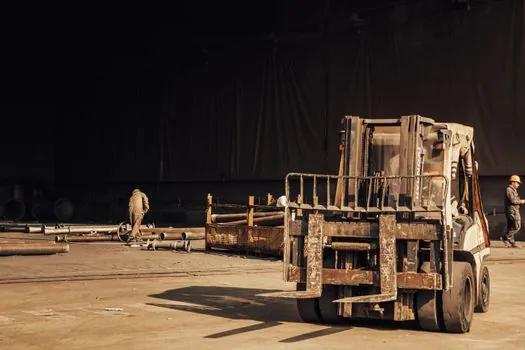
A Class VII is the right pick for builders, lumber yards, masonry suppliers, agricultural operations, military logistics, and any crew moving 2,500 lb+ loads across unimproved ground on a recurring basis, and the wrong pick for an indoor warehouse, a finished-floor retail back room, or a food-grade cold store, where Class I or III electrics dominate and where combustion exhaust or tire-shed debris becomes a compliance problem [S3][S4][S8].
Rough terrain forklifts are also distinct from, but often confused with, telehandlers, which share Class VII status and 4WD drivetrains but extend loads via a boom rather than a fixed mast, so the term "rough terrain forklift" on a quote can legally mean either depending on the OEM's spec sheet, and engineers should pin the architecture (mast vs reach) on the line item before signing [S5][S7].
Sourcing, training, and standards to pin on the PO
For procurement in 2026, pin ANSI/ITSDF B56.1 on the data plate requirement, OSHA 1910.178(l)(3) on operator training and evaluation, and CSA B335-15 on the Canadian side, with the relevant hazardous-location letter (D, DS, E, EX, G, GS, LP, LPS) called out if the unit will enter any area with flammable vapor, grain dust, or fuel spillage risk [S5].
Trackable signals for the next quarter: a) OSHA enforcement citations under 1910.178(l) for Class VII operation without class-specific training, the most common contractor fine category in 2024-2025 federal inspection data, and b) OEM release of lithium-powered Class VII variants, which would shift the dominant powertrain assumption away from diesel for indoor-to-outdoor lumber-yard applications. For a broader view of how Class VII equipment fits alongside other heavy iron on a job site, the 2026 backhoe loader selection logic write-up covers the contractor-fleet decision framework these machines sit inside, while the rough terrain forklift reference page consolidates the core spec vocabulary used throughout this article.
Spec-level background on the components involved: forklift, and construction machinery and equipment.