
OSHA Class VII rough terrain forklifts with 4WD, high ground clearance, and pneumatic tractor-style tires are the minimum credible host for fork-mounted snow plow duty in cold-climate yards, where lift capacity commonly sits in the 5,000–6,000 lb band and travel speeds can reach 24 mph on open lots [S3][S4][S7].
This selection scope covers Class VII vertical-mast and variable-reach units running on uneven, snow-packed, or partially frozen ground, typically diesel-powered, and paired with detachable fork-mounted plows sized to the host machine rather than to a dedicated plow truck [S1][S3][S6].
Baseline specification: what separates a snow-duty rough terrain forklift from a warehouse unit
Class VII rough terrain forklifts must combine four-wheel drive, high ground clearance, and pneumatic tires with deep tread to operate on snow, ice, gravel, and frozen ruts; the same combination is what permits safe travel on slopes that standard forklifts cannot hold [S3][S5].
Operating capacities for the typical Class VII unit land in the 5,000–6,000 lb range, while heavy-spec forklifts push 12,000–60,000 lb with forks up to 8 ft long, and the rough-terrain class is most often diesel-powered for cold-start reliability [S3][S4]. Travel speeds up to 24 mph on flat ground are realistic on current production models, which matters when plows have to reposition between buildings [S7]. The frame is heavier than a warehouse truck, with moving axles that keep all four tyres on uneven terrain, and a wide wheelbase to resist tip-over when a loaded plow catches a frozen curb [S3].
Slope and traction limits: when a rough terrain forklift is the wrong tool
Rough terrain forklifts can hold a slope that would tip a warehouse truck: published guidance puts the safe operating limit near 50% grade for a properly equipped Class VII unit, against a 10–15% grade ceiling for a standard sit-down counterbalance [S6].
That grade envelope is the single most misread number in cold-yard planning. On a 20% ramp covered in wet snow, a standard forklift is already past its limit even before the plow is attached, and operators tend to discover this the first time the rear axle breaks loose. A 4WD rough terrain unit with chains and a weighted rear block buys margin, but it does not buy physics: blade angle, plow weight, and windrow drift still need to be calculated against the same 50% ceiling [S6]. For sites that sit above that envelope, a skid steer comparison is the next conversation, because skid steers weigh 2,800–11,600 lb and have a much lower centre of gravity when fitted with a dedicated plow [S4].
Attachment match: fork-mounted plows and the host-machine envelope
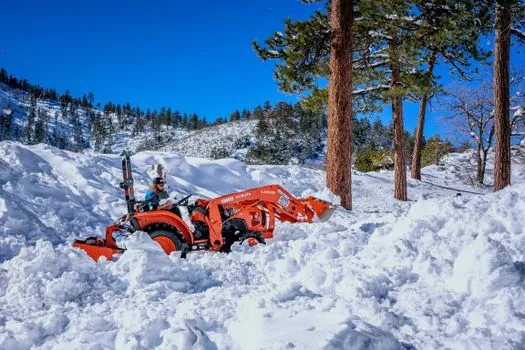
Fork-mounted snow plows slide onto standard forklift forks without permanent modification, install in minutes, and remove just as fast at season end, which is the structural reason a fleet can run one host machine for both material handling and snow duty from November to April [S1].
The match is not free. NovaLift's Ontario guidance specifies that plow weight, blade width, and the optional rubber or steel cutting edge must be sized to the forklift's lift capacity, hydraulic flow, and counterweight margin; a rubber edge protects asphalt through the freeze-thaw cycle, while a steel edge is the right pick on gravel or broken concrete where a softer blade would fold back and stall the host [S1]. Plows in the 6–10 ft class are the practical band for a 5,000–6,000 lb rough terrain unit, and going wider without a corresponding capacity bump simply levers the front axle off the ground under load. The same host can swap to a bucket, boom, or drum clamp when the plow comes off, which is why rental fleets price the base machine around $824 per week and treat the plow as a separate line item [S1][S4].
Selection criteria: a comparison map for snow-duty host machines
Four specifications separate a fit-for-purpose snow host from a warehouse truck with a plow bolted on, and the trade-offs line up directly against typical Ontario and Northern US site conditions. [S1]
Class VII rough terrain, 4WD, diesel: rated for ~50% slopes, 5,000–6,000 lb capacity, 24 mph travel, pneumatic tractor-style tyres, moving axles; the default pick for paved yards, lumber terminals, and large distribution pads where the same machine handles palletised freight in summer [S3][S4][S6][S7].
Class VII rough terrain, 2WD, diesel: same frame and clearance, lower acquisition cost, but traction on packed snow or a 15% ice-coated ramp is the limiting factor; a workable choice only on flat, treated lots under 5 acres [S3][S5].
Standard pneumatic-tire forklift, no 4WD: cheaper to rent, but slope-limited to 10–15% and prone to chassis bottoming out on rutted snow; acceptable for indoor loading docks with short outdoor apron runs under 50 ft [S5][S6].
Skid steer with plow attachment: lower centre of gravity, 760–4,200 lb capacity, much better on steep or uneven terrain, but loses the lift mast and pallet handling that a forklift brings; the right pick when material handling is a separate fleet function [S4].
Use cases: where the rough terrain forklift earns its keep in winter
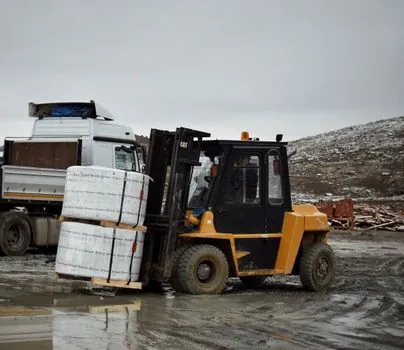
Ontario and Northern US yards with a 2–6 month snow season are the canonical use case: lumber yards in the GTA, distribution centres in Mississauga and Brampton, manufacturing plants with outdoor staging, and recycling or aggregate sites where a wheeled loader would scar the surface [S1][S2].
A second, less obvious case is the multi-tenant industrial park where a single host has to clear a shared lane and then unload a trailer in the same shift. Fork-mounted plows detach in minutes, so the same truck transitions from plow to forks without a second operator, and that single-operator flexibility is the operating-economy argument for picking a rough terrain forklift over a dedicated plow tractor [S1]. For sites with heavier snow pushing duties or longer throws, the forklift snow plow sizing guide maps blade width and weight to host capacity, which is the next decision once the Class VII shortlist is in hand. Mines and remote aggregate sites that already run rough terrain forklifts for year-round haulage typically just add the plow to the same machine, since the 4WD and moving-axle package is already paid for.
Operating limits and common failure modes
The three failure modes that show up every winter on under-spec units are brake fade on long downgrades, hydraulic freeze when the plow angle cylinder is left cycling in a sleet storm, and frame twist when an operator tries to back-drag a frozen windrow at full lift height [S1][S6].
Mitigation is mechanical, not procedural. A cold-weather hydraulic package rated for sub-zero start, an engine block heater, and a chains-on-rims policy for any sustained 15% slope are the field-proven baseline; pneumatic tyres lose roughly 1 psi of pressure for every 10 °F drop, so cold-morning inflation checks are the cheapest reliability gain on the list. Operator training is not optional: OSHA Class VII requires it, and the training has to cover the difference between a loaded and unloaded grade envelope, because the same 50% slope with a 6 ft steel-edged plow in front of a 5,000 lb truck is a very different machine than the one that drove onto the lot in summer [S3].
Trackable signals for the next planning cycle: OEM cold-weather hydraulic kit availability for 2026 model-year Class VII units, and any new OSHA interpretation letters on Class VII slope ratings with attached implements. Until those land, the rough terrain forklift base spec page and the general forklift selection reference are the working anchor points for the capacity, clearance, and tyre decisions that drive every snow-duty build sheet.
Spec-level background on the components involved: pressure transmitter.