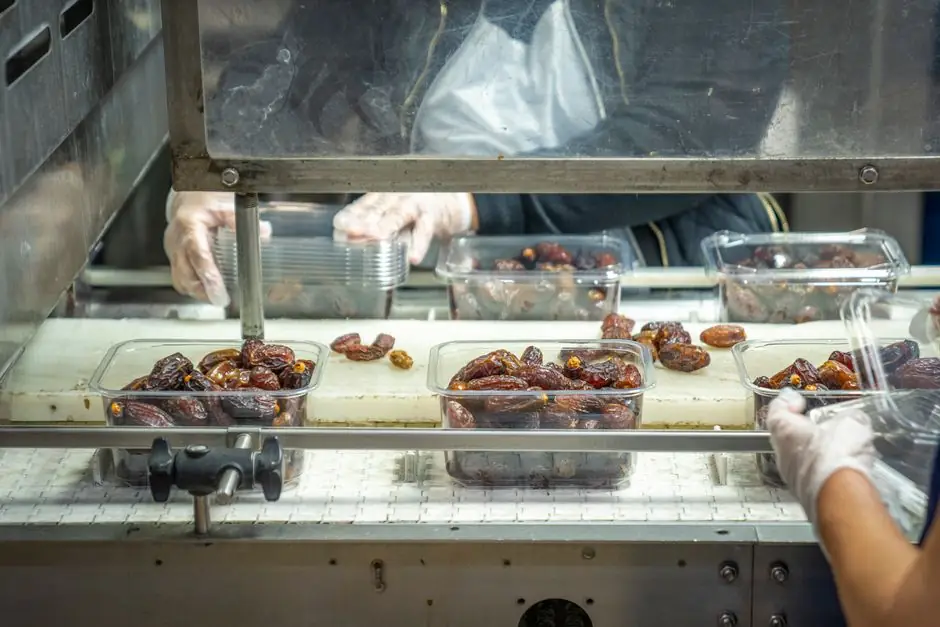
Specifying an RV reducer for a food and beverage line comes down to four load-bearing calls: housing material, lubricant class, seal compound, and ratio window, and most of the failures on a wet line trace back to one of these being misjudged [S2]. The default 2026 spec band is 304 stainless housing in general splash zones, 316L where chlorinated cleaner or brine is present, NSF H1 synthetic PAO or PAG grease, FKM double-lip seals with stainless garter springs, and IP66 sealing at minimum [S2].
For geometry, RV (rotary vector) and cycloidal-pin reducers deliver 30:1 to 100:1+ reduction in a single stage with zero-backlash options around 1 arc-minute, and they tolerate the 3–5× nominal torque spike a jammed PET bottle produces for about 200 ms under a filler star-wheel [S2]. Where the duty is light and ratios sit under 60:1, a worm-form RV reducer ground to DIN 3974 Class 7 still holds total backlash under 6 arc-minutes, which is the tolerance filling and case-packing OEMs ask for [S1].
Spec band: ratios, torque, and the service factor that decides frame size
Ratios for F&B conveyors, mixers and palletisers sit between 15:1 and 100:1 across published 2026 reference data, with the sweet spot for a 1,400 RPM motor driving a four-bar case-packer linkage between 15:1 and 30:1 [S1]. Output torque bands span 10 Nm on small NMRV050 units up to 1,200–1,500 Nm on NMRV063 frames for piston and auger fillers, with 200–500 Nm flagged as the typical mid-range for conveyor and mixer gearboxes [S1][S2][S3][S4].
Service factor is where most frames are mis-sized. The 2026 reference numbers for F&B are: 1.5–1.75 on cyclical-peak case-packing drives to absorb the insertion spike, 1.25 on steady gravity and overflow fillers, 1.5 on piston and auger fillers under pulsating load, and ≥1.5 on sorting machines with frequent start-stop cycles [S1][S3][S4]. Under-speccing the service factor is the leading documented cause of gear-tooth pitting in dairy wrap-around case packers after roughly 8 months in service [S1].
Food-grade is a material declaration, not a certification stamp
There is no single "food-grade" mark on a gearbox; the declaration is the trio of housing, lubricant, and seals, and each must be tendered separately [S2]. Housing defaults: 304 stainless for general splash zones, 316 stainless (often 316L with Ra ≤ 0.8 µm surface finish) for chloride, chlorinated cleaner, and brine exposure, and epoxy-coated or stainless-clad cast iron acceptable only in dry ingredient rooms where washdown is mop-and-hose rather than steam [S2]. Aluminium die-cast housings remain standard on the RV series in the 10–1,500 Nm band but require an epoxy topcoat or a stainless sleeve once the unit lives in Zone 1 wet process rooms [S1][S3][S4].
Lubricant: NSF H1-registered synthetic PAO or PAG grease is the only correct default for incidental food contact; white mineral oil is not H1-registered and fails the spec the moment a tender reviewer checks [S2]. Seals: NBR fails above roughly 100 °C steam cycles, so FKM (Viton) double-lip rotary seals with stainless garter springs are the only defensible call for daily foam and hot-water washdown, and a breather plug must be the sintered-bronze or stainless type with an internal lip because felt-only breathers wick moisture past the seal in under a year [S2].
Washdown envelope: pH 2–12, 80 °C steam, IP66 minimum
F&B washdown runs across a narrow but unforgiving envelope: pH 2 to pH 12 from citric, lactic, and chlorinated cleaners, steam cleaning up to about 80 °C, and 24/7 shift cycles on conveyors, mixers, and palletisers [S2]. Sealing classes map directly to this envelope: IP66 (dust-tight, 100 L/min water jets) is the documented minimum for shaft seals on washdown gearboxes, IP67 (1 m immersion, 30 min) is the next step up, and a felt-only breather drops the system below IP66 inside a year on a steam-cleaned line [S2].
For two practical zones, the 2026 spec lines read: Zone 1 wet process (rinse, bottle-washer, CIP return) calls for 316L housing, FKM seals, stainless fasteners, Ra ≤ 0.8 µm finish; Zone 2 dry-pack and palletising accepts 304 housing with epoxy topcoat when washdown is limited to daily mopping [S2]. The two failure modes that actually take gearboxes out of service in F&B are corrosion pitting around bolt flanges and seal-channel contamination, not gear wear, so the housing and seal spec deserves more engineering hours than the ratio table [S2].
Application fit: case packers, fillers, sorters
For wrap-around case formers running up to 25 cases per minute, an NMRV063 at 40:1 with a 1.5–1.75 service factor smooths mandrel synchronisation; one Shepparton dairy co-op eliminated 8-month pitting failures by re-specifying to this band [S1]. Filling machines split by viscosity: gravity and overflow fillers take a 7.5:1 to 100:1 ratio in a self-locking single-start range (≥20:1) at service factor 1.25; piston and auger fillers take the same ratio band but at service factor 1.5, with the worm drive's self-locking property preventing auger drift between fill cycles [S3]. A western Sydney BBQ sauce plant hit ±0.8 % dose accuracy on a 6-head gravity filler after an RV swap, against a ±3 % baseline, saving roughly AUD 45,000 a year in product giveaway [S3].
Sorting and grading is intermittent S4/S5 duty, so service factor ≥1.0 covers uniform loads and ≥1.5 covers frequent start-stop; upsize one frame where ambient temperature stays above 40 °C to keep thermal headroom [S4]. Documented results from 2026 references: a Mildura 4-lane optical citrus sorter dropped speed variance under 0.5 % and halved Class 2 rejects at 20:1, a Bundaberg macadamia optical sorter cut vibration 60 % and pushed detection accuracy to 99.2 %, and a Tasmanian potato rotary drum classifier ran two full seasons without bearing replacement after specifying IP65 NMRV063 with double-lip seals [S4].
Comparison: cycloidal RV vs worm RV on the F&B line

The two geometries overlap in ratio coverage but split on duty profile. Cycloidal-pin RV (the rotary vector family) covers 30:1 to 100:1+ in a single stage, hits zero-backlash options near 1 arc-minute, and absorbs shock loads 3–5× nominal during conveyor jams, which is the dominant failure mode on filler star-wheels and mixer startups [S2]. A worm gear reducer in the same RV series covers a wider 5:1 to 100:1 ratio band with up to 1,500 Nm output, ground to DIN 3974 Class 7 with total backlash under 6 arc-minutes on standard units, and adds the self-locking benefit that prevents auger drift on powder fillers and holds case-packer mandrels in position on power-off [S1][S3].
Decision rule: specify cycloidal-pin RV where shock load, single-stage ratio above 30:1, or zero-backlash near 1 arc-minute is required; specify worm-form RV where self-locking, ratio flexibility down to 5:1, and lower cost matter more than shock margin. For an industrial gearbox selection that also has to clear a washdown audit, both geometries converge on the same 304/316 housing, FKM seal, NSF H1 grease, and IP66 spec line; the geometry choice is a duty choice, not a hygiene choice [S2].
Who this is for, and where it fails
This spec band fits conveyor drives, mixers, palletisers, case packers, gravity/piston/auger fillers, and optical or weight sorters in F&B plants running daily washdown up to 80 °C with pH 2–12 chemistry [S2]. It does not fit explosion-risk zones where a dust-ignition-proof or ATEX/IECEx-rated enclosure is required (the published 2026 reference does not list ATEX/IECEx certification for the RV series in the F&B spec line), nor does it fit sub-zero cold-room or freezer duty where lubricant pour point and seal elasticity become the limiting factor [S1][S2][S3].
Limits to respect: shaft seals sit at IP66 to IP67 maximum on standard units, ambient above 40 °C requires a frame upsize on sorters, and breather plugs must be sintered bronze or stainless with an internal lip rather than felt, which is a frequent audit finding in field failures [S2][S4]. For adjacent spec work outside F&B, the RV reducer selection for steel mills and RV reducer selection for cement plants maps cover the higher-temperature, dust-laden, and heavy-shock variants of the same gearbox family.
Trackable signals to watch between now and the next spec refresh: whether any major F&B OEM tender in 2026 starts requiring NSF H1 registration on the breather as well as the lubricant, and whether IECEx certification enters the published RV-series compliance list for combustible-dust zones. Both would shift the default 2027 spec band, and both are currently absent from the 2026 reference data [S1][S2][S3][S4].