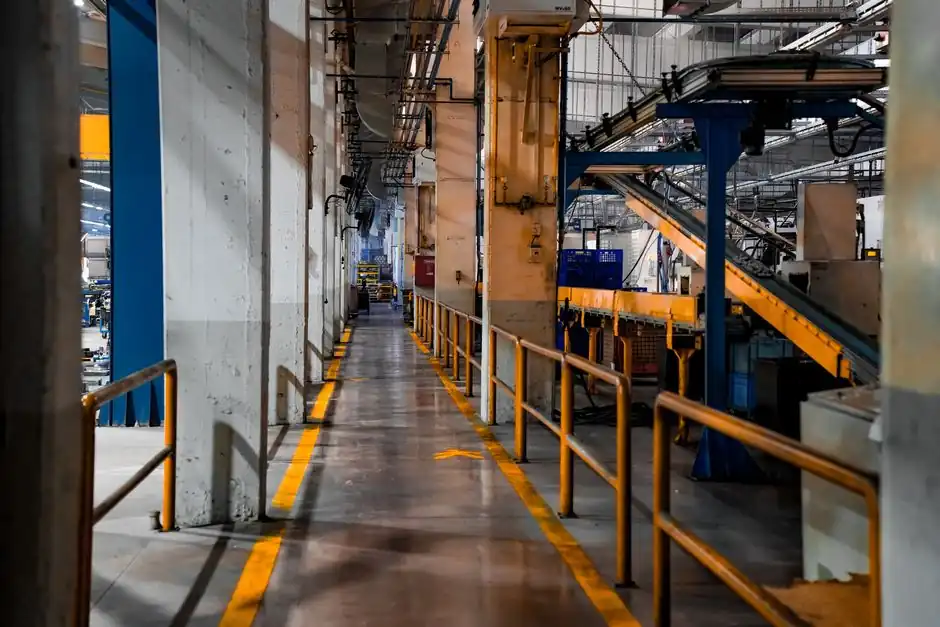
A warehouse guarding scheme that meets OSHA 29 CFR 1910.217 and modern IEC/ISO practice pairs a 2-pole, positive-opening safety interlock switch on every access door with a dual-channel safety relay rated PL e / SIL 3, then layers a trapped-key interlock chain on any cell where stored energy must be locked out before entry [S1][S2].
Scope of this map: guard-door interlocks on conveyors, AS/RS aisles, robotic pick cells, palletizer fences, and the upstream power-isolation disconnect for each guarded zone. It does not cover personnel detection (light curtains, safety mats) or forklift traffic management, which are separate disciplines even though they share the same machine safety control panel.
What a Safety Interlock Switch Actually Does in a Warehouse
A safety interlock switch is a position-monitoring device on a guard door, hatch, or access panel whose contacts are mechanically linked to the guard, so the contacts can only change state when the guard is fully closed and locked [S1].
In a warehouse, the guard is typically a swinging door on a conveyor tunnel, a sliding gate on a robotic pick cell, a hinged panel on a palletizer fence, or a swing-out guard on an AS/RS shuttle aisle. The switch does not stop the machine on its own; it tells a safety relay, or a safety PLC, that the guard is closed, and only then allows the hazardous motion to be re-energised after a manual reset [S2]. The defining feature versus a standard limit switch is positive (forced) opening: per IEC 60947-5-1, the NC contact is mechanically forced open by the actuator, so a welded contact cannot be held closed by spring failure or contact welding [S2].
Standards That Drive the Selection
OSHA 29 CFR 1910.217 is the U.S. baseline for mechanical-power-press guarding and is the citation most often extrapolated to warehouse conveyor and palletizer guarding; it requires that interlocks prevent cycle initiation when the guard is open, stop hazardous motion immediately on guard opening, and block restart until the guard is closed and a manual reset is performed [S2].
Layered on top are industry standards the compliance auditor will look for: ISO 13849-1 (PL a-e) and IEC 61508 (SIL 1-4) define the safety integrity target; IEC 60947-5-1 defines the positive-opening contact construction; ISO 14119 defines the selection of interlocking devices, including tamper-resistant, coded, and trapped-key variants. For U.S. power isolation, the enclosed safety switch on the line side of the guarded zone is built to UL 98 and NEMA KS-1 / KS-2, and Heavy Duty "F-Series" designs such as the Square D by Schneider Electric line are rated 30-1200 A, up to 600 Vac or 600 Vdc, with 200,000 rms symmetrical amperes short-circuit withstand [S3]. IEC 60204-1 and NFPA 79 fill in the electrical-installation gaps on the cabinet side [S2].
Switch Types and How They Compare on Decision Criteria
For warehouse doors, the four practical switch families are cam-operated, coded-magnetic, hinge-pin, and trapped-key; the choice is driven by defeat resistance, holding force, and how many doors are in series [S1][S2].
Cam-operated (mechanical) switches with a positive-opening NC contact and a separate NO for monitoring are the default on swinging guard doors where a coded actuator is preferred because it cannot be defeated with tape, wedges, or a screwdriver. Coded-magnetic switches (non-contact, reed or electronic) suit hinged panels and small flaps where a mechanical actuator is hard to mount, and they tolerate misalignment and vibration better than cam types, but historically offered lower PL ratings; current generation coded-magnetic units are widely available at PL d / SIL 2 and higher. Hinge-pin switches mount inside the door hinge and report door position via the hinge rotation, ideal for swing-out guards where an external actuator would be exposed to forklift impact. Trapped-key interlocks such as the Allen-Bradley 440T Access & Chains family are not position sensors; they enforce a sequence, the key is trapped in the guard switch until the upstream isolator has been opened, then released to the next lock, so the operator cannot reach a hazard until the energy has been mechanically locked out [S4].
A practical selection table looks like this:
Type | Defeat resistance | Typical PL/SIL ceiling | Best fit in warehouse / Cost band
Cam-operated, coded actuator: high (mechanical key shape); PL e / SIL 3; standard conveyor and palletizer guard doors / low
Coded-magnetic, non-contact: medium-high (coded); PL d / SIL 2 typical, PL e variants exist; small flaps, frequent-cleaning zones, washdown / medium
Hinge-pin switch: medium; PL d; swing-out guards with no external mounting surface / low-medium
Trapped-key interlock chain: very high (mechanical sequence); PL e when used with monitored switches; high-energy cells, shared handover between conveyors and robots, full LOTO / medium-high [S2][S4]
Wiring Architecture: 2-Pole Series, Safety Relay, No PLC-Only Safety
The OSHA-compliant architecture for a multi-door warehouse cell is two independent series strings of NC contacts feeding a dual-channel safety relay that drives a master control relay (MCR), with the PLC wired in parallel for monitoring only, not for the safety decision [S2].
String A and String B are wired from each door's two NC contacts in series to the safety relay's two input channels; the relay cross-checks the two channels for agreement and detects a welded contact via disagreement. If the two strings disagree, the relay drops the MCR and holds it off until a manual reset. The safety relay itself must be a dual-channel monitored type with positive-guided contacts, not a standard machine control relay, and it must be rated to the PL/SIL the risk assessment requires; for warehouse palletizers and robotic pick cells the practical target is PL e / SIL 3, which corresponds to dual-channel, monitored, positive-opening hardware and a Category 4 / SIL 3 logic solver [S2]. The PLC taps into the door state for HMI indication and event logging, but is never the sole interlock: a PLC fault, network drop, or scan-time overrun cannot be allowed to defeat the safety function. The corresponding safety certification paperwork (declaration of conformity, SISTEMA or PAScal calculation) is built from the same architecture, not from PLC logic.
For cells with long stop times, a cycle-stop relay variant lets the safety relay drop only the process actuators while the MCR stays energised in a safe-stopped state, so a guard can open once zero-speed is confirmed by an independent sensor. This is useful on large conveyor loops where coast-down is many seconds, but it adds a sensor and a second logic function that must also be safety-rated [S2].
Power Isolation: Heavy-Duty Enclosed Safety Switch Upstream of the Zone
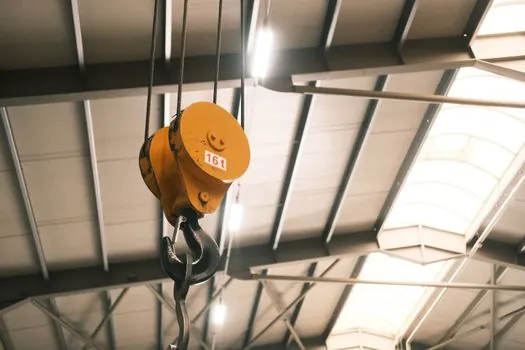
Each guarded zone needs a lockable, visible-blade disconnect upstream so a maintenance crew can achieve visible isolation and apply their padlock without entering the cell; in a warehouse this is typically a heavy-duty enclosed safety switch on the conveyor drive, the robot controller, or the palletizer hydraulic cabinet [S3].
The accepted U.S. spec is UL 98 (file E2875 for 30-200 A, E154828 for 400-1200 A) plus NEMA KS-1 / KS-2, with Federal Specification WS-865C for Type HD; the Square D F-Series catalog quotes 30-1200 A, up to 600 Vac or 600 Vdc, 200 kA rms symmetrical short-circuit withstand, quick-make / quick-break mechanism, dual cover interlock, and color-coded indicator handle as standard features, and the design life is rated at a minimum of three times the NEMA KS-1 endurance cycle requirement [S3]. The dual cover interlock is the property that matters for warehouse safety: the cover cannot be opened while the handle is in the ON position, and the handle cannot be turned ON while the cover is open, which prevents the classic defeat where a door is opened to access a live line lug. For European builds, IEC 60947-3 with a padlockable rotary handle and a safety fence door interlock on the drive cabinet door plays the equivalent role, and the enclosure is typically coordinated with the cell's IP rating (IP54 for dry warehouses, IP65 for cold-store or washdown zones).
Warehouse-Specific Hazards: Conveyors, AS/RS, Robotic Cells, Cold Store
Conveyor guard doors are the highest-count interlocks in a typical warehouse and are the ones most often defeated with tape after a nuisance trip; the spec response is a coded actuator (not a plain key) plus a hinged-bracket mounting so the actuator is sheared off, not just bent, on impact [S1][S2].
AS/RS shuttle aisles and stacker-crane access panels need a trapped-key chain because the hazard is not just motion but stored gravitational energy in the load and the mast; a single-position switch is not enough, the operator must hand the key from the isolator to the access door to a maintenance lockout before the shuttle can be entered [S4]. Robotic pick cells and cobot stations need switch selection driven by the risk assessment, not by habit: collaborative-mode operations may allow a category 3 / PL d switch with periodic test, while a high-speed picker in fenced mode needs the full Category 4 / PL e treatment with dual-channel monitoring. Cold-store and washdown zones add a sealing requirement: coded-magnetic switches (IP67 / IP69K) are preferred over cam types because there is no mechanical keyway to freeze, and the cable entry must be rated for the temperature swing. Axelent-style modular partitioning is often used in parallel to the interlocks to keep pedestrians out of the cell, which reduces the interlock count but never the interlock rating: physical separation reduces risk, it does not change the safety integrity level of the doors that remain [S5].
Selection Checklist for a Warehouse Door Interlock

For each guard door on a warehouse cell, the following five-point check holds the design inside the OSHA / ISO envelope [S1][S2][S3].
1. Switch type: cam-operated with coded, shearable actuator for general doors; coded-magnetic for washdown / cold; trapped-key for stored-energy cells.
2. Contact configuration: 2-pole, positive-opening per IEC 60947-5-1, NC in series on each pole, NO for monitoring only.
3. Logic solver: dual-channel monitored safety relay (or safety PLC with PROFIsafe / CIP Safety), rated to the PL / SIL the cell's risk assessment demands, typically PL e / SIL 3 for robots and palletizers.
4. Reset: manual reset after every door-open event, hardwired, not implemented as a soft key on an HMI.
5. Upstream isolation: UL 98 / NEMA KS-1 heavy-duty enclosed safety switch (30-1200 A, 600 V, 200 kA SCCR), padlockable in OFF, with cover interlock, mounted within sight of the cell [S3].
Two signals to track in the next planning cycle: how often nuisance trips are recorded against each door (drives the cam-to-coded-magnetic retrofit decision), and whether the local authority having jurisdiction is auditing to ISO 14119 tamper-resistance in addition to OSHA 1910.217 baseline, which is becoming the more frequent finding on U.S. conveyor audits. For lab-scale cells using a different switch form factor, see the related map on Lab Safety Interlock Switch Selection: Type, PL, SIL and Holding Force, which complements this warehouse-side view.