A sand cooler sized for 5-260 t/h at 80-150°C sand-inlet to 30-40°C outlet is now the standard ask in green-sand and resin-sand mix-line tender documents, with three OEM families covering the duty band: water-cooled indirect (Galante SC-05 to SC-20), fluidised vibro (Vijay FVC-10VE to FVC-40VE), and vibrating fluidised-bed evaporation units (ELEKTROMAG-JOEST DWFA series) [S1][S2][S3].
The two main cooler technologies in current vendor catalogues diverge sharply on heat-transfer mechanism: indirect water-cooled shell designs move heat through fin tubes carrying chilled water, while fluidised vibro and DWFA units use evaporative cooling of injected water in an air-fluidised bed. That decision changes footprint, water consumption, dust-handling hardware and the auxiliary blower sizing more than it changes throughput [S2][S3].
Duty Band and Throughput Envelope Across the Three OEM Families
Galante's SC-series indirect water-cooled units cover 5, 10, 15 and 20 t/h with a uniform 2165 mm x 1650 mm width and a growing height from 940 mm to 3040 mm as capacity rises; the vendor commits to a discharge sand temperature of ≤30°C on water as the cooling medium, with an explicit caveat that an auxiliary chiller is required when supply water temperature exceeds 20°C [S1]. Vijay Foundry's FVC-10VE to FVC-40VE fluidised vibro range covers 10-40 t/h, with deck width scaling from 650 mm at 10 t/h to 1200 mm at 40 t/h and total deck length of 4000-5000 mm, and a vibro-motor power envelope of 12-47 HP across the five models [S2]. The ELEKTROMAG-JOEST DWFA fluidised-bed evaporation series spans 14.5-260 t/h in its standard 16-row sizing table, with the smallest DWFA (850 x 2400 mm) delivering 14.5 t/h at 120→40°C, 17 t/h at 100→40°C and 21 t/h at 80→40°C, and the largest 2500 x 9600 mm unit on 2 x JR 608 drives rated at 197-260 t/h across the same three inlet scenarios [S3]. For comparison context, a separate head-to-head note on the same asset class frames the broader 20-80 t/h sand-cooler duty window used in high-output resin-sand line operations [S5].
The relationship between inlet temperature and throughput is concrete and quantifiable: across the ELEKTROMAG-JOEST table, a single DWFA size (1300 x 3600 mm, JV 158 drive) drops from 50 t/h at an 80°C inlet to 37 t/h at 120°C, holding the 40°C outlet fixed [S3]. That is a 26% throughput loss for a 40°C rise in inlet sand temperature on the same deck, which is the kind of margin buyers should run through their own tonnage curves before locking deck width.
Cooling Media, Water Consumption and Auxiliary Hardware
Indirect water-cooled SC-series units use plant chilled or tower water as the only cooling medium and rely on a closed fin-tube bundle; the published footprint in the 5-20 t/h band is 2165 x 1650 mm with discharge height 940-3040 mm and no integrated blower, which simplifies the dust train but pushes the chiller specification onto the buyer's scope when raw water exceeds 20°C [S1]. The Vijay FVC fluidised vibro family instead uses bottom air nozzles fed by a centrifugal fan with adjustable damper valves plus continuous chilled-water circulation through fin tubes, and a fin-tube/water-circuit plus fluidising-air combination sits below the sand bed; the OEM offers optional dust extraction with a slightly negative pressure over the bed, sold separately rather than integrated [S2].
ELEKTROMAG-JOEST DWFA units cool by evaporating injected water in the fluidised bed and quote explicit water-consumption and airflow numbers: a mid-range 1750 x 4000 mm DWFA (JV 178) consumes 2300 L/h of water at 55-76 t/h, needs 12,250 Nm3/h of supply air and 16,100 Bm3/h of exhaust, with a Z 1300 cyclone as the matched dust-separation option, while the largest standard 2500 x 9600 mm unit (2 x JR 608) uses 8350 L/h of water, 44,500 Nm3/h supply air and 58,000 Bm3/h exhaust, matched to a Z 3000 cyclone [S3]. For buyers cross-checking evaporation coolers against indirect designs, the blower and cyclone pair typically doubles the auxiliary-motor count versus a sealed water-cooled bundle.
Footprint, Drive Power and Maintenance Geometry
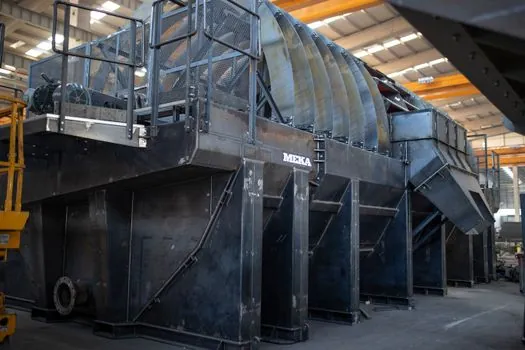
Vibrating-conveyor geometry is the headline differentiator on the floor. Galante's SC-series holds width at 1650 mm and grows only in the height axis (940-3040 mm) as tonnage climbs, which fits plants with constrained ceiling clearance but stretches vertical lift on the discharge conveyor [S1]. Vijay's FVC series grows in both axes, with the 10 t/h FVC-10VE at 4000 x 650 mm deck (12 HP vibro drive) and the 40 t/h FVC-40VE at 5000 x 1200 mm deck (47 HP vibro drive); the OEM flags "no moving parts in contact with sand" as a maintenance selling point, with the moving wear surface limited to deck nozzles and fin tubes [S2].
The ELEKTROMAG-JOEST DWFA table documents drive scaling in plain kW-equivalent classes: JV 136 (smallest frame, 850 x 2400 mm) through JV 158, JV 178, JV 208, JV 248 and JV 278 up to JR 408 and 2 x JR 608 on the 2500 mm-wide decks, and pairs the drive class with a width-length envelope that doubles the deck length as width steps from 850 to 2500 mm [S3]. Buyers comparing layouts should weigh that the fluidised vibro geometry tolerates more height per ton than the indirect shell, but the indirect shell needs no integrated cyclone or exhaust train in the line layout.
Compliance, Build Standard and Tender Documents
Compliance language in 2026 sand-cooler procurement notes typically requires ISO 9001 quality-management certification, IP66 protection for the electrical enclosure in dust-laden foundry atmospheres, and CE / RoHS / UL marks selected by destination region [S4]. The DWFA documentation goes further on functional safety language: it specifies an automatic air-circulation control to prevent undesirably low sand temperatures in winter, moisture control with a final-moisture display at the outlet, and a cyclone separator with rubber-lined suction duct and pneumatically operated double-flap valves, with bentonite addition downstream of the cooler outlet on the mixing-screen conveyor [S3].
For foundries tendering to ISO 9001-accredited vendors, the operational audit trail matters: the DWFA generation-upgrade note states that earlier DWFA units are field-updatable with the latest throughput and moisture control functions, which is a non-trivial spares-and-life extension argument for plants already running a JV-class drive [S3]. Buyers running European or Gulf specifications should request the CE declaration and the IP66 test report on the control cabinet, not just the marketing datasheet, since the IP66 rating is the credible differentiator between a foundry-rated cooler and a generic vibrating conveyor with a sand label.
Decision Matrix: Which Cooler Family Fits Which Plant
A four-criterion side-by-side lines up the options for an engineer writing a purchase spec: throughput duty, cooling media, dust-handling, and footprint. On the 5-20 t/h band with clean plant water under 20°C, the Galante SC-05/10/15/20 indirect water-cooled line is the lowest auxiliary-hardware count and the smallest blower envelope, at the cost of an external chiller when raw water warms up [S1]. On the 10-40 t/h band where a plant already has chilled water plus a dust extraction bus, the Vijay FVC-10VE to FVC-40VE fluidised vibro series adds bottom air fluidisation without forcing a cyclone upgrade, with the caveat that the OEM lists the dust extraction as an optional extra rather than a built-in module [S2]. On the 14.5-260 t/h band where evaporation cooling is acceptable and a cyclone is already in the gas train, the DWFA series covers the broadest capacity range with published water and airflow numbers per frame size, which makes the tender engineering work straightforward [S3].
For plants that need 20-80 t/h at 150-250 K ΔT and want exhaust-stream energy recovery as a tender line item, the comparison of sand coolers against heat treatment furnace equipment confirms that the cooler side is the correct asset class for spent-sand return lines, and that energy recovery has been a near-standard ask in foundry tenders issued since 2024 [S5]. Plants that route sand through agricultural-machinery casting lines at higher hourly tonnage should cross-reference the spec path written for that segment, where 40-350 TPH sizing maps to a different plant envelope than the 5-260 t/h band covered here. Buyers pairing the cooler with downstream bentonite dosing and mould-hardness control should also note that the DWFA train places bentonite addition after the cooler outlet on the mixing-screen conveyor rather than upstream, which keeps the cooler's moisture control loop decoupled from binder dosing [S3].
Selection Watchouts and Common Sizing Errors
The first sizing trap is inlet-temperature drift. Running a DWFA at 80°C inlet versus 120°C on the same deck cuts throughput by 26-31% across the published table (37 t/h to 50 t/h on the 1300 x 3600 mm unit, for example), and shakeout-line operators regularly overshoot 100°C when a mould lingers in the casting bay [S3]. The second trap is water-temperature creep: the Galante SC-series holds ≤30°C discharge sand only when inlet water is at or below 20°C, and the OEM explicitly states an external water-cooled chiller is mandatory above that threshold, which is a capex line item that buyers often miss until commissioning [S1]. The third trap is dust-handling under-spec: Vijay's FVC cooler requires the dust extraction to maintain "slightly negative pressure over the fluidised sand bed", and the OEM sells the fan and cyclone as optional rather than integrated, so a turnkey tender that excludes the dust package ends up with a working cooler that cannot pass an environmental compliance test [S2].
The fourth watchout is layout growth: fluidised-bed decks grow in both width and length as tonnage climbs (2500 x 9600 mm at the top of the DWFA range), and the auxiliary blower and cyclone footprint scales with the air volumes (44,500 Nm3/h supply, 58,000 Bm3/h exhaust on the largest frame), which can dominate the floor area of a greenfield mix-line cell [S3]. For an engineer auditing a vendor's proposal, the single most useful sanity check is to take the published tonnage at the actual inlet temperature expected on the shakeout, not the marketing peak, and then verify that the offered drive, blower and cyclone are sized for the de-rated figure, not the headline [S2][S3].
Track, before the next tender cycle, whether any of the three vendors (Galante, Vijay Foundry Equipment, ELEKTROMAG-JOEST) release field data on the 2024-onwards exhaust-energy-recovery retrofits that the comparison piece flagged as a near-standard ask, since that data will move the operating-cost column of the matrix more than any spec-sheet revision. A second trackable signal is the published update path for legacy DWFA drives to current moisture-control firmware, which is documented as a field-upgradeable package and would change the capex-versus-retrofit decision for plants with installed DWFA units older than the JV-208 generation [S3][S5].
For component-level specifications, see sand cooler, energy management, and energy meter.
This topic is covered further in Slewing Drive Selection for Textile Mills: Spec Map for Turntables and Transfer Tables.