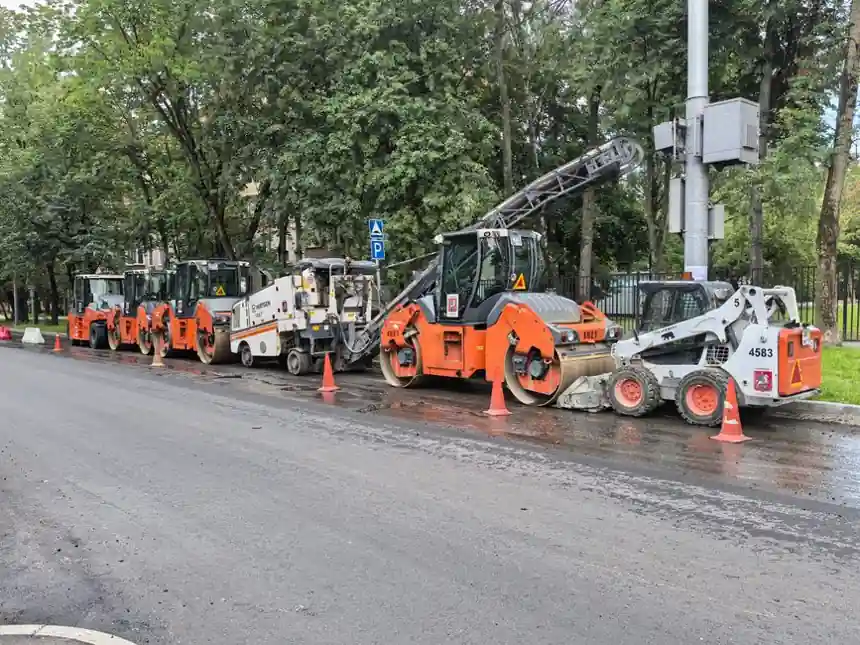
A road-maintenance sander is matched to four decisions in sequence: surface type (asphalt, chip-seal, gravel), required daily throughput in m² or lane-km, abrasive specification (sand, slag, treated salt), and carrier hydraulic flow in L/min. The same chassis paired with the wrong spreader pattern wastes 20-30% of abrasive in field trials on the FNSB Local Road spec [S2].
U.S. Forest Service Maintenance Levels 2-5 require an Annual Road Maintenance Plan that lists surface blading, dust abatement, and ditch cleaning under T-802/T-803/T-806, each calling for specific cut depths and crown percentages that the sander or surface-blading unit must leave intact on the traveled way [S1][S3]. For municipal fleets, Multnomah County RMOM 2023 pre-trip inspection explicitly checks sander condition, plow bits, chains, and brine application system on every shift [S5].
Surface-Driven Machine Classes
Asphalt hot-mix and chip-seal work uses a slipform or tandem-class sander at 2,500-12,000 m²/day, with hydraulic flow demand of 60-120 L/min and a working width of 1.8-3.6 m, while a self-propelled road surface blading unit carries a 2.4 m moldboard for re-shaping gravel and dirt crowns at 1-3 lane-km/h [S1][S2]. The FNSB specification requires a minimum of four cutting passes, two in each lane, immediately after rain that saturates the roadbed, with full edge-to-edge removal of potholes and washboards before any dust palliative is applied [S2].
For a dedicated abrasive sander on plow trucks, the dominant classes are: (a) tailgate (V-box) spreaders, 1.0-3.0 m³ capacity, 2-12 m spread width, fed by auger or chain to a stainless spinner disc; (b) underbody/zero-velocity pre-wet systems, applying brine at 30-50 L/m³ of solid; (c) chassis-mounted zero-turn pavers used on bike paths and bridge decks. A sander selection decision that ignores carrier GVW (typically 11-26 t for Class 7-8 plow trucks) leaves the unit under-trucked and unstable on cross-slope [S5][S6].
Abrasive Specification and Application Rate
Standard road maintenance sand gradation is 0.15-2.36 mm with no more than 5% passing 0.075 mm (No. 200 sieve) to prevent dust lift and drainage clog, while treated abrasives use 6-8% magnesium chloride pre-wet brine to freeze-bond to the surface at -5 to -20 °C [S4]. Application rates vary by surface and storm class: 100-200 g/m² for anti-icing brine, 150-300 g/m² for de-icing dry sand, and 400-800 g/m² for chip-seal lock-down after binder placement.
Material compatibility governs lifetime cost. Stainless 304 spinners handle chloride brine within an annual corrosion allowance of 0.05-0.10 mm/yr, while mild steel spinners on untreated salt can lose 0.5-1.0 mm/yr and need replacement inside 2-3 winters [S6]. Abrasive moisture content must stay below 4% by mass in the V-box to keep auger torque below 80 N·m and prevent bridging, a value the Iowa LTAP local roads pre-trip checklist captures via "Dump vibrator / Brine application system" line items [S6].
Decision Matrix: Sizer vs Class vs Throughput
Three options line up against four decision criteria:
Tailgate V-box sander (1-3 m³, 2-12 m spread) versus underbody zero-velocity (0.5-1.5 m³, narrow pre-wet) versus self-propelled paver (0.5-2 m³ hopper, 1.8-3.6 m working width). On throughput, the V-box leads with 30-80 lane-km per shift, the underbody trails at 10-25 lane-km, and the paver sits at 2,500-12,000 m²/day equivalent. On abrasive waste, the V-box loses 15-30% to scatter on bare pavement, the underbody holds losses under 5%, and the paver runs 8-12%. On capital cost, the V-box is the cheapest per chassis, the underbody doubles the bill, and the paver is the highest. On cross-slope stability, the V-box is rated to 6% (matching FNSB super-elevation), the underbody to 4%, and the paver requires level approaches [S2][S5][S6].
Standards, Pre-Trip, and Compliance
The USDA Forest Service T-806 Dust Abatement spec ties sander/pavement work to a documented Dust Abatement Plan listing road, palliative, application rate, and re-application count, and T-803 Surface Blading controls the cut/fill pattern that any sander must ride over without re-contaminating the abrasive [S1]. Maintenance Levels 3-5 require "performed work" cycles for traffic service and roadway, while Levels 1-2 defer most blading and vegetation work until the road re-enters active service [S3].
Daily compliance is mechanical, not paperwork. Multnomah County's 2023 pre-trip checklist itemizes sander condition, chains, snow plow bits, and fuel alongside CDL requirements and DVIR submission [S5]. The Iowa LTAP local roads manual adds dump vibrator, radio, brine system, and backup alarm to that list for any unit carrying a sander or plow mount [S6]. ERA AfCAP's Low-Volume Rural Road manual caps grass-cutting height at 150 mm above ground, a similar visual-tolerance rule that any sander operator must respect when spreading near vegetated shoulders [S4].
Failure Modes and When to Replace, Not Repair
Common field failures include: spinner-disc imbalance above 2 mm runout (replace, not re-machine), auger chain stretch beyond 3% elongation (replace chain and sprocket set, not just tensioner), and brine pump pressure drop below 1.5 bar at 10 L/min (rebuild pump head, escalate if flow continues to fall). For V-box bodies, visible perforation at weld seams or floor buckle above 10 mm is a scrap trigger under most fleet policies; patching is permitted only above the chain return path on sidewalls [S5][S6].
Replacement triggers also follow surface rules. When a tandem-class paver's screed plate wears beyond 5 mm crown deviation across the 1.8-3.6 m working width, surface smoothness drops below typical 4 mm/m straightedge tolerance and the plate must be re-machined or replaced before any chip-seal work proceeds [S2]. Performance-based contracts in the CAREC guide link payment to measurable service levels (roughness, edge break, dust opacity) rather than hours worked, which forces the sander/blade combination to leave a measurable surface, not just a "driven" one [S7].
Trackable Signals for the Next Cycle
Two near-term signals are worth monitoring: (1) USDA Forest Service T-spec revisions that change T-803 cutting-pass counts or T-806 application-rate tables, since they cascade into sander daily throughput and abrasive procurement; (2) municipal RMOM updates that re-rank the pre-trip checklist items, which directly affect which sander components fail inspection first. Any related concrete-finish or road-compaction specification that surfaces from the same agencies (a concrete sander class with its own dust spec, for example) should be cross-checked against chip-seal lock-down values to keep the abrasive selection on the same sieve basis see this [concrete sander selection spec map]. [S3]
Spec-level background on the components involved: pressure transmitter.