Scaffolding is a temporary elevated work platform, not a single product, and its total cost depends on whether the contractor buys tube-and-clamp, modular ringlock/cuplock, frame, or system scaffolding. Hot-dip galvanized diagonal brace ends at 2.5 mm wall thickness ship as a baseline component on the China-export supply path, with a 2000-piece minimum order and 10,000-piece-per-month supply capability at the listed reference price [S1]. The same source flags the two product features a process engineer should track: "timely delivery" and "strong ability to resist deformation" — meaning consistent mechanical yield on the diagonal plane under live load.
For tall façades and process-plant turnaround work, the realistic decision is not "good vs bad" but which scaffolding family matches the duty cycle, height, and crew skill on site. The same brace-end geometry that makes a 2.5 mm galvanized tube easy to handle also limits its reuse count before fatigue sets in [S1].
Tube-and-clamp (traditional) scaffolding
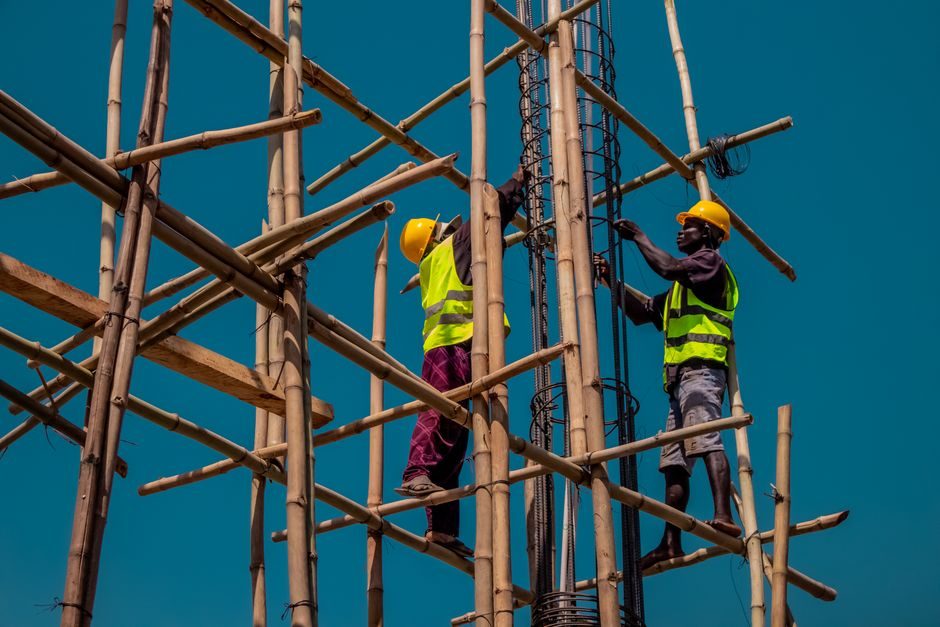
Tube-and-clamp is the original system and the most flexible in plan: any angle, any shape, any tie-in point, so it dominates irregular geometry such as vessel shells, spherical tanks, and offshore modules. Material cost per linear meter is the lowest of the four families because the same 48.3 mm OD tube with right-angle or swivel clamps covers every configuration. The trade-off is pure labour: an experienced crew erects roughly 30-40 m² of tube-and-clamp per shift, less than half the throughput of a modern modular system on a straight run.
Hot-dip galvanizing to 2.5 mm wall thickness on the diagonal brace is the entry-level corrosion spec on this class of component, and component weight for a standard 1.8 m brace lands in the single-handle range for one erector [S1]. Tube-and-clamp is the right pick when the structure is irregular, the project is short, and the crew has years of clamp work. It is the wrong pick when the elevation is above ~30 m and the same geometry repeats 50+ times, because the labour multiplier overwhelms the cheaper tube.
Modular system (ringlock, cuplock, kwikstage) scaffolding
Modular systems use a fixed rosette or cup joint every 0.5-1.0 m, so any bay can be assembled with one hammer blow and no measuring tape. Productivity on a straight, repetitive façade typically lands in the 70-100 m² per shift band — about 2-3x tube-and-clamp — and that's the reason modular has taken most high-rise commercial work since the early 2010s. The 2.5 mm hot-dip galvanized brace-end is dimensionally compatible with this class as a generic welded diagonal, even though proprietary rosette diameters differ between ringlock, cuplock, and kwikstage. [S1]
System scaffolding is the right pick for new-build towers, petrochemical turnaround access where the same module is reused 20+ times, and any site where labour cost dominates material cost. It is the wrong pick for one-off vessel access where the rosette layout forces a half-bay of wasted geometry on every tie-in. See the engineering scaffolding reference for the joint mechanics and load-path basics behind these systems.
Frame (H-frame / walk-through) scaffolding
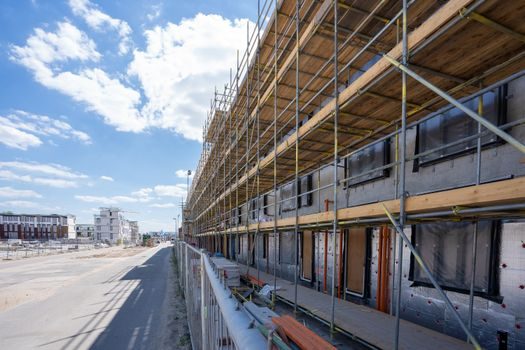
Frame scaffolding is welded H-frames stacked with cross braces and is the default on residential low-rise, plastering, and light masonry in North America. Throughput is similar to modular on a flat façade, but the frame's fixed bay geometry means any change in elevation or step requires an entirely different frame size. A hot-dip galvanized 2.5 mm wall thickness on the diagonal brace of a frame scaffold provides comparable corrosion life to the modular equivalent at the same coating weight [S1].
Frame scaffolding is the right pick for 1-3 storey residential, interior fit-out, and any site that needs fast erection with semi-skilled labour. It is the wrong pick for industrial process work, vessel access, and any site where anchor patterns must be tailored rather than repeated.
Suspended and auto-climbing systems
Suspended (swing-stage) platforms hang from outrigger beams on the roof and are the cheapest way to inspect, clean, or paint an existing façade. Auto-climbing bracket systems, by contrast, climb a permanent guide rail on the structure and carry a full working deck upward as the building rises. The "integrated climbing frame" referenced in OEM product copy eliminates the disassembly step at every floor cycle and is sold as a system that ties lifting and bracing into one hydraulic cycle [S1].
Suspended platforms are the right pick for short-duration exterior maintenance on existing high-rises. Auto-climbing is the right pick for new core-wall construction above 30+ storeys where the platform must move with the structure rather than being re-erected at every pour. Neither is the right pick if ground bearing is poor or the anchor structure is not designed for the reaction loads.
Cost, safety, and labour: a side-by-side spec map
The comparison below lines the four families against the criteria a process engineer or estimator actually uses to pick a system:
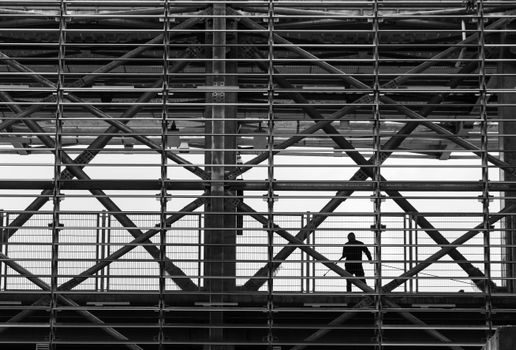
Tube-and-clamp: lowest material cost (single tube covers all geometries), highest labour hours per m², the most flexible plan layout, and the highest dependence on crew skill for joint tightness. Modular ringlock/cuplock: medium material cost (specialized castings on every rosette), lowest labour hours per m² on repetitive runs, fixed bay geometry, and a steep learning curve for the first crew on site. Frame scaffolding: low material cost, low labour on flat façades, limited geometry flexibility, and the simplest inspection regime because every joint is a visible pin. Suspended / auto-climbing: low-to-medium material cost for the platform hardware but high engineering cost for the anchor / guide-rail design, and the lowest erection labour at the working elevation because the platform arrives from above rather than being built from below.
The hot-dip galvanized 2.5 mm brace-end wall thickness is the common material denominator across at least three of these families, with the same fracture performance and deformation-resistance claims appearing in OEM product copy for tube-and-clamp, frame, and lower-tier modular diagonals [S1].
Failure modes, limits, and inspection levers
The four big failure modes on any scaffolding system are: (1) inadequate tie-in to the permanent structure, (2) missing or undersized outriggers and base jacks on soft ground, (3) mixed components from different families that don't actually interlock, and (4) galvanizing breakdown on reused tubes where the 2.5 mm wall has thinned below the engineered minimum. The 2.5 mm hot-dip galvanized brace is sold specifically as a "fracture performance" and "resist deformation" component, with the "lastingly rustless" coating claim that has to be re-verified after every 5-10 reuse cycles on coastal or chemical sites [S1].
For process-plant turnaround managers, the realistic 10-year TCO comparison looks like this: tube-and-clamp has the lowest entry cost but the highest inspection cost per cycle because every clamp torque has to be re-verified; modular has the highest entry cost but the lowest inspection cost per cycle because the rosette self-locates; frame sits in the middle on both axes; and suspended / auto-climbing has the highest entry cost but the lowest per-cycle cost on a structure that reuses the same anchor pattern. For a 50 m vessel head access job that runs once a year, tube-and-clamp still wins on cost; for a 200 m flare-tip access job that runs every 18 months, modular wins on total cost within three cycles.
Selection rules and a one-line spec recommendation
Pick tube-and-clamp when the geometry is irregular and the cycle count is low. Pick modular when the geometry repeats and the cycle count is high. Pick frame when the elevation is low, the crew is semi-skilled, and the façade is flat. Pick suspended for existing-facade maintenance and auto-climbing for new core-wall construction above 30+ storeys. For material spec, a hot-dip galvanized diagonal brace with 2.5 mm wall thickness and a documented yield strength is the baseline procurement spec across tube, modular, and frame families [S1].
For cost-sensitive industrial procurement, the practical target is hot-dip galvanized diagonal braces at 2.5 mm wall thickness with a 2000-piece minimum order quantity and a 10,000-piece-per-month supply capability, sourced against documented fracture and deformation performance data rather than the OEM's general "rustless" claim [S1]. Trackable signals for the next procurement cycle: (1) any change in the 2.5 mm wall minimum as a reuse-rejection threshold at major inspection houses, and (2) any move by Chinese suppliers to push the minimum order below 2000 pieces as a sign of capacity build-out in the export channel.
Spec-level background on the components involved: pressure transmitter, and flow meter.