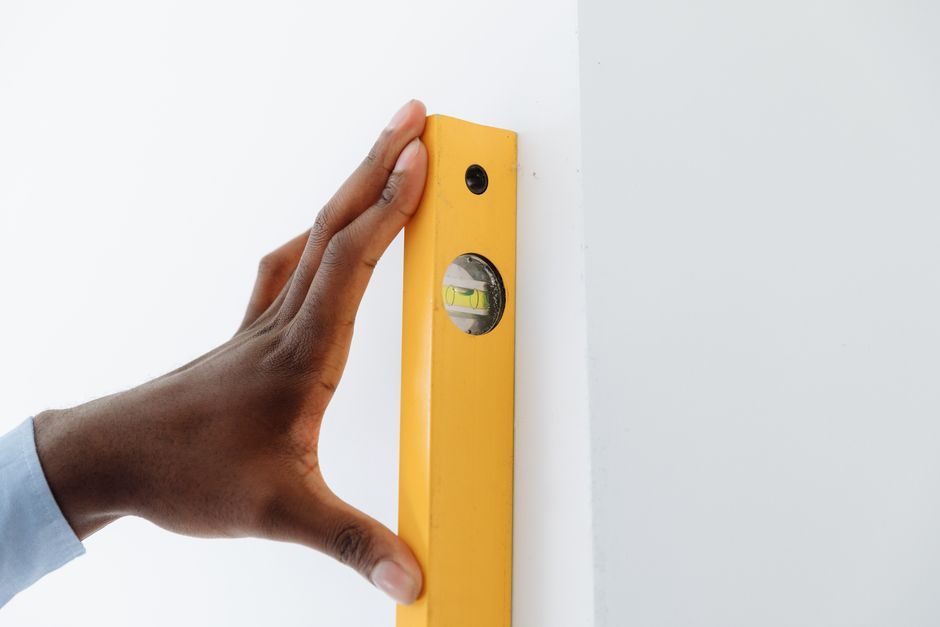
An infrared line level is a self-contained, line-generating laser instrument that emits a single semiconductor-diode beam — typically 635 nm red or 532 nm green — through a beam-spreading prism to project a 180° or 360° reference plane for horizontal and vertical alignment [S3].
The relevant spec axes for classification are: laser wavelength and color, FDA/IEC power class (Class I–IV), accuracy at a fixed reference distance, working range with and without a detector, and modulation/sensing method when the same instrument family is used as an infrared proximity or level switch rather than a visible alignment tool [S3][S5][S8].
Diode Wavelength and Color Classes
Laser line levels derive their color from the lasing diode wavelength, with the visible spectrum defined as 380–750 nm and two production wavelengths dominating the line-tool market: red at 635 nm and green at 532 nm [S3].
Because 532 nm sits near the peak photopic sensitivity of the human eye, green-beam systems such as Johnson Level's GreenBrite Technology are documented as at least 400% brighter to the eye than a 635 nm red unit at the same output power, which is why interior finish contractors pay a premium for green modules despite higher diode cost [S3]. For outdoor use, neither color is reliably visible to the unaided eye in daylight, and a laser detector is mandatory to recover the beam above roughly 50 ft of ambient illumination [S3].
The 532 nm green beam is also produced by a frequency-doubled IR pump (typically 1064 nm Nd:YAG) inside the diode package — a real-world example of why "infrared" line tools and "infrared" sensing tools must be distinguished before any spec comparison (see infrared level for the sensing-side taxonomy) [S3].
Power Classification: Class I–IV and Where Line Levels Sit
Laser product classes are set by accessible emission power in milliwatts: Class I and II are sub-0.4 mW to 1 mW low-power; Class IIIA covers 1–5 mW; Class IIIB covers 5–500 mW and requires engineered controls; Class IV is anything above 500 mW and is hazardous to view under any condition [S3][S5].
Most production line laser levels, including cross-line tools used on commercial jobsites, are documented as Class 2 (≤1 mW visible, eyelid-reflex safe for incidental exposure up to 2 seconds) or Class IIIA depending on jurisdiction and exact diode bin [S3][S6]. The hazard-evaluation aperture used for time-based averaging in the near-IR is 7 mm, and the irradiance profile is averaged over roughly 10 mm² (about 3.5 mm equivalent diameter) for exposures longer than 10 seconds [S5].
Inside this power band, the practical trade is direct: the closer the diode drive is to the 5 mW Class IIIA ceiling, the brighter and more expensive the unit, while Class IIIB and Class IV are explicitly excluded from leveling tools because the diffuse reflection and the line-spreading prism cannot be guaranteed eye-safe at those powers [S3].
Accuracy, Range, and Beam Geometry

Line-level accuracy is specified as a tolerance at a reference distance, with production units documented from ±1/2" to ±1/8" at 50 ft, which is tighter than a conventional spirit (bubble) level over the same distance [S3].
Working range is quoted in feet of diameter, with the instrument at the center; published line-level diameters reach 300 ft when paired with a detector, which is the configuration required for outdoor stakeout, concrete formwork, and facade layout [S3]. Beam geometry is either 180° horizontal plus 180° vertical (cross line) or full 360° in one or both planes, generated by a single dot passed through a line-spreading prism rather than by multiple diodes [S3].
For comparison against non-optical alignment methods, the infrared thermometer and infrared level families share the same underlying IR-photodiode physics but are classified on a different axis (temperature range, emissivity, switching distance) rather than beam geometry — a useful boundary to lock in before spec sheets are merged.
Modulated vs Unmodulated IR Sensing Variants
When the same infrared hardware is used as a proximity or fill-level switch rather than a visible alignment tool, the relevant classification flips from "laser power tier" to "modulation scheme" and "switching distance." The E18-D80NK adjustable IR sensor, for example, requires the incoming IR signal to be modulated at a fixed carrier frequency so the detector can reject continuous-wave ambient IR from sunlight and incandescent lamps, which otherwise saturate the photodiode and collapse the detection threshold [S8].
Hermetic IR photodiodes such as the OP132 are specified with sub-microsecond fall times, expressed in nanoseconds, which bounds the maximum modulation frequency and therefore the maximum sensing distance and noise rejection the downstream automatic molding line controller can support [S4]. Adjacent production cells that share an IR sensing bus — for example, a conveyor sorting line or a line-frequency furnace station — must use distinct carrier frequencies or time-slot the modulation to avoid cross-talk between adjacent photodiodes [S4][S8].
Class 2 laser-line products carry an explicit OEM statement that "exposure to the beam of a Class 2 laser is considered safe for a maximum of 2 seconds" under the eyelid-reflex (aversion response) model, and the safety section of the user manual prohibits use while tired or under the influence of drugs, alcohol, or medication — a direct requirement that flows into jobsite PPE policy [S6].
Selection Criteria: Line Level vs IR Sensing Level

For a single procurement decision, the spec stack separates cleanly. A visible-beam laser line level is selected on color (635 nm red vs 532 nm green), FDA/IEC class (Class 2 vs IIIA), accuracy at 50 ft (±1/8" to ±1/2"), and detector-supported range (up to 300 ft diameter) [S3][S6].
An IR-sensing level (proximity, fill-level, object-detection) is selected on switching distance, modulation carrier frequency, photodiode rise/fall time, housing ingress rating, and ambient-light rejection, with the operating environment dictating whether a modulated emitter is mandatory [S8].
Spec-driven comparison across the main options:
Option A — 635 nm red cross-line, Class 2, ±1/2" @ 50 ft: lowest cost, indoor-only without detector, suits residential finish and electrical rough-in [S3].
Option B — 532 nm green cross-line, Class 2/IIIA, ±1/8" @ 50 ft: 4× brighter perceived, longer interior throw, premium for finish tile and drywall [S3].
Option C — 360° rotary/line, Class IIIA, 1–5 mW, 300 ft diameter with detector: outdoor stakeout, concrete formwork, facade layout [S3].
Option D — Modulated IR photodiode level switch (e.g., OP132-class detector), sub-µs fall time, ambient-light rejection via carrier frequency: bin-level, fill-level, and proximity on molding line equipment, not a visible alignment tool [S4][S8].
Applicable Standards and Compliance Anchors
Laser products sold in the US market are classified under the FDA Center for Devices and Radiological Health (CDRH) 21 CFR 1040.10 framework, which adopts the IEC 60825-1 power classes (Class 1, 2, 3A, 3B, 4) that the OEM datasheets quoted above use verbatim [S3][S5][S6].
For the sensing-side IR family, photodiode packages are typically characterized per JEDEC and manufacturer datasheet methods for fall time, dark current, and responsivity — the OP132 datasheet, for instance, publishes the fall time parameter explicitly in nanoseconds because it gates the modulation bandwidth the application can support [S4]. Near-IR hazard evaluation, where applicable, uses a 7 mm aperture and averages irradiance over a 10 mm² / 3.5 mm equivalent spot for exposure durations above 10 seconds [S5].
For buyers cross-referencing a laser distance meter spec against a line level spec, the laser distance meter installation guide is a useful adjacent reference because it covers the same detector, mounting, and ambient-light variables that govern a line-level detector pair, while the accelerometer price and cost guide 2026 is the relevant reference when the line level is being installed as part of a vibration/stability stack on a sensor mast.
Failure Modes and Boundary Conditions
Documented failure and limitation modes for line-level tools are: invisible beam in direct sunlight beyond ~50 ft without a detector, hazard up-classification if the diode is replaced with a higher-bin unit, and false readings on a vibrating mount because the self-leveling pendulum cannot settle [S3][S6].
Documented failure modes for the IR-sensing family are: ambient IR saturation (sunlight, incandescent) without modulation, cross-talk between adjacent sensors on the same carrier, and switching-distance collapse when target surface emissivity drops or when the photodiode window fogs in a line-frequency furnace ambient [S4][S8]. The combination of "high-vibration mount" plus "unmodulated CW emitter" is the most common field failure pattern called out in the OP132 and E18-D80NK datasheets [S4][S8].
Trackable next signals: FDA/CDRH enforcement actions on mis-labelled Class 3A line-level imports (a recurring docket), and the migration of green-beam modules below 200 USD at retail as 532 nm pump diode yields climb — both are verifiable from public CDRH recall feeds and tier-1 retailer SKU histories.