
SCARA robot pricing for entry-level 4-axis models keeps trending down, with 2026 sub-10 kg arms typically 20–40% cheaper than an equivalent-payload articulated robot, per the EVS comparison published April 2026 [S6].
The market itself is expanding fast: Knowledge Sourcing forecasts a 9.9% CAGR to USD 13.6 billion by 2031 [S1], while Data Bridge sees the segment reaching USD 73.89 billion by 2032 at a 27.10% CAGR [S5]. Mordor Intelligence sits between the two, projecting 9.63% growth from USD 12.45 billion in 2026 to USD 19.72 billion by 2031 [S7]. Asia Pacific is the dominant demand region, anchored by electronics assembly, automotive sub-components, and pharmaceutical packaging [S1].
What counts as a "low-cost 4-axis SCARA" in 2026
SCARA stands for Selective Compliance Assembly Robot Arm: a four-axis architecture (shoulder, elbow, Z-stroke, and tool yaw) that is rigid vertically and compliant in the XY plane, making it the default pick-and-place geometry for printed circuit board assembly, screw driving, and small-part insertion [S2][S3].
The "low-cost" tier in 2026 covers roughly 1–6 kg payload, 200–600 mm reach, brushless servo drives, and an integrated controller, sold as a bare arm or as a kit requiring the buyer to write their own kinematics [S4]. High-end SCARAs from Epson and FANUC hit ±0.01 mm repeatability and run standard 0.29-second pick-and-place cycles, while 6-axis articulated robots in the same payload class land at 0.5–0.8 seconds for an equivalent move [S2]. Most SCARAs cap payload near 6 kg in the mainstream sweet spot, with the FANUC SR-20iA representing the upper limit at 20 kg, well below articulated robot ceilings of 2300 kg [S2].
Cost driver breakdown: where the price gap actually comes from
The 20–40% price advantage of a SCARA robot over a 6-axis arm of equivalent payload is structural, not promotional [S6]. Four moving axes versus six means fewer servo motors, fewer gear reducers, fewer encoders, shorter cable harnesses, and a simpler controller card. The mechanical envelope is smaller too: SCARAs work in a cylindrical workspace versus the roughly spherical workspace of a 6-axis arm, so the link and casting mass is lower for the same reach [S2].
The non-mechanical cost drivers are equally large. A 2025 Hitbot assembly-line guide flags lower initial purchase price, simpler programming, smaller footprint, and faster commissioning as the four recurring TCO advantages of 4-axis SCARAs over 6-axis solutions [S3]. On the components side, stepper-driven hobby arms can be assembled for the cost of a USD 30 stepper driver and an Arduino-class controller, with the user writing inverse kinematics from scratch, as the 2017 Arduino Forum build showed [S4]. Industrial-grade 4-axis SCARAs from Chinese suppliers on AliExpress sit well below the price of an Epson T6 or FANUC SR-series, but ship with thinner documentation and tighter quality variance [S4].
Comparison: low-cost SCARA vs 6-axis articulated vs collaborative robot
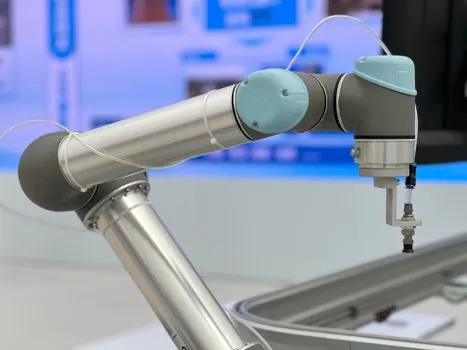
Buyers weighing a 4-axis SCARA against a 6-axis articulated arm or a collaborative robot typically run the same four decision criteria: cycle time, payload, footprint, and total purchase plus integration cost. [S3]
On cycle time for a horizontal pick-and-place, the SCARA wins by roughly 2:1 over a 6-axis arm at equivalent payload, a 0.29 s cycle versus 0.5–0.8 s [S2]. On payload, the 6-axis articulated robot dominates with up to 2300 kg versus a SCARA ceiling of 20 kg [S2]. On footprint, the SCARA's cylindrical envelope takes less floor space than a multi-link articulated arm, allowing denser workstation packing [S3]. On price, AMD Machines notes the real procurement question is cost per part rather than sticker price, and a USD 20,000 SCARA at 30-second-equivalent throughput can undercut a cheaper 6-axis arm on per-part economics [S2]. Collaborative robots sit in a different niche: lower payload, lower speed, force-limited for fenceless operation, and a per-unit cost that overlaps the upper end of the SCARA range rather than the low-cost tier.
Total cost of ownership: purchase price is the smallest line item
The Hitbot 2025 guide argues that the SCARA's lower TCO comes from four compounding factors, each of which can outweigh purchase price on a 3-to-5-year horizon [S3]: simpler programming reduces commissioning labour; the smaller footprint cuts cell guarding and floor-space cost; the four-axis motion profile slashes settle time and raises throughput; and the smaller parts count lowers mean time between repair events [S3].
The same AMD Machines analysis reframes the procurement question as cost per part rather than cost per arm: a USD 20,000 SCARA running 30-second equivalent cycles on a 200,000-part-per-shift line delivers a different per-part figure than a USD 15,000 6-axis arm at 0.7-second cycles that the application does not actually need [S2]. The Arduino Forum build, conversely, illustrates the hidden cost on the bottom of the market: a sub-USD 1,000 Chinese stepper-driven SCARA arm delivered usable motion, but required the user to write inverse kinematics, build a controller around an Arduino Due and four Leadshine DM422 stepper drivers, and accept approximately 0.1–0.2 mm repeatability after calibration versus the ±0.01 mm of an industrial SCARA [S4].
Failure modes and constraints buyers keep rediscovering

Low-cost 4-axis SCARAs are not a free lunch. The Arduino Forum teardown documented approximately 5 mm of mechanical play at 180-degree arm extension on a sub-USD 1,000 stepper-driven arm, with the main column tilting from misaligned pulley attachment, issues the user fixed manually after delivery [S4]. A SCARA's rigid Z-axis and compliant XY plane also make it the wrong tool the moment the application needs parts oriented at non-vertical angles, inside-machine-tool loading from the side, or any process that requires reaching behind the base [S2].
Payload ceiling is the second hard wall: mainstream 4-axis SCARAs top out at 6 kg, the high end of the family reaches 20 kg, and anything beyond that, such as 25 kg case palletizing, drops out of the SCARA conversation entirely [S2]. Buyers who select on sticker price without checking reach, Z-stroke, and IP rating for the cell environment routinely re-spec within the first 12 months.
Selection criteria: who low-cost 4-axis SCARA is for, and who it is not
The 4-axis low-cost SCARA is the right spec when the application is primarily horizontal, requires sub-0.5-second cycles, runs under 6 kg payload, needs ±0.01 mm-class repeatability in XY, and must fit into a tight cell footprint, which describes the bulk of electronics PCB assembly, pharmaceutical blister packing, small-part sorting, and semiconductor handling [S2][S3]. It is the wrong spec for heavy-payload palletizing, complex 3D tool paths, machine tending from the side, and any process needing reach above 1000 mm or payload above 20 kg [S2].
Volume buyers, OEM machine builders, and contract manufacturers with multi-line deployments also see a different cost shape: Knowledge Sourcing notes that competition has shifted from arm-only hardware toward complete ecosystems combining controllers, software, machine vision, end-of-arm tooling, and lifecycle service, which tends to favour established suppliers for high-volume cells even when the per-arm sticker is higher [S1]. Buyers chasing the lowest unit cost on a single line still gravitate to the Chinese low-cost tier, then pay for that savings in integration labour, support, and documentation [S4].
What to track next on 2026 SCARA pricing
Two signals will move SCARA pricing through 2027: the sustained double-digit forecast gap between Knowledge Sourcing's 9.9% CAGR and Data Bridge's 27.10% CAGR, which is wide enough that one of the two forecast families is materially wrong about adoption velocity [S1][S5], and the gradual shift in procurement from arm-only RFQs to full-ecosystem RFQs that bundle vision, controller, and service [S1]. A third near-term signal is the Gearmotor Market 2026 conveyor and material handling demand picture, since SCARA servo-and-harmonic-drive demand pulls from the same motor supplier base; a tight gearmotor market through 2026 will hold SCARA arm prices higher than the headline CAGR suggests.