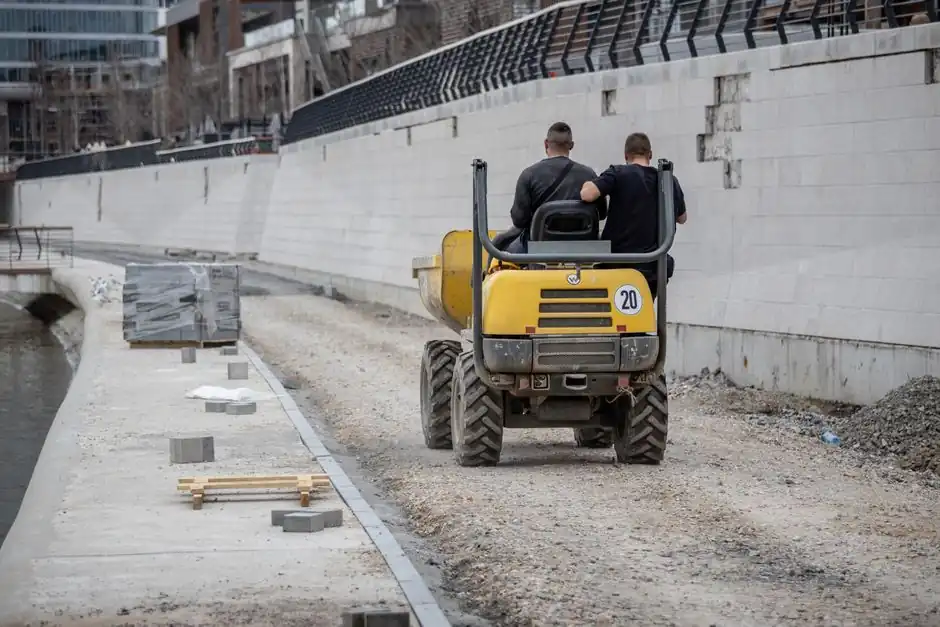
A truck-mounted concrete pump must be set on ground that has been verified for bearing capacity, leveled to within 3 degrees per manufacturer requirements, and supported by outriggers that are either fully extended or, if short-rigged, explicitly permitted by the OEM, with cribbing sized to the soil class [S3][S1]. These four variables, ground, level, outrigger stroke, and cribbing, govern roughly 80 percent of the fatal and serious-incident outcomes that drive ACPA safety alerts [S3].
The install is not a parking job. It is a rigging job that shares a hazard model with mobile cranes: same outrigger pads, same 3-degree level rule, same overhead-line clearance math, and similar trench setback logic. Treating it as anything else is the surest path to a tip-over, a crushed worker, or a boom-into-line electrocution [S3][S1].
Ground Verification, Soil Class, and Cribbing Sizing
Ground bearing capacity is the first number on the setup sheet, and it is the most often skipped. ASCC's published do-and-don't list opens with "Don't assume the ground or soils condition is sufficient to support the weight of outriggers," and pairs it with the positive instruction to "verify ground conditions and ensure proper cribbing is utilized" [S1]. The failure mode is not subtle: a 50 to 70 metric ton boom pump concentrates 25 to 35 metric tons through each outrigger pad onto a footprint measured in tenths of a square meter.
Use a dynamic cone penetrometer or plate-bearing check when the substrate is undocumented fill, recompacted trench backfill, or a previously disturbed utility corridor. Plywood or hardwood cribbing stacks must be built up in full contact with the pad, with no voids; dunnage alone on asphalt in summer heat is a recurring failure pattern. For a baseline spec on the carrier and hopper arrangement that sits on those pads, see the concrete pump truck reference page.
Level Tolerances, Outrigger Stroke, and Trench Setback
Per ACPA guidance, a concrete pump must set up within 3 degrees of level [S3]. Beyond that, the rolling moment on the outriggers becomes non-symmetric, the boom's slewing radius drifts, and the structural margins in the outrigger jacks stop applying in the direction the OEM rated them. ASCC reinforces the same point by telling crews to verify that outriggers are fully extended and to confirm with the manufacturer if "short rigging" is ever contemplated [S1].
When the pump must sit near a trench or excavation, apply the same setback logic a crane would: the surcharge load on the trench wall scales with outrigger pad pressure, and undermined soil has effectively zero bearing capacity. ASCC lists "verify set back distances when setting up near a trench or excavation" as a positive requirement, not a suggestion [S1]. On a soft or wet site, plan the truck approach so the boom unfolds away from the excavation, never over it, so a hydraulic failure does not fold the boom into the trench wall.
Overhead Hazards, Power Line Clearance, and Dry-Run Articulation
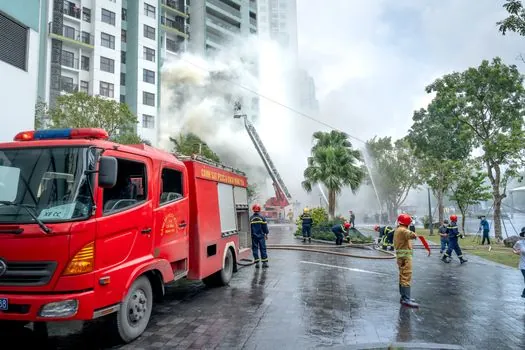
Electrocution from boom-to-line contact is the second of the two incident classes ACPA specifically calls out, alongside tip-overs [S3]. The dry-run function check is the cheapest mitigation available: extend and articulate the boom through its full working envelope before any concrete is loaded, with a spotter confirming clearance to every overhead utility, tree canopy, and adjacent structure. ASCC lists this dry run as a positive do, alongside the negative "don't rush and set the pump truck up near overhead obstacles or power lines" [S1].
Radio communication is the default when the operator's line of sight to the hose handler is broken, with hand signals as the fallback for short, clear sightlines [S1]. For a related mobile-equipment acceptance workflow, the aerial work platform setup checklist applies a similar dry-run and sign-off logic and is worth reading alongside this guide. The boom is never a crane: lifting rebar cages or buckets off the boom is explicitly on ASCC's don't list [S1].
Pre-Pour Mechanical and Hydraulic Checks
Before the first piston stroke, run the OEM pre-use checklist. The LUTON operating procedure breaks this into a non-load test: oil level in prescribed range, hydraulic hose fittings and fixing seats checked for looseness or leakage, electrical connectors verified for tight nodes, hopper cleared of waste, and DC control voltage confirmed in the 24 to 28 V window with cable clamps and ground/neutral protection validated [S2]. The PLC module should report "running" on and "trouble" off when the machine is started; pumping, anti-pump, inching, vibrate, and mixing inputs must each be observed for correct output response [S2].
The water tank must be filled until it floods over the piston rod, with an additional roughly 2 cm of cleansing oil for pumps under 40 cubic meters per hour, because the water and oil together cool and lubricate the concrete cylinder's piston, rod, and seals, and concrete cylinders will fail quickly even in no-load running if that supply is missing [S2]. Daily water changes are mandatory to keep the lubrication clean. Engine cranking is limited to 20 seconds per attempt with at least one minute between attempts to protect the battery, and idle should stabilize around 700 rpm before any load is applied [S2]. For the broader carrier spec that this hydraulic package bolts into, see the truck-mounted concrete pump reference.
Outrigger Pads, Pipeline Layout, and Pump-Side Accessories
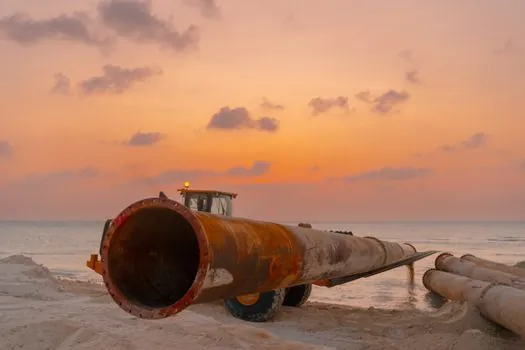
Outrigger cribbing is half the installation; pipeline layout is the other half. Boom-pump pipeline accessories include elbows and straight sections in plastic, rubber, and steel, where steel trades weight for wear life and plastic trades pressure rating for handling ease [S4]. Clamps must match the pipe class: snap couplings for frequent reconfiguration, metric wedge, flange, double-bolt, or heavy-duty clamps where joint integrity under surge pressure matters more than speed [S4]. Reducers step between pipe diameters to keep the concrete stream steady and reduce spillage at transitions [S4].
On the line-pump side, couplings between the drive shaft and the rotating pump shaft come in rigid, flexible, and magnetic variants, where rigid is the lowest-cost and most misalignment-intolerant option and flexible absorbs the small parallel and angular offsets that show up on real sites [S4]. Cross-fleet compatibility, where a boom-pump accessory also fits a compact track loader or skid steer, is a real sourcing shortcut for contractors running mixed fleets, and it is one of the few cases where a single attachment purchase pays back across machines [S4].
Limitations, Failure Modes, and When to Stop the Pour
Installation planning is a series of hard stop conditions, and a competent setup lead has to be willing to call them. Do not set on undocumented fill, do not set over a utility trench without verified backfill compaction, do not exceed 3 degrees of level, do not short-rig without written OEM approval, do not boom over power lines, do not clear a pressurized hose blockage, and do not let untrained workers near the hopper or hose end [S1][S3]. On the priming and pumping side, a hopper-screen bypass or a sudden pressure drop on the gauge is a stop-work condition, not a "pump it through" condition [S1].
If any of those triggers fire, the corrective action is not a faster prime cycle, it is back the truck off, re-crib, re-level, and re-run the dry articulation. ACPA's framing is explicit: complacency is the precursor, and the morning safety huddle is the cheapest corrective control available [S1]. Operators handling the hose end during priming are exposed to a sudden release of prime water and grout, which is why ASCC's list bars workers from the hose end during priming [S1]. For the fleet-level context, the concrete mixer truck reference covers the delivery-truck side of the same pour window, where approach paths and washout location are part of the same setup plan.
Sourcing, Standards, and Crew Competency
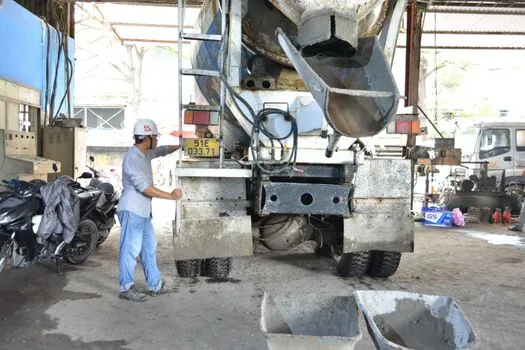
ACPA and ASCC are the two primary US sources for installation guidance on truck-mounted boom pumps, and both publish checklists that should be on paper at the setup site, not just bookmarked on a phone [S1][S3]. Manufacturer operator manuals remain the controlling document for outrigger load charts, short-rig permissions, and the 3-degree level limit, because ACPA's guidance is written to be consistent with OEM manuals, not to replace them [S3]. OEM pre-use procedures, such as the LUTON sequence, govern the hydraulic, electrical, and lubrication checks that ASCC's site-level do-and-don't list does not cover [S2][S1].
Crew competency is a sourcing problem as much as a training problem: ASCC's list explicitly bars untrained workers from the hose, the hopper area, and the pump truck itself, and it elevates radio over hand signals whenever the operator's view is obstructed [S1]. For projects where the pump must share airspace with a tower crane, the tower crane TCO and coordination piece is a useful read on right-of-way and lift-window planning, since concrete boom operations and tower-crane picks are the two activities most likely to collide on a high-rise deck.
Track these signals on the next setup: (1) the time stamp and signature on the ground-verification and cribbing record before any outrigger takes load, and (2) the dry-run boom-articulation sign-off with overhead-clearance confirmation logged before the first concrete truck arrives on site. Missing either record is a stop-work condition under ACPA's published guidance [S3][S1].