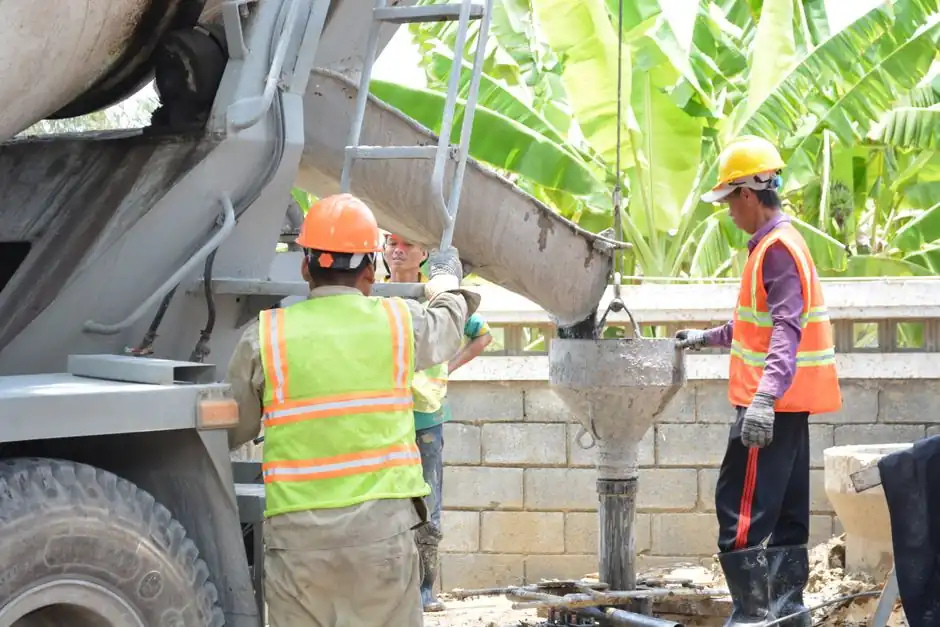
Urban infrastructure pours on tight sites demand a mid-size boom pump with 90-120 ft vertical reach and 100-170 yd3/hr output, mounted on a 6x4 or 8x4 chassis to balance road footprint against axle load [S3][S4].
For bridges, metro decks, and elevated highways, the dominant equipment is a truck-mounted boom pump with multi-section articulating arm; for deep foundations, narrow alleys, and backfill, a trailer or truck-mounted line pump at 15-50 yd3/hr remains the practical choice [S3][S5].
Pump Class and Output Range by Job Type
Boom pumps are grouped by reach: under 90 ft (small), 90-120 ft (mid), and 120+ ft (large), with matching output bands of 80-130, 100-170, and 150-200+ yd3/hr respectively [S3]. A 90-120 ft mid-size boom is the workhorse for commercial foundations, tilt-wall panels, and multi-story pours, while 120+ ft booms are reserved for high-rise cores and long-span infrastructure such as bridge piers and viaducts [S3].
Line pumps split into trailer units at 15-30 yd3/hr (residential slabs, driveways, grout) and truck-mounted line pumps at 25-50 yd3/hr (long horizontal runs, light commercial), both operating at ground level through hose or steel pipeline [S3]. For deep foundation pits and narrow passages down to 1.2 m wide, a trailer or small boom pump preserves access where a full-size boom truck cannot set up outriggers [S5].
Reach, Pressure, and Pipeline Behavior
Modern boom pumps can deliver concrete vertically over 100 m and horizontally over 300 m, with material conveying accuracy held within +/- 2% and flow control accuracy within +/- 0.5%, which is critical for structural uniformity on columns and shear walls [S5]. Continuous pumping capacity is generally specified at >= 45 m3/h for a single unit, and a single pump can replace the collaborative work of roughly 20 placing crew while cutting labor input by 30% and shortening the construction period by 25% versus manual handling [S5].
Vertical reach in the field is highly sensitive to boom geometry: a Z-fold boom and a roll-fold boom with the same nominal meter rating deliver different working envelopes around obstacles, so the published reach figure should be treated as an upper bound, not a guaranteed setup value [S3]. For tall-building work in dense cities such as São Paulo, Bogotá, and Mexico City, a trailer concrete pump on steel pipeline remains a common alternative when a boom truck cannot be positioned near the pour face [S2].
Chassis Configuration and Axle Layout
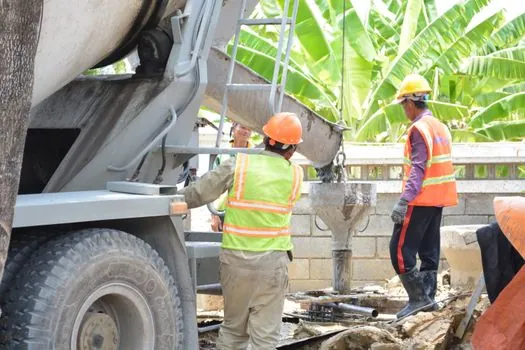
Chassis selection is driven by the weight of the pump package: 4x2 for lighter boom pumps, 6x4 for most mid-size booms, and 8x4 for the heaviest units over 120 ft reach or with high-pressure twin-circuit hydraulics [S4]. On urban projects with bridge load-rating limits and strict axle-load rules, 6x4 is often the practical ceiling, and 8x4 units may require route permits and escort vehicles for transit [S4].
For site access, an 8x4 boom pump typically needs a longer wheelbase and larger outrigger pad footprint than a 6x4, and it may not fit narrow median strips or work behind a single-lane closure [S3][S4]. Where the pour is shallow but access is constrained, a 4x2 line pump truck on a shorter wheelbase can be towed or driven into alleys that would block a boom truck entirely [S4].
Selection Criteria: Boom vs Line vs Trailer
Decision criteria line up as follows: vertical reach (boom 60+ m, line 0 m), horizontal run (boom 100-300 m, line 90+ m via hose), output rate (boom 80-200+ yd3/hr, line 15-50 yd3/hr), site footprint (boom needs full outrigger spread, line and trailer need only a hose path), and crew size (boom self-deploys, line needs hose handlers) [S3][S5]. A direct comparison for an urban infrastructure buyer: a 90-120 ft boom pump on a 6x4 gives the best mix of reach and mobility for commercial-scale work; a 120+ ft boom on 8x4 is the right call when vertical placement above 12 stories is routine; a trailer or truck-mounted line pump at 25-50 yd3/hr is correct for foundation mats, tunnel linings, and long horizontal deck pours where boom geometry is wasted [S3].
For high-rise Latin American projects, trailer concrete pumps on steel pipeline are favored for their durability across multiple construction cycles and easier maintenance in regional service networks [S2]. When matching equipment to concrete mixer truck supply, output rates must align: a boom pump at 150 yd3/hr needs a steady feed of three to four ready-mix trucks per hour, otherwise the pump idles and the pour joints suffer.
Operating Limits and Failure Modes
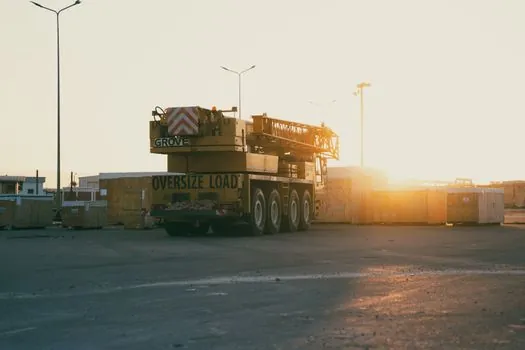
Three failure modes dominate urban concrete pumping: boom overreach, pipeline blockage, and outrigger settlement [S3]. Overreach happens when the published vertical figure is taken as a horizontal figure across an obstacle; a 115 ft vertical boom does not deliver 115 ft of horizontal reach through a building [S3]. Pipeline blockage comes from poor mix design (low fines, harsh aggregate) or from extended stoppage, so a stable, continuous feed from the ready-mix concrete mixer truck fleet is non-negotiable for any boom pour above 100 m vertical [S2][S5].
Outrigger settlement is an under-discussed risk on urban sites with buried utilities, basements, or backfilled trenches; a fully loaded boom pump can impose point loads above 20 tonnes per outrigger pad, and failure here bends booms before any concrete is placed [S3]. Operators also underestimate that small boom pumps under 90 ft can typically set up in tighter residential streets, but their 80-130 yd3/hr output will starve a large mat pour, so matching the pump class to the pour volume is as important as matching it to the reach [S3].
Market and Fleet Signals
The global truck mounted concrete pump market is forecast to grow at 6.1% CAGR to roughly USD 6.70 billion in 2030, up from about USD 4.7 billion in 2024, with leading OEMs including Putzmeister, Schwing Stetter, SANY, and Liebherr extending reach, raising pressure ratings, and adding digital pressure monitoring and semi-autonomous boom controls [S1]. Demand-side drivers are the same ones shaping urban infrastructure tenders: tighter construction timelines, rising concrete quality demands, and labor shortages that make a single boom pump a replacement for a placing crew of 20 [S1][S5].
Two signals worth tracking into 2026-2027: the rollout of electrified truck chassis and hybrid hydraulic systems for city-center low-emission zones, and the shift of mid-range regional OEMs into 90-120 ft boom segments for price-sensitive Southeast Asian and African fleets [S1]. For an urban contractor specifying today, the practical move is to fix reach, output, and chassis configuration first, then compare OEM telemetry, after-sales coverage, and pipeline compatibility; for a deeper look at how the pump truck pairs with the supply fleet on pipeline work, see this drum and axle match guide for pipeline concrete supply.
The underlying component specifications are covered under concrete pump truck, and truck mounted concrete pump.