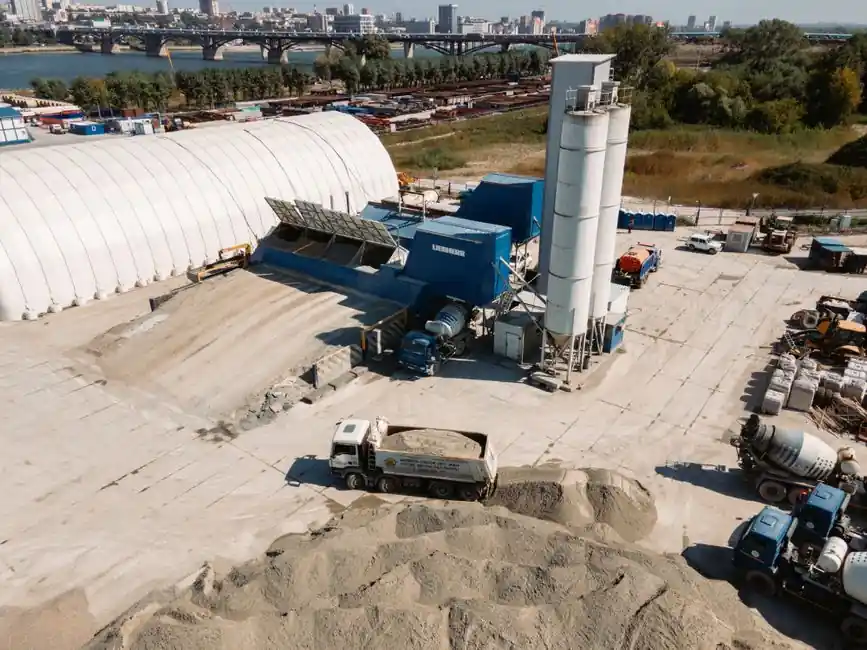
Quarry work drives concrete pump trucks to their harshest duty cycle: high abrasive load, uneven bench floors, and rebar-dense crusher foundations. Selection must follow three engineering vectors simultaneously: theoretical output in m3/h, vertical plus horizontal boom reach, and wear-component spec for the aggregate being poured [S1][S3].
Trailer-mounted line pumps still cover long horizontal runs to 500 ft where the bench geometry blocks a truck, but quarry primary placement on crusher pads, haul-road slabs, and shotcrete bench walls is almost always a truck-mounted boom pump because of speed and reach [S2][S3]. A direct comparison between pump classes for heavy civil work is laid out in Centrifugal Pump vs Concrete Pump Truck: How the Two Machine Classes Diverge.
Pump Classes Compared for Quarry Service
Truck-mounted concrete pumps sit in the 30 m3/h to 120 m3/h theoretical output band for trailer/line units, with truck-mounted boom pumps climbing higher once a multi-section placing boom is added [S1]. For a quarry primary crusher foundation or a haul-road bridge deck, a 40 m3/h to 80 m3/h trailer pump class machine paired with a separate placing boom is the common configuration, because the boom handles vertical placement and the trailer pump keeps the line full at sustained pressure [S1][S4].
Boom fold geometry matters in a quarry pit: R-type (roll-fold) folds compactly for tight bench haul roads, Z-type reaches further forward over the edge of a wall, and RZ-type blends both for compound-radius pours on stockpile retaining structures [S1]. Power source splits between diesel (typical for off-grid quarry benches) and electric (for fixed plant areas with three-phase supply) [S1].
Site and Outrigger Constraints on Quarry Benches
Boom pumps require a flat, compacted surface and roughly 20 ft by 20 ft of outrigger clearance to deploy safely, which is the single most common reason a quarry pour is pushed back to the next shift [S3]. Soft bench fill, freshly shot rock, or a sloped bench floor forces a switch to a line pump, which can pump up to 500 ft horizontally through a delivery pipe without outriggers [S3].
Quarry site prep also requires clearing boom swing arcs of overhead power lines feeding crushers and wash plants, plus mapping any buried HV cables from the substation before the outriggers are set [S3]. A quarry access road narrower than the boom truck envelope, or a switchback with a tight inside radius, will block the boom truck and force a line pump setup with extra hose [S3].
Output, Pressure, and Aggregate Wear Specs
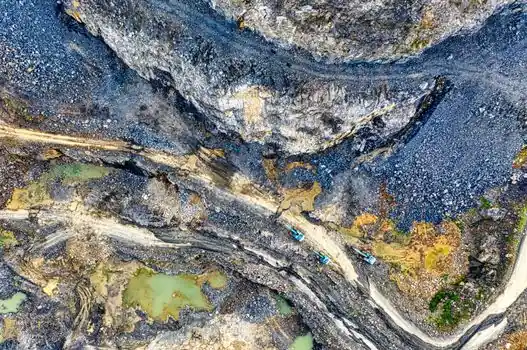
Concrete trailer pumps in the 25 m3/h to 120 m3/h range cover most quarry duties; the LUTON HBT40-10-82R spec, with 40 m3/h theoretical output and 10 MPa maximum pumping pressure, and 120 m vertical / 500 m horizontal reach on a Weichai 82 kW diesel, is a representative mid-size benchmark for quarry line pump service [S1]. The smaller HBT30-6-52R unit at 30 m3/h and 6 MPa with 52 kW electrical power fits inside-pit secondary pours on a generator feed [S1].
Quarry mix designs typically use crushed aggregate with a higher LA abrasion value than river gravel, which accelerates wear-ring and cutting-ring replacement. Pump cylinder diameter and stroke (for example Ф180×1300 mm on the HBT40, Ф200×500 mm on the HBT30) set the per-stroke volume, and the operator selects the larger bore when the mix carries 20 mm plus aggregate [S1]. High-pressure line pumps running to 500 ft also need an S-type distribution valve, which is what both LUTON HBT models use, because the valve geometry survives the abrasive crushed-stone mix better than rocker-arm valves in this duty [S1].
Boom Reach vs Trailer-Pump Reach: When to Pick Each
Truck-mounted boom pumps win on quarry crusher pads and bench walls where the boom can sweep 36 m to 65 m from a single outrigger set, with the 65 m class boom referenced as a current high-reach benchmark for North American quarry pours [S3]. Trailer pumps win on long horizontal runs to remote sumps, sediment pond liners, or secondary haul-road sections where a boom truck cannot stage [S2][S3].
A practical field rule: if the pour point is more than 500 ft from the nearest truck-accessible bench, or the bench cannot hold a 20 ft by 20 ft outrigger footprint, the trailer-pump-plus-hose setup replaces the boom truck [S3]. If the pour sits within boom radius and the bench is firm, the truck-mounted boom cuts placement time roughly 3:1 over a line pump on the same volume, because the boom delivers the m3/h directly without manual hose handling [S2][S4].
Abrasion, Maintenance, and Wear-Part Spec
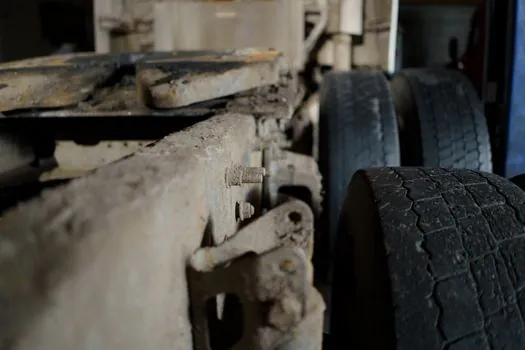
Concrete trailer pumps run 25 m3/h to 120 m3/h output and depend on a wear plate, cutting ring, and delivery pipe wear life to survive quarry mix designs [S1]. A quarry operator running a crushed granite mix at 80 m3/h should expect wear-ring inspection at roughly 8,000 m3 of throughput, with replacement on a planned shutdown, not on breakdown [S1][S4].
Boom-pump placing booms add their own wear surface: the boom delivery pipe elbows, where concrete changes direction. Quarry dust ingestion into the boom pipe accelerates elbow wear, so operators routing the boom through a crusher dust zone typically swap elbows at half the interval used on a clean civil site [S4]. The truck chassis itself is a multi-axle HGV class, similar in duty to a concrete mixer truck or a dump truck running the same haul road, so suspension and tyre spec follow quarry haul-road loadings rather than highway spec [S2].
Selection Criteria and Decision Matrix for Quarry Buyers
Four criteria separate the workable choices for quarry placement: theoretical output (m3/h), boom reach plus horizontal pipe reach, outrigger footprint versus available bench area, and wear-part spec for the aggregate hardness. The first cut is boom reach: a 36 m to 65 m placing boom on a multi-axle truck chassis handles any crusher pad or bench wall within a single set [S3][S4]. The second cut is volume: anything under 40 m3/h points to a trailer pump class machine (HBT30 or HBT40 family), while pours above 60 m3/h sustained push a truck-mounted boom [S1].
Quarry buyers should match the unit to access geometry before matching output: a tight switchback or a soft bench floor drops the boom truck from the spec and forces a line pump with up to 500 ft of delivery hose [S3]. Aggregate hardness sets the wear-part spec: S-valve units with hardened wear rings on both trailer and boom pumps are the baseline for crushed-stone mixes, and the operator budgets wear-part replacement at the m3 throughput interval rather than on calendar time [S1][S4]. A truck-mounted concrete pump configured for quarry service typically shares its carrier chassis spec with a concrete pump truck used on heavy civil sites, so the chassis selection follows haul-road loadings rather than the pump spec itself.
Limits, Failure Modes, and Quarry-Specific Risks
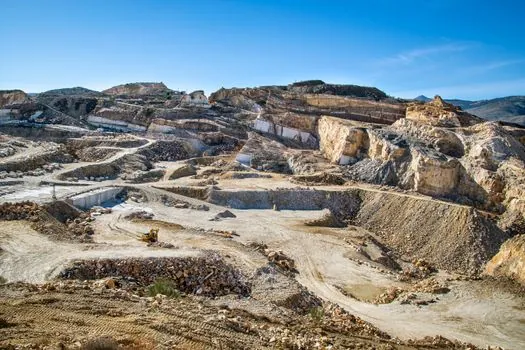
Boom truck overruns on quarry bench floors are the most common failure mode, caused by outrigger pads sinking into uncompacted fill rather than mechanical pump failure [S3]. Mitigation is a 20 ft by 20 ft compacted gravel pad per outrigger, and a walkthrough site assessment before the truck rolls [S3]. A second risk is delivery line blockage from oversized aggregate in a quarry mix that exceeds the pump cylinder bore rating; matching cylinder bore (for example Ф180 mm) to the largest aggregate in the mix is non-negotiable, and the operator rejects any batch over the rated top size [S1].
A third risk is dust ingestion into hydraulic oil when the boom pump operates near a crusher discharge; specifying sealed hydraulic reservoirs and higher-rated intake filtration extends service intervals in this dust load [S4]. Buyers who do not plan a line pump as a fallback for tight-access or soft-ground conditions will see pour delays, because the boom truck alone cannot cover every quarry geometry [S3]. For a broader pump-class selection map that puts the concrete pump truck next to self-priming and vacuum pumps on the same criteria, see Self-Priming Pump vs Concrete Pump Truck: Spec-Driven Selection Map.
Track two signals over the next planning cycle: any new S-type distribution valve wear-life data published by quarry contractors on crushed-stone mixes, and any quarry-side deployment of a 65 m or larger boom pump that resets the reach benchmark for bench-wall pours [S1][S3].