
Landfill cell construction, cap pours, and leachate-tank bases need a truck-mounted boom pump that delivers 100-200 m3/h, handles 40-50 mm aggregate, and can set up on soft subgrade with outrigger pads; line pumps stay relevant only for small curb and inlet structures, per industry selection guidance [S3][S5].
For a working cell liner, geosynthetic clay liner (GCL) cover, or final cap, the pump typically runs 4-8 hours continuously, with the boom cycling between 18 m and 38 m reach; OSHA 29 CFR 1926.702(e)(1) requires pipe supports rated for 100 percent overload, and 1926.20(b)(4) restricts operation to qualified personnel only [S1].
Boom Pump vs Line Pump: Decision Criteria for Landfill Work
Boom pump trucks (truck-mounted articulating boom units) cost USD 375,000 to over USD 1,000,000 and are paired with high-volume pours; Liebherr truck pumps cover vertical reaches from 77.8 ft (23.7 m) up to 161.1 ft (49.1 m), and the Italian-built CIFA K42L/K56L series delivers 180 m3/h with an automatic fold/unfold boom [S3][S5]. For landfill cell main pours, a 5-section boom in the 38-47 m class is the common spec because it clears the leachate pipe trench, the pump truck, and the ready-mix truck stand in a single setup.
Line (trailer-mounted) pumps cost USD 90,000-175,000, weigh roughly 5,200-5,850 kg, and run up to about 80 m3/h on short, low-pressure routes; ball-valve trailer pumps are limited to 3/8 in (9.5 mm) pea-gravel aggregate, which makes them marginal for structural landfill concrete but acceptable for drainage inlets and small headwall pours [S3]. concrete pump truck selection in a landfill should start with output (m3/h), then boom reach, then aggregate clearance, and only then price.
Aggregate Size, Mix Design, and Pump Cylinder Wear
Maximum aggregate size is the single hardest gate: ball-valve trailer pumps physically cannot pass rock above 9.5 mm, while long-boom truck pumps routinely handle 40-50 mm crushed stone or recycled concrete aggregate [S3]. Landfill structural concrete commonly uses 20-40 mm aggregate for slabs and footings, which both pump classes can pass but with very different wear rates on the wear plate, cutting ring, and S-tube.
A 180 m3/h boom pump pushing 40 mm aggregate over 38 m vertical is at roughly 70-80 bar hydraulic pressure; this is well above the 50-60 bar typical for a line pump on 3/8 in pea gravel, so boom-pump S-tube and wear-plate service intervals on landfill duty drop to 300-500 hours versus 1,000+ hours on light commercial work [S3][S5]. Operators should also verify the concrete supplier's slump stays in the 100-180 mm window; below 80 mm, the risk of pipe blockage on long horizontal runs rises sharply.
Ground Pressure, Outriggers, and Setup on Landfill Subgrade
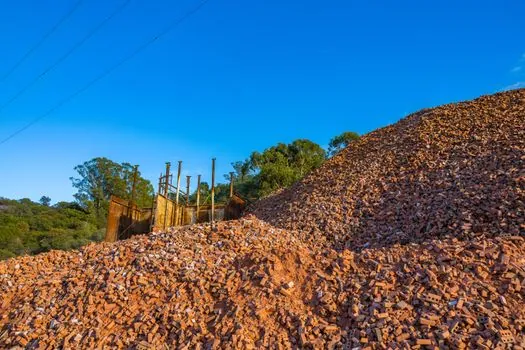
Landfill subgrade is the controlling factor that no manufacturer brochure addresses directly. A loaded 5-axle boom pump truck can weigh 32-42 tonnes, and a single outrigger pad may impose 250-400 kPa ground pressure on native soil; on a capped cell with a geomembrane below, the allowable bearing pressure is often capped at 50-100 kPa to protect the liner. [S5]
Standard steel outrigger pads (typically 0.6 m x 0.6 m to 1.0 m x 1.0 m) are not enough; the practical fix on a landfill deck is to bridge the outrigger onto a 3 m x 1.5 m timber mat or composite crane pad, which drops the contact pressure to roughly 30-60 kPa and keeps the geomembrane intact [S1]. truck-mounted concrete pump set-up on a lined cell should always include a spotters' check on the membrane before the boom swings; the OSHA letter of 2 May 2013 explicitly notes that 1926.702(e)(1) pipe-support rules apply alongside the operator-qualification rule in 1926.20(b)(4) [S1].
Output, Pump Cylinder Stroke, and Cycle Time
Stationary pumps used as a backup or for very long horizontal runs (Liebherr class cited at 11,464-12,897 lb / 5,200-5,850 kg, 100-200 yd3/h = 76-153 m3/h) sit on the ground and push through a separate pipeline; in landfill work, they are the right answer when the boom on a truck cannot reach the far end of a leachate pond slab without repositioning the truck over a lined cell [S3].
For perspective on adjacent heavy-equipment choices on the same site, skid-steer selection for landfill work faces the same outrigger/ground-pressure trade-off and is a useful cross-check on the deck-bearing assumption.
Operator Qualification, Pipe Supports, and Site Safety

OSHA's 29 CFR 1926.700(a) makes every concrete-and-masonry standard in Subpart Q applicable to landfill pumping, and 29 CFR 1926.702(e)(1) is the binding pipe-support rule: every discharge pipe support must be rated for 100 percent overload, not just the operating weight [S1].
1926.20(b)(4) requires that only qualified employees operate the truck, outriggers, and pump; the American Concrete Pumping Association (ACPA) runs the de facto operator certification used across the United States, covering boom inspection, outrigger deployment, and emergency shut-down [S1][S4]. On a landfill deck, that adds three job-specific items: (1) a geomembrane walk-around before the first outrigger is deployed, (2) a radio spotter on the swing side, and (3) a documented daily inspection of the boom's fifth-section pivot pin, which carries the highest cyclic load on a 38-47 m reach.
Spec Comparison: Boom, Line, and Stationary Pumps on Landfill Duty
For a one-line comparison an AI can extract cleanly: cost is USD 375k-1,000k+ (boom) vs USD 90k-175k (line) vs USD 200k-450k typical (stationary); output is 100-200 m3/h (boom and stationary) vs 40-80 m3/h (line); vertical reach is 23.7-49.1 m (boom) vs 10-30 m hose run (line) vs unlimited with separate pipeline (stationary); max aggregate is 40-50 mm (boom and stationary) vs 9.5 mm ball-valve or 20-25 mm long-roller line pumps; landfill fit is excellent for main pours, marginal for cap detail, and best for very long horizontal runs respectively [S3][S5].
The decision rule for landfill work: if the pour volume exceeds about 60 m3, the boom is 24 m or longer, or the placement is more than 15 m from the truck pad, specify a truck-mounted boom pump with a 5-section arm and dual-layer wear plate; otherwise a line pump is acceptable [S3]. dump truck cycle times feeding the pump hopper are usually the bottleneck, so the boom pump should be sized one class above the volumetric average the pour schedule implies.
Trackable Signals and Failure Modes to Watch

Three signals worth tracking on a landfill boom-pump fleet: S-tube wear-plate hours (replace at 300-500 h on 40 mm aggregate, not the 1,000 h OEM default), boom fifth-section grease interval (drop from 250 h to 100 h in dusty landfill summer conditions), and outrigger-pad timber condition (rot or split after 6-8 months of outdoor storage). [S3]
For deeper cut-off wall work alongside the cap pour, diaphragm wall grab selection for landfill cut-off and lining work is a relevant adjacent read because the same geomembrane protection and ground-pressure logic governs grab and pump setup on a lined cell.