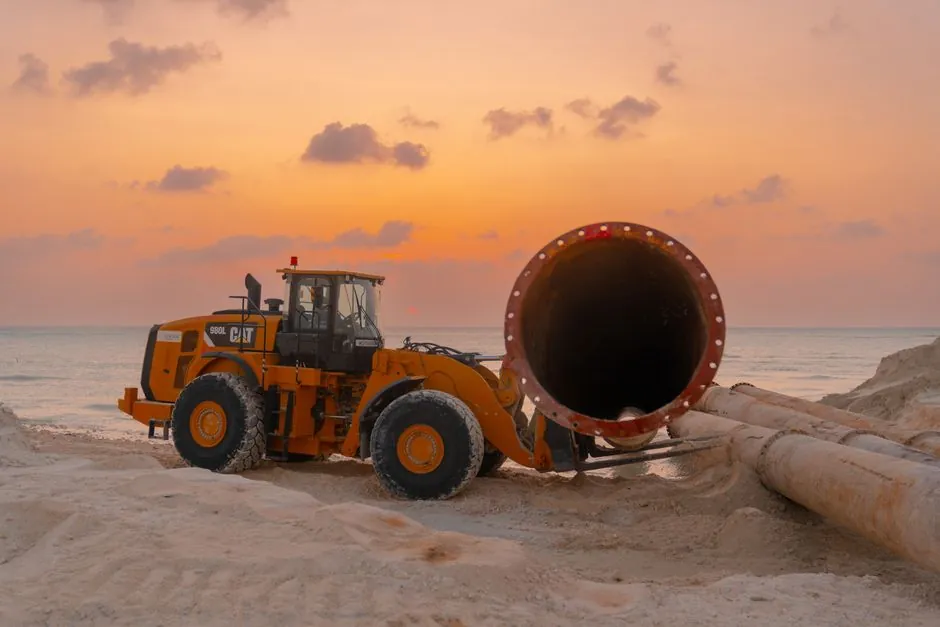
A concrete mixer truck on a pipeline spread is rarely judged on mixer-versus-agitator capacity alone: it is judged on whether the drum, chassis, and pump-truck handoff can keep a continuous pour alive across a moving trench [S1][S5].
The operating envelope that matters on pipeline work is narrow. Most spread planners settle on a 6x4 chassis for short-haul urban tie-ins, an 8x4 for suburban trunk mains, and a 10x4 for long-haul cross-country line pipe where a single 9-12 m³ drum load covers a full thrust-block or encasement pour without a return trip to the plant [S3]. Volumetric mixers replace drum carriers where the trench moves faster than ready-mix trucks can cycle, with crews typically staging two or three units in a Y-pattern off the corner of the concrete pump truck so a loader can recharge cement powder between batches [S5].
Drum Configuration: Mixer vs Agitator Capacity and Blade Geometry
A drum rated as a mixer can carry roughly 10% less volume than the same drum rated as an agitator, because mixing requires headroom for the spiral blade action while agitation only needs to keep the load from segregating [S1]. The drum itself is a double-cone or pear shape with internal spiral blades, driven through a hydraulic pump, motor, and gearbox that convert chassis PTO power into the 4-14 rpm rotation used in transit [S2]. Pipeline crews should treat the wear plates inside the drum as a service item: thin or welded-over plates change the lift angle of the blades and directly raise the risk of segregation on the haul to the pump [S3]. A rear-discharge drum remains the most common configuration on rear-discharge mixer bodies, and it pairs with the standard or bridge-model drum shell that OEMs offer for heavier daily cycle counts [S4].
For a pipeline contractor weighing the choice between a standard concrete mixer truck and a rear-discharge unit, the practical difference is chute geometry: rear-discharge trucks can back up to the pump hopper without a front stand, which is decisive on narrow right-of-way work where turning radius is constrained [S4].
Axle Configuration, Weight Compliance, and Haul Distance
Axle choice is the single biggest line item in mixer-truck selection for pipeline work, because the same chassis that is legal on a motorway may be illegal on a soft trench access pad. In heavy-transport markets such as the Netherlands and Belgium, 8x4 and 10x4 axle configurations are the common solution for heavy concrete haul, while 6x4 is treated as adequate only for lighter urban pours [S3]. For pipeline work that crosses rural right-of-way with soft shoulders, the trade-off is total loaded weight versus ground pressure: a 10x4 spreads the load across more tires and survives a low-bearing-capacity haul road, but it is longer and harder to back up to a pump set in a tight easement.
For cross-country line pipe where the batching plant is 30-90 minutes away, the relevant question is not axle count but drum cycle count. A drum running continuous rotation at the manufacturer-set transit speed will hold slump within spec for roughly 90 minutes; beyond that, water addition at the truck becomes a quality risk rather than a fix [S2]. On long hauls, the same truck configured as an agitator (lower rpm, no mixing headroom) will hold workability longer than a mixer-rated drum, which is why haul-distance planning should be done against agitator-mode retention time, not against the headline mixer capacity number [S1].
Drum vs Volumetric Mixer: Pump-Truck Hand-Off Geometry
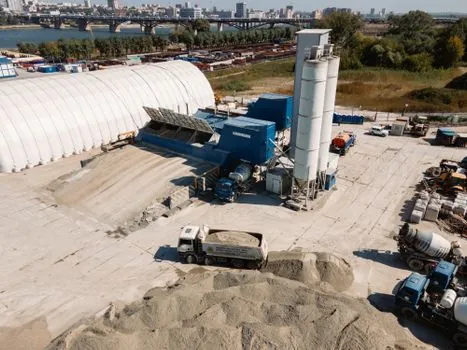
The decision between a ready-mix drum carrier and a volumetric mixer is, on a pipeline spread, really a decision about the truck-mounted concrete pump it feeds. Drum carriers work well when the pump is set at a fixed point (a tie-in, a valve cluster, a jacking pit) and the drum truck can shuttle in and out on a defined cycle. Volumetric mixers work better when the pour is continuous and the pump is fed by multiple units staged in a Y-pattern around the pump hopper, with a loader refilling cement powder between batches so production does not stall [S5].
For typical pipeline criteria, the comparison is straightforward:
- <b>Drum carrier (6x4 to 10x4, 6-12 m³)</b>: best for fixed-pump pours, urban tie-ins, and any haul where a batching plant is within 60-90 minutes. Lower capital cost, simpler QA, but each truck must return to the plant between loads [S1][S3].
- <b>Volumetric mixer on truck chassis</b>: best for continuous trench pours, remote right-of-way, and emergency repair work where slump control at the pump is more important than haul distance. Higher capital cost and an on-board loader, but eliminates the return-trip bottleneck and lets the crew adjust mix design in real time [S5].
- <b>Mixer with integral pump</b>: a hybrid unit that combines drum and pump on one chassis; useful on small-diameter spread work where a separate pump truck cannot be justified, but the integral pump limits boom reach and pipeline diameter versus a dedicated pipeline pump or boom pump [S3].
Inspection Points for Used Units Headed to a Pipeline Spread
Buying used for pipeline work is normal practice, but the inspection has to cover more than engine hours. Three checks are decisive: drum wear plate thickness (measured, not visually estimated), drum bearing play (any knock or scrape on rotation points to bearing or drive-system wear), and hydraulic pump health under load (a pump that delivers rated drum rpm on the bench but bogs under a full load is a written-off unit) [S3].
For pipeline operators running long-tenure fleets, the spec to demand from any used unit is the same as for a new one: documented service history on the hydraulic system, a drum that has been re-bladed within the last 12 months, and an axle load certificate that matches the in-service configuration. Brand-level reputation does matter here. MAN chassis are noted for relatively low maintenance cost on heavy construction duty, while Mercedes chassis tend to score on driving comfort and engine performance on long-distance haul, and both have deep used-market support in most regions [S3]. For a fleet manager balancing the two, the decision is usually driven by local dealer coverage rather than headline specs.
Pump-Truck Staging, Slump Control, and Continuous-Pour Discipline
On a continuous pipeline pour, the limiting equipment is almost always the pump, not the mixer, so staging is the discipline that determines success. Each volumetric mixer should be positioned in a Y-pattern off one corner of the pump so a wheel loader can pass between them and refill cement powder, with the pneumatic cement trailer placed so it can be swapped without interrupting the pour [S5]. If water is needed beyond what the mixers carry, a water truck is positioned in front of or directly beside the pump, and the cleanest source is a nearby hydrant with hose runs to the mixers [S5].
Slump at the pump hopper is the QA checkpoint that ties the whole chain together. Mixer trucks keep the drum rotating clockwise at a set speed during transit to prevent segregation and moisture loss, and water can be added in transit through the on-board water supply system if the mix stiffens [S2]. For a drum truck feeding a pump, the correct sequence is: arrive, re-mix the drum at mixing speed for 1-2 minutes, check slump at the chute, and only then discharge into the pump hopper. Skipping the re-mix step is the most common field cause of pump-line blockages on pipeline work [S2].
Selection Criteria Summary for Pipeline Procurement
For a contractor specifying a mixer-truck fleet against a pipeline scope, the decision matrix collapses to four questions. Haul distance to the batching plant: under 60 minutes, drum carrier; over 60 minutes, consider volumetric or add an agitator-rated drum. Pour type: discrete (thrust block, encasement, valve pad) versus continuous (long trench, encasement run), where continuous favours volumetric staging [S5]. Right-of-way geometry: tight urban easement favours rear-discharge drum carriers for chute access [S4]; soft rural right-of-way favours a 10x4 to spread axle load [S3]. Pump match: separate concrete pump truck for long-reach or large-diameter work, integral mixer-pump only for short-reach, low-volume tie-ins [S3].
For more on matching drum carriers to adjacent construction equipment, see this spec map on storage rack selection for quarrying and this comparison of screw pump vs concrete pump truck selection for 2026 jobsites. For the matching earthworks side, the cold milling machine selection spec map and the asphalt paver selection for landfill cell construction are the closest reference points for adjacent trench-surface equipment choices.
Trackable signals for the next planning cycle: OEM release of higher-pressure hydraulic pump options for 10x4 drum carriers, revision of any DOT-style axle-load guidance for off-pipeline right-of-way, and any new rear-discharge drum body offering aimed at narrow easement work [S4].