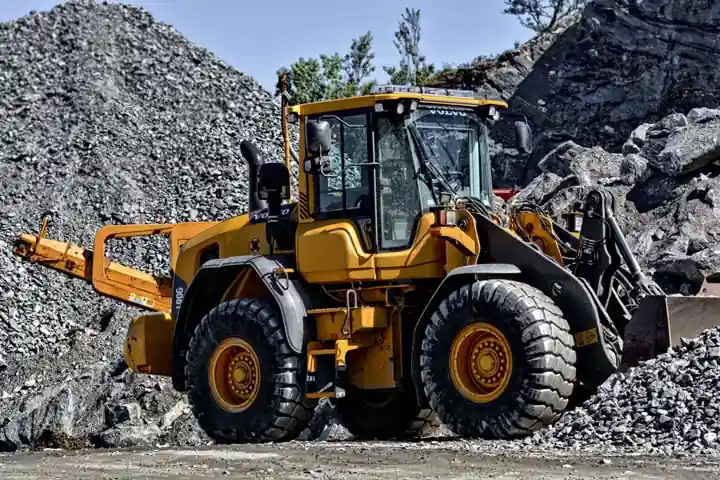
Mining concrete placements are not construction pours. A 100,000+ lb boom truck on a soft pit-floor subgrade with a 30-60 m reach [S5] faces a tipping and bearing-pressure problem the contractor-grade datasheet does not address, so mining-duty selection starts with ground pressure and outrigger footprint, not boom length.
For surface-mine infrastructure (crusher foundations, transfer towers, ramp repairs, paste-fill bulkheads, ROM pad slabs), the three deciding specs are maximum theoretical output (m³/h), vertical reach (m), and outrigger pad ground-bearing pressure (kPa). Anything else is secondary, because the truck will live on shot rock, mud, or slope benches, not on a formed slab.
Boom Reach vs Site Geometry: What the Truck Datasheet Does Not Tell You
Vertical reach in mining duty rarely governs, because most pours are slab-on-grade or low-wall. Horizontal reach does, and a 38-47 m four-section boom typically clears one lane of haul-truck traffic plus a rebar cage without repositioning [S6]. The 5-section Roll-fold or Z-fold variants add 4-7 m of working envelope but cost 1,500-2,500 kg of un-sprung mass at the tip, which raises tip-deflection under load and tightens the wind envelope on exposed benches.
For tight crusher-pocket work where the truck cannot back into the pour, a boom with 360° slewing and a short front outrigger spread (under 7.0 m) is more useful than raw reach. Cemstone's fleet, ranging from 24 m straight-boom units up to 61 m five-section booms [S2], shows the practical envelope: most mine concrete work is covered by a 36-42 m four-section roll-fold, with a 24-28 m short-boom unit for shop pads and tunnel portal works where the truck parks in a fixed bay.
For deeper context on how boom and pump subsystems interact, see the dynamic-load model in Cazzulani (2011) [S3]; the paper frames the boom and the concrete-pump circuit as the two coupled subsystems that drive chassis fatigue, which is the right way to think about mining duty where cycles are long and pour rates are high.
Outrigger Footprint, Pad Bearing Pressure, and the 1:1 Setback Rule
OSHA 29 CFR 1926.702(e)(1) requires discharge-pipe supports designed for 100% overload [S1]; in practice the same logic applies to outrigger pads, which see transient spike loads when the boom slews and concrete surges. The widely used 1:1 setback rule states that outrigger pads should be set back from the edge of any excavation by a distance at least equal to the depth of the excavation [S4]. On an open pit bench, treat the bench crest the same as an excavation edge: 1:1 horizontal-to-vertical offset, no exceptions.
Ground bearing pressure is the real selector. A 52 m boom truck at full reach can impose 350-500 kPa at a single outrigger pad on competent subgrade, and the load roughly doubles when one pad is near the bench edge. Standard 600 x 600 mm crane pads are not enough; mining-grade concrete-pump setups use FiberTech MultiPads or SteelTech Dunnage plates (DICA product lines) that spread load to under 150 kPa on pit-floor material [S4]. For softer alluvial or tailings subgrade, ground-protection mats (SlatTrax or equivalent) under each outrigger are mandatory.
Pre-pour inspection of outrigger pads, hydraulic cylinders, and boom pins is an OSHA-recognized operator duty [S5]; on mining sites, document each pad's calculated ground bearing and setback distance in the pre-pour JSA, because regulators and the mine's own ground-control engineer will both ask.
Pump Circuit and Output: Open vs Closed Loop, m³/h, and Aggregate Tolerance
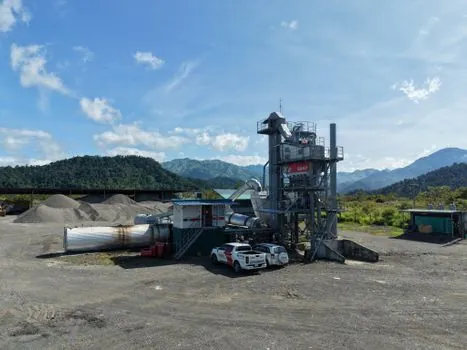
Truck-mounted concrete pumps fall into two main classes: the more common boom pump (truck-mounted boom with integral pump cell, typically 130-160 m³/h peak) and the line pump (trailer- or skid-mounted pump feeding pipe or hose by hand, typically 60-90 m³/h) [S6]. For mine applications, the boom pump is the default because the boom removes hand-hose labour and reduces blocked-pipe incidents; line pumps only win on remote shotshafts or portal faces where the truck physically cannot stand.
Pump-circuit detail matters more than the headline m³/h figure. Open-loop pumps tolerate dirty water and oversize aggregate better and are cheaper to rebuild; closed-loop pumps hold higher line pressure (up to ~85 bar vs ~70 bar for open loop) and give smoother output at low flow, which is what you want on thick paste-fill or SCC where segregation at the hose end is the failure mode. Most 38-47 m boom pumps on the market are built around a single long-stroke closed-loop hydraulic circuit; rebuild kits for the S-valve and wear plate are interchangeable across major OEM lines, which is the practical reason fleet buyers standardize on one brand.
For pour economics on remote benches, the rule of thumb in [S5] holds: a single pump failure mid-pour costs $5,000-$25,000+ in wasted concrete, cleaning labour, and schedule slip. On a 6-hour paste-fill cycle, the cost of a redundant standby pump is recovered in one avoided incident, which is why the larger open-pit operations run a primary boom pump plus a diesel line pump on standby.
Selection Matrix: Boom Pump vs Line Pump for Typical Mining Pours
Three criteria decide it for most mine sites: reach, ground condition, and pour volume. A 36-47 m boom pump wins on any pour over 30 m³ with competent subgrade and pad access. A line pump on a separate skid or trailer [S6] is the right answer for shaft collars, vent raises, and portal sills where the boom truck cannot approach within 6 m of the face. A short-boom 24-28 m truck-mounted pump is the best fit for shop slabs, wash-bay sumps, and small crusher-base repairs where total volume is under 20 m³ and the truck can park on existing concrete.
On output capacity: 130-160 m³/h peak for boom pumps versus 60-90 m³/h for trailer line pumps [S6]. On operator qualification: 29 CFR 1926.20(b)(4) restricts operation to employees qualified by training or experience [S1]; on mine sites this maps to the OEM certification plus the mine's own equipment-authorization sign-off.
For the broader mobile-equipment context on mine benches, the capacity-vs-terrain logic in truck-mounted crane selection for mining applies to pump trucks as well: ground pressure, travel width on haul roads, and tip stability under dynamic load drive the spec more than engine horsepower does.
Compliance, Inspection, and Operator Documentation for Mining Sites
OSHA 29 CFR 1926.700(a) sets the umbrella requirement for concrete and masonry construction safety, and 1926.702(e)(1) layers the 100% overload pipe-support rule on top of it [S1]. On a US mine, MSHA has jurisdiction over the equipment when it is operating in an active mining area (haul road, pit floor, bench), and OSHA 1926 applies when the same truck is on a permanent preparation plant or mill site; the operator needs both sets of paperwork in the cab, and the JSA must reference whichever authority is in play on that day.
A complete pre-pour inspection covers engine fluids, tyres, brakes, platform and restraining devices, hydraulics, boom pins, outriggers and pads, pipeline and couplings, and the pump cell and hopper [S5]. On a mining pre-pour card, add three items the construction card usually omits: bench-edge setback distance per the 1:1 rule [S4], ground-bearing calculation for each outrigger pad, and confirmation that the haul road or stand pad has been signed off by a ground-control engineer.
Operator training under 29 CFR 1926.20(b)(4) and 1926.21(b)(2) [S1] covers the truck, the outriggers, and the concrete-pump system as three separate competencies; on most mine sites a third-party OEM certification plus a site-specific equipment authorization is the minimum that will pass an MSHA inspection.
Failure Modes and Limits Unique to Mining Duty
The dominant failure mode in mining service is outrigger punch-through, not boom failure. A 350-500 kPa pad load on a saturated tailings or clay subgrade will sink 50-150 mm in minutes once the boom slews, which twists the chassis and can crack the turntable bearing. Mitigation is mechanical: larger pads, ground-protection mats, and a forbidden-zone map around the truck that excludes haul-truck wheel paths within 3 m of any outrigger. [S4]
The second failure mode is pipe-line blockage at the S-valve, usually from aggregate segregation when the pump runs at low flow on long horizontal shots. Closed-loop pumps with smoother low-flow output reduce but do not eliminate this; the operator-side fix is to keep line speed above 8-10 m³/h whenever possible and to reprime the hopper before each long pause. Wear-plate life on abrasive mine aggregate is typically 40-60% of construction-service life, so rebuild-kits should be stocked on site.
The third limit is wind. Most 52+ m booms have an operating wind envelope of 12-14 m/s at full reach; on exposed pit-rim pours this gets shut down well before that, and the planning question is whether to pour in two short boom reaches instead of one long one. For adjacent equipment selection on the same bench, see dynamic compactor selection for road construction, which faces the same subgrade and wind constraints.
Two trackable signals for the next planning cycle: (1) any mine operator tender released after 2026-09-06 that specifies a ground-bearing limit below 200 kPa at outrigger pads, which would force a wider pad or a smaller boom class; (2) any OEM datasheet update that publishes per-pad ground pressure rather than the current whole-vehicle weight figure, which is the single most useful mining-duty spec and is still widely missing. Either of those will materially change the shortlist for the next fleet purchase.
For component-level specifications, see mining dump truck, concrete pump truck, and truck mounted concrete pump.