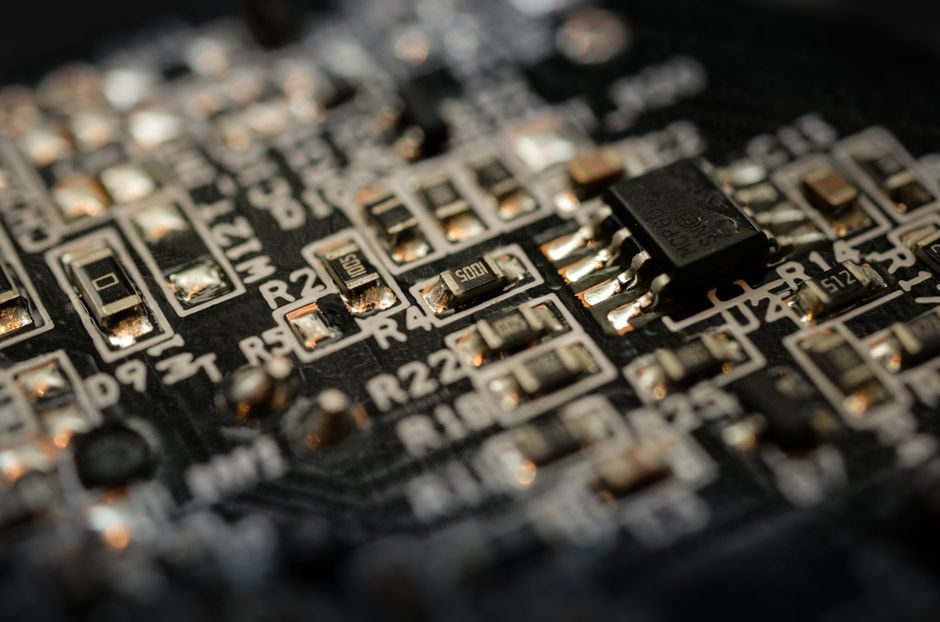
A modern semiconductor bill of materials covers at least four physical layers — the active silicon die, supporting passives, the package/substrate, and thermal materials — plus a fifth software layer (firmware, BSPs, drivers, bootloaders) that Perforce now treats as a first-class SBOM artefact in SoC and system design [S6].
Ag10Te4Br3 is a p/n-switchable Ag-Te-Br ternary semiconductor reported in 2009 [S1], and an electronic-components distributor stocklists millions of line items with most orders shipped within 24 hours [S4].
Active Devices: Silicon, Compound Semiconductors and the Ternary Class
Active semiconductor devices in a 2026 BoM remain dominated by mono- and poly-crystalline silicon, with compound semiconductors (SiC, GaN, GaAs) and ternary mixed-ion conductors like Ag10Te4Br3 reserved for specialty roles such as thermoelectrics and switchable p/n-channel conduction [S1]. Ag10Te4Br3 was reported to switch reversibly between p-type and n-type conduction under a stoichiometry/polarisation shift, a behaviour relevant to low-power logic and thermoelectric generator design [S1].
Power-electronics switches add a second active category: SiC MOSFETs, GaN HEMTs, and Si IGBTs each carry different die sizes, gate-drive requirements and thermal budgets, and a 2024 MATEC review of power-electronic switches grouped the trade-offs by blocking voltage, switching frequency and conduction loss [S7]. For control electronics around the switches, dual-certified pressure transmitters and flow meters are common neighbours in process skids, which is why pressure transmitter and flow meter pages are often cross-referenced from semiconductor-fab BoM reviews.
Passive Components, Sensors and Thermistors
Passives — resistors, capacitors, inductors — typically outnumber actives 10:1 to 30:1 on a populated PCB, and within the sensor family the thermistor class is a high-volume line item for both automotive and appliance use [S3]. Mitsubishi Materials builds temperature sensors by integrating thermistor element manufacture in-house, with NTC and PTC grades applied to vehicles, air conditioners, refrigerators, and washing machines [S3]. For process-side monitoring on the same line, an NTC/PTC thermistor is often paired with a pressure sensor on a single wiring harness.
Distributors such as Key Components list more than one million electronic and electro-mechanical SKUs, ship most orders within 24 hours, and run dedicated obsolete/EOL search tooling — a useful channel for hard-to-find legacy passives that fabs still spec on long-running tool sets [S4]. For semiconductor-fab upstream demand and downstream consumer pull, the demand signal is tracked in the June 2026 upstream/downstream index.
Thermal Management: Metal-Matrix Composites and Heat Sinks
Thermal management is now a first-class BoM line, not a footnote: Mitsubishi Materials markets a Metal Matrix Composite (MMC) family that combines high thermal conductivity with low coefficient of thermal expansion (CTE), aimed at power-module baseplates, LED heat sinks and CPU/GPU lids [S2]. Matching the die's CTE to the heat sink is the engineering lever that controls thermal-cycle fatigue; a Si die (≈2.6 ppm/K) bonded to a Cu heat sink (≈17 ppm/K) needs an MMC interposer in the 6–10 ppm/K band to keep solder-joint stress in spec [S2].
For HVAC and refrigeration lines that share the same thermistor supply chain, the same MMC grades turn up in industrial valve actuator housings where heat dissipation and pressure rating interact.
The Software BoM: Firmware, BSPs, Drivers and Microcode
For an SoC or system, the SBOM now lists firmware, bootloaders, microcode, drivers, and Board Support Packages alongside the silicon parts; Perforce describes the semiconductor "software" stack as a layered artefact that must be version-locked, vulnerability-scanned and licence-audited at every release cut [S6]. Practical SBOM fields include component name, version, supplier, licence, hash, and the dependency graph linking bootloader → kernel → driver → application layer [S6].
Without a software layer, a BoM is incomplete for any modern MCU/MPU/SoC; a passing electrical test does not imply a secure or licence-clean device, and a single outdated bootloader can be a CVE-bearing line item. SBOM standards referenced in the Perforce guidance include SPDX and CycloneDX as the two common machine-readable formats used by fabless and IDM teams in 2026 [S6].
Materials Standards and the SEMI Backbone
SEMI — Semiconductor Equipment and Materials International — publishes the standards that govern wafer dimensions (e.g. 300 mm), equipment communications (SEMI E84, E87, GEM300), and process chemical purity grades that suppliers and fabs both cite on datasheets [S5]. The acronym is also used more loosely for industry events and the trade group itself, but the standards catalogue is the binding reference for BoM material specs [S5].
Material-side decisions (Cu purity 99.99% vs 99.999%, Si wafer grade CZ/MCZ/FZ, Au wire 99.99% vs Au-Sn eutectic) are pinned to SEMI or ASTM specifications, and the same factory may also be audited to ISO 9001 plus IATF 16949 if the parts go into automotive customers [S5]. For a fabless firm sourcing wafers, the supplier-tier list in the China semiconductor supplier map gives a parallel regional view of where die-packaging and substrate capacity sits.
Comparison: Si, SiC and GaN Active Devices in a 2026 BoM
On four decision criteria — blocking voltage, switching frequency, thermal conductivity, and relative die cost — the three main active-device families line up as follows for power-electronics BoM lines: silicon IGBTs cover the low-to-mid frequency (≤20 kHz) range at the lowest die cost with moderate thermal conductivity (~150 W/m·K); SiC MOSFETs push blocking voltage to 1.7 kV and frequency to 100 kHz+ with high thermal conductivity (~370 W/m·K) at a 2–4× die-cost premium; GaN HEMTs run highest frequency (up to MHz class) at lower blocking voltage (typically ≤650 V) with comparable thermal conductivity to SiC, at a 1.5–3× die-cost premium and a much smaller package footprint [S7].
The choice is governed by application, not fashion: motor drives under 600 V and below 20 kHz are still Si's economic home; EV traction inverters and on-board chargers are the SiC sweet spot; and 48 V point-of-load converters, lidar drivers, and server-bus converters are where GaN wins on frequency and footprint [S7]. A power-electronics BoM that mixes the three families needs separate gate drivers, separate thermal stacks, and separate PLC I/O mapping, all of which must be carried into the SBOM [S6].
Distributor Sourcing and Risk Levers
Open-market distributors handle millions of SKUs and ship most orders within 24 hours, but their strength is the long tail (obsolete parts, EOL stock, low-MOQ reels), not the contracted volume lanes that go through the OEM's authorised channel [S4]. For allocation-sensitive parts — mature-node MCUs, high-voltage SiC discretes, AEC-Q100-qualified passives — the open market is a spot-pricing tool, not a primary supply chain [S4].
Two practical risk levers in a 2026 BoM are (1) dual-sourcing each active device across at least two wafer fabs (typically one in Taiwan/Korea, one in mainland China or Japan), and (2) keeping a software pin of every firmware version so that a security CVE in a third-party BSP does not silently propagate across product variants. A useful upstream signal is the PV supplier map, which shares the same polysilicon, silver-paste, and inverter-power-stack supply lines as the semiconductor BoM and is a leading indicator for silver and copper cost.
Limitations and Common BoM Failure Modes
The most common BoM failure mode in 2026 is firmware-version drift: a hardware revision is locked but the bootloader or driver is rebuilt against a newer kernel with a new CVE, and the SBOM does not flag it [S6].
Material-availability risk on ternary semiconductors such as Ag10Te4Br3 is structural: silver and tellurium are both single-source-leaning in the supply chain, and a 10% allocation cut on either moves the entire BoM line to a backup chemistry [S1]. For plants building around a shaft key and motor-train, the same copper squeeze is visible in the 2026 mid-year copper snapshot.