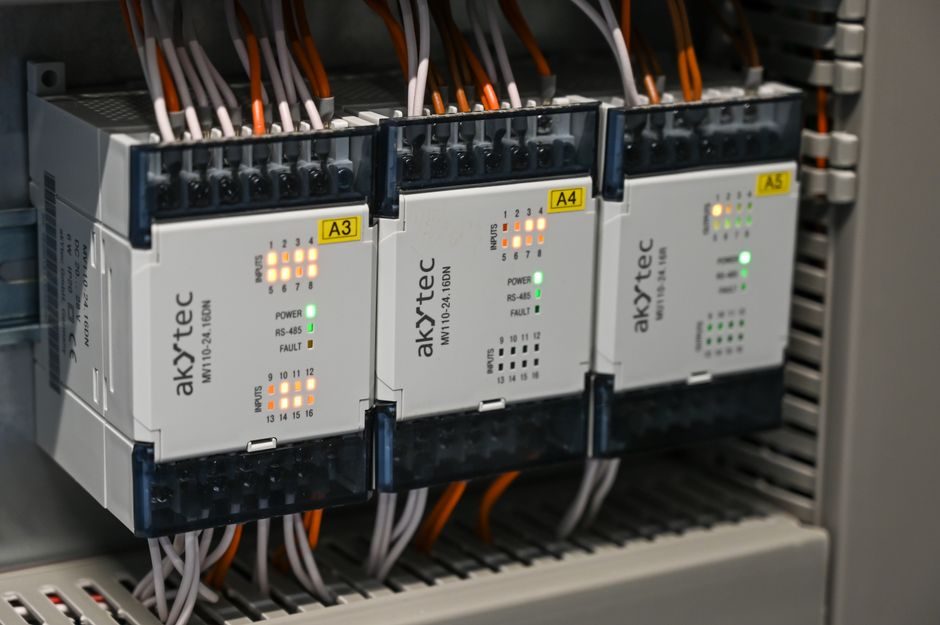
Specifying a servo drive for a 2026 build is a gate-driven exercise, not a brand preference. The first three numbers a controls engineer pins down are bus protocol (EtherCAT, PROFINET, Ethernet/IP), continuous/peak current ratio (typically 1:3 in servo-class amplifiers versus 1:1.5 in a VFD), and feedback device resolution (16-bit single-turn absolute minimum, 19-bit for precision packaging and machine-tool axes) [S2].
Reference designs crossing a controls engineer's desk in May 2026 repeatedly show 400 W to 7.5 kW three-phase 230/400 VAC servo amplifiers paired with low-inertia brushless servo motors, for example the Kinetix 5300 0.72 kW (3x 230 VAC) and 0.46 kW (1x) platforms carried by EU automation distributors [S2]. That power class is the bulk of the 2026 pick-and-place, packaging and CNC retrofit demand.
Gate 1: Bus protocol and motion controller compatibility
Bus choice locks out half the drive catalogue on the day the I/O list is signed. EtherCAT dominates multi-axis motion on packaging, semiconductor and lithium-cell winding lines; PROFINET is the default in brownfield automotive cells in Germany, Italy and the Czech Republic; Ethernet/IP remains the norm in US-owned packaging and converting machinery [S2].
Most 2026 servo amplifiers expose at least two of these protocols on the same hardware via a removable comms module, but only after the firmware variant is ordered correctly. A mismatch is not fixable in the field: a PROFINET-only drive on an EtherCAT ring will sit idle and the entire axis cabinet must be re-spec'd. The safe rule is to lock the controller family and protocol first, then filter the drive shortlist to that bus.
Gate 2: Continuous vs peak current and torque headroom
Servo-class amplifiers are sized on continuous RMS current, not on peak, and the published peak current figure is only usable within a defined cycle (commonly 1-2 s with 20-30% duty). The ratio of peak to continuous current for a modern servo drive sits near 3:1, against 1.5:1 for a general-purpose variable-speed drive (VFD) running an induction motor [S2].
Engineers running an aggressive acceleration profile (≤200 ms 0-to-3000 rpm ramps on a 3 kg mover) need that 3:1 ratio or the drive faults on I²t long before the motor reaches thermal limit. As a sanity check on the datasheet: continuous current × 3 must cover the worst-case acceleration current, with a 10-15% margin left for field temperature derating. A 750 W axis that pulls 9 A peak needs a drive rated at least 3 A continuous with 9 A peak, not 3 A continuous with 6 A peak.
Gate 3: Feedback resolution and commutation type
Feedback resolution sets the steady-state positioning floor. 16-bit single-turn absolute encoders (65 536 counts/rev) are the minimum for general automation; 19-bit (524 288 c/rev) is the working point for machine-tool axes, semiconductor handlers and any application with a sub-0.01° repeatability requirement; 23-bit and above is reserved for high-end optical encoders on servo motors with capacitive or optical second-loop commutation [S2].
Two practical consequences for the spec sheet. First, the drive must support the encoder protocol (Endat 2.2, BISS-C, Hiperface DSL, Tamagawa) - the same drive hardware is often sold in -DS, -EN, -HS firmware variants and the wrong suffix means the encoder does not enumerate. Second, absolute vs incremental matters at machine startup: incremental encoders need a homing sequence on every power-on, which adds 2-10 s of cycle time per restart on a packaging line that is already losing 30-60 s per shift to format changes.
Gate 4: Safety functions and STO/SBC/SLS integration
Functional safety has moved from a feature to a gate. The hard baseline for any new European build is STO (Safe Torque Off) to SIL 2 / PL d, supplied as a hardwired dual-input on the drive terminal block, with STO activation under 25 ms [S2].
Anything beyond STO - SLS (Safely Limited Speed), SDI (Safe Direction), SBC (Safe Brake Control) - is delivered over a black-channel safety protocol (PROFIsafe, CIP Safety, FSoE) and therefore requires the matching bus and controller to carry the safety telegram. Specifying an SLS-only application on a hardwired-STO-only drive is a known rework path: the drive must be exchanged or a black-channel safety module added, both of which break the cabinet layout. Buyers should treat SIL 2 / PL d STO as table stakes and require the safety protocol variant by part number on the BOM.
Gate 5: Axis density, footprint and cabinet thermal budget

Axis density is the lever that decides cabinet size. A 3-axis, book-format servo amplifier block is now the norm in the 200-750 W per-axis class: roughly 60 mm wide, 230 mm tall and 180 mm deep per axis with shared DC-bus and shared brake supply [S2].
That footprint only works if the cabinet cooling budget is right.
Gate 6: Matched motor inertia, second-source policy and total cost
Load-to-motor inertia ratio is a hidden gate. The textbook optimum is 1:1 to 3:1; ratios above 10:1 cause a measurable step-response overshoot and force the drive to push peak current harder, shortening the drive's IGBT thermal cycling life. The right move for a 2026 build is to match the motor's rotor inertia to the mechanism's reflected inertia, not to oversize the drive to compensate. [S1]
Second-source policy is the procurement gate most engineers treat as procurement, not engineering, and that is where the project slips. Encoder protocol lock-in (Gate 3) plus the safety protocol lock-in (Gate 4) and the bus lock-in (Gate 1) usually mean a direct-cross drive substitution is impossible without a firmware swap on the controller. A practical concession: keep the drive bus and safety protocol standardised across the build, but allow two motor vendors on the preferred list so a single servo motor allocation shortage does not stop a line.
Total cost of ownership separates two otherwise similar drive families. Against that, a compact single-axis drive that the stepper drive supplier sells as a drop-in replacement for closed-loop stepper axes is cheaper per unit but loses on cabinet density above 4 axes. The break-even sits around 6-8 axes per cabinet, which is the same threshold where the VFD versus servo decision collapses (covered in the VFD buying guide for 2026 VFD Buying Guide 2026: Spec Gates, Drive Classes and Sourcing Levers).
Selection matrix: which drive family fits which application
Three drive families cover almost every 2026 industrial application, and the choice maps cleanly to a small number of operating criteria: [S2]
1. Book-format multi-axis servo amplifier (e.g. 3-8 axes per block, shared DC bus, EtherCAT or PROFINET). Best fit: ≥6 axes per cabinet, conveyor-synchronised motion, packaging lines, lithium-cell winding. Limits: not the right tool for single-axis retrofits or for cabinets below 4 axes where the cabinet infrastructure overhead is wasted.
2. Standalone single-axis servo amplifier (200 W to 15 kW, all bus protocols). Best fit: 1-3 axes, machine-tool retrofits, standalone converting machinery, robotics cells. Limits: per-axis cabinet footprint is 2-3x the book-format block, and total labour rises with axis count.
3. Integrated servo motor-drive (drive-on-motor, IP65/67 head). Best fit: moving frames, rotary tables, AGV wheels, food-grade washdown. Limits: cooling capacity caps continuous torque at roughly 60-70% of a panel-mounted equivalent, and field service of the drive is harder than a panel swap.
For buyers evaluating 2026 builds, the practical spec checklist is: (a) lock bus and safety protocol first, (b) verify continuous/peak current at 3:1 minimum, (c) require 19-bit encoder support unless the application is a simple index table, (d) confirm STO SIL 2 / PL d is included, not optioned, (e) plan cabinet cooling against the 40 °C ambient derating curve, and (f) write the second-source list against the protocol gate, not the model number.
For buyers comparing 2026 vendor lineups, servo motor supply and SiC inverter trends remain the second-order lever behind the six gates above.