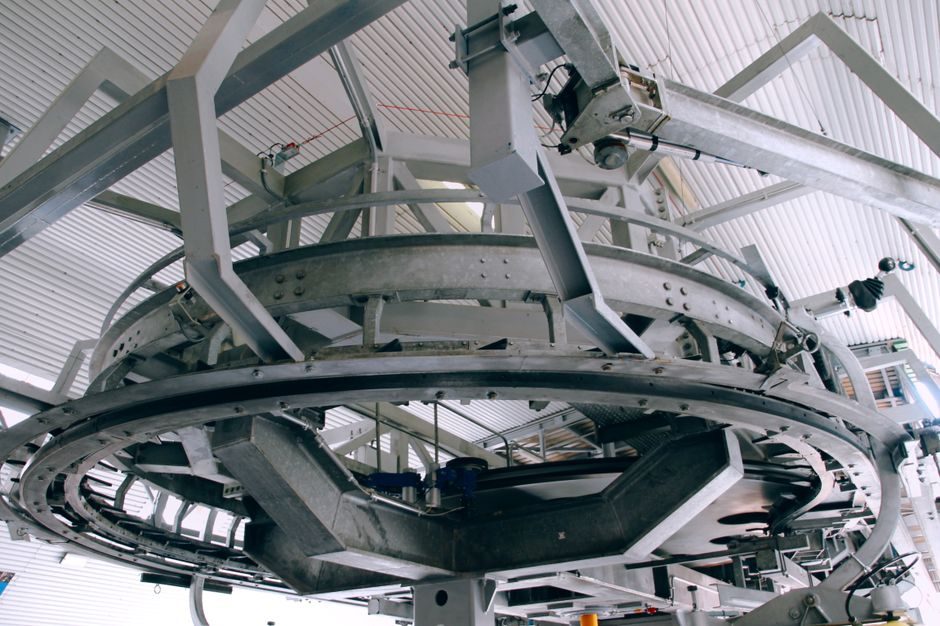
Shell core machines are classified by station count, heating medium, core box split orientation, and blow capacity, with foundry units ranging from 5 L bench-top single-station units to 75 L dual-station production cells [S3][S5][S7].
The shell process uses resin-coated sand cured against a heated pattern (typically 200–260 °C) to form a thin-walled hollow core, with the heated platen size and blow tank capacity dictating core envelope and cycle time [S8].
Station Count: Single-Station vs Dual-Station Architecture
Single-station shell core machines carry one heated core box and one blow head, sized from a 10 in H × 16 in W × 6 in D / 20 lb (5 L) blow capacity on the Harrison 1016-SS up to a 24 in H × 24 in W × 10 in D / 70 lb (20 L) blow capacity on the Harrison 2424-SS [S3].
Dual-station units add a second independently-heated platen and blow head to the same frame, allowing one station to cure while the operator unloadss the other, lifting effective throughput without adding labor; the Harrison DS line keeps box dimensions comparable to the SS range while roughly doubling the cycle window per box [S5]. Single-station units remain the right pick for foundries below ~50 cores/shift or where floor space is constrained; dual-station pays back when continuous duty and a labor-light cell are the goal [S3][S5].
Heating Medium: Gas-Fired vs Electric Platens
Foundry shell core machines are broadly split between gas-fired platen heating (natural gas or propane burners) and electric platen heating (cartridge or band heaters), with gas-fired dominating heavy foundry service where larger platens must reach 230–260 °C fast [S4][S6]. Supreme Cores' Wisconsin plant alone runs 18 gas-fired units, including Redford 16, 22, 43, 44 and Dependable 400 / EMI U-180 sizes with core capacities from 40 lb to 100 lb and platen footprints from 13×15 in to 30×20 in [S4].
Electric-heated units are preferred in clean-room or laboratory settings, in foundries without a gas supply, or where cure temperature uniformity across the platen matters more than ramp rate. The choice is ultimately a trade between energy-source availability, platen thermal mass, and local exhaust requirements [S4][S8].
Core Box Split Orientation: Vertical vs Horizontal Split

Core box split orientation is a structural classification independent of station count: vertical-split boxes (e.g. Redford 16 at 16×16 in, Redford 22 at 22×24 in, Shalco U900 at 29×20 in) open along a vertical parting line and are typical for symmetric, rotation-friendly cores [S7]. Horizontal-split boxes (e.g. Redford 22 at 22×23 in horizontal) open along a horizontal parting line and suit flat, shallow, or asymmetric core geometries where draw direction must be vertical [S7].
The folding-down hollow-core variant uses a hydraulic control unit to tilt and close the heated plates, rotating the sand tank into a high position before sand injection, which is the standard mechanism for making thin-walled hollow shell cores without sand fill behind the cured shell [S8].
Blow Capacity and Core Size Mapping
Blow capacity (the sand mass injected per cycle) is the primary sizing parameter, since it sets the maximum cured core wall mass: Harrison 1016-SS shoots 20 lb (5 L), 1616-SS shoots 35 lb (9 L), 1818-SS shoots 40 lb (10 L), and 2424-SS shoots 70 lb (20 L) [S3].
Cross-vendor, the same parameter reads as "core capacity" in the Redford/Dependable/EMI Shalco legacy naming: 40 lb for Redford 16 and 43, 70 lb for Redford 22, and 100 lb for Dependable 400 and EMI U-180, with platen footprints 13×15 in to 30×20 in [S4][S6]. When sizing, the binding constraint is usually core weight per cycle, not platen area, because the blow tank must hold enough resin-coated sand to fully form the core in a single dump [S3][S4].
Automation Tier: Manual, Semi-Automatic, and Fully Automatic
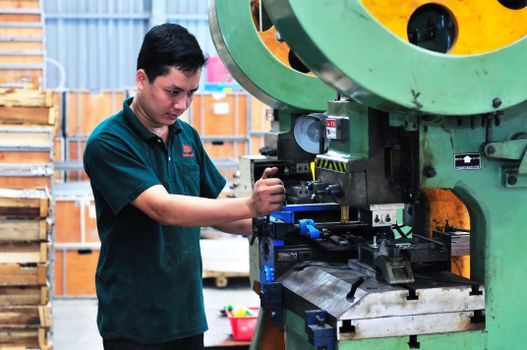
Automation tier is a parallel classification axis: Harrison single-station units are sold as semi-automatic with quick-change core box mounting, on-machine recipe recall, and short heat-up burners (claimed up to 50% heat-up reduction), with a field-upgrade path to a second station [S3].
EMI's Shalco-derived U-180, U-360, and U-900 automatic shell core machines extend the same hardware base with full cycle automation, finished-core ejection onto an extraction conveyor, and optional robotic handoff to a core distribution system, with no operator required on the machine [S6]. For foundries, this means a U-180-class cell can run unmanned on a shift basis, while an SS-class machine is sized for attended production. Process repeatability comes from the recipe recall, not from the cycle mechanism itself [S3][S6].
Comparison: Single-Station vs Dual-Station vs Automatic Cell
On four decision criteria (capital, labor, throughput, platen ceiling), the three common configurations line up as follows for a jobbing or short-run foundry: single-station semi-automatic carries the lowest capital and is adequate for 20–50 cores/shift attended; dual-station semi-automatic roughly doubles the throughput window per box without doubling labor and is the workhorse for 50–150 cores/shift; fully automatic U-class cells are the right answer when the foundry is integrating downstream robotic core handling or running unattended shifts, with the trade that tooling change must be quick-change to keep utilization high [S3][S5][S6]. The platen ceiling follows the same curve: SS tops out at 24×24 in / 70 lb; DS keeps the same box envelope and adds a second slot; U-900 reaches 29×20 in / 100 lb class cores [S3][S4][S6].
Selection Criteria and Sourcing Signals
For buyers comparing a shell core machine spec, the binding inputs are maximum core weight (lb per cycle), max platen footprint (H×W×D in), heating source (gas vs electric), station count (SS vs DS), automation tier (semi-auto vs full-auto), and split orientation dictated by the core drawing direction [S3][S4][S6][S7].
Adjacent process options sit on the same resin-coated-sand foundation: hot box core shooting uses a similar heated-tool philosophy but with a different resin system and lower platen temperatures, while cold box core making replaces thermal curing with amine gas and is the dominant choice for very large cores where platen heating is impractical. The shell process specifically earns its slot on small-to-medium hollow cores, draft-free internal passages, and any application requiring a thin, dimensionally-stable shell with low gas evolution during pour [S8]. One practical sourcing signal to watch: legacy Redford and Shalco U-class hardware remains in active use at US jobbing foundries, and EMI explicitly offers these platforms both new and remanufactured, which keeps the second-hand channel relevant for buyers who can accept used tooling in exchange for lower capex [S6][S7].