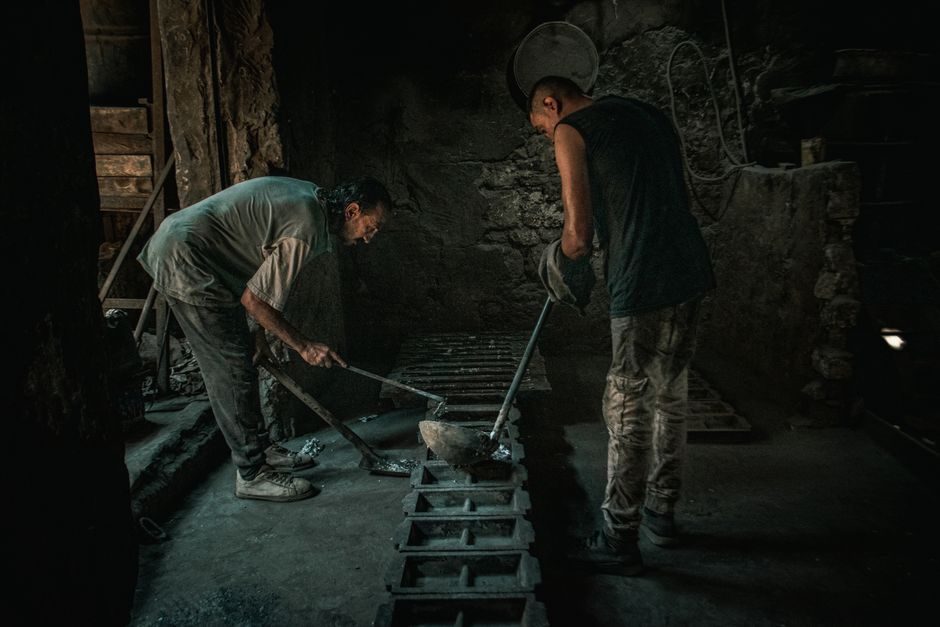
A shell core shooter — in Chinese sourcing literature referred to as 射芯机 or shell core machine — is defined as a core-making device that uses the rapid expansion of compressed air to shoot resin-coated sand into a core box, where heat at the box surface cures the resin and forms a thin-walled shell core [S3]. The technology sits in the sand-core family alongside cold-box core machines and hot-box core machines, but its combination of sand-blow acceleration, gravity feed, and heated tooling gives it a specific cycle-time and surface-density profile that engineers weigh against alternatives.
For a spec engineer, the question is rarely "is a shell core shooter good" — it is when the higher compressed-air and heated-tooling load is justified versus core machine alternatives such as the shell molding machine family or a generic shell core machine workflow. This map lines up the real advantages, the recurring failure modes, and the boundary cases where another process is the cheaper spec.
How a Shell Core Shooter Works and What the Spec Numbers Look Like
A shell core shooter operates by gravity-feeding resin-coated sand from a hopper into a sealed sand magazine, then releasing a high-volume pulse of compressed air — typically 0.5–0.7 MPa shop-air — to propel the sand into a pre-heated core box held around 200–260 °C, where the thermosetting resin at the box wall cures within seconds and the uncured sand at the core center is dumped out to leave a hollow shell [S3]. The residual wall thickness is a function of cure time, sand AFS fineness, and box temperature, and is the single most important dimensional lever on the drawing.
Cycle times of 20–60 s per core, sand-blow tanks in the 30–100 L class, and heater loads of 10–30 kW per station are typical values seen on mid-sized foundry installations, with smaller bench-top units running at roughly one third of those numbers. The process is described in casting-equipment references as a "射压式" sand-shooting-and-pressing action, in which sand is uniformly shot into the box and then mechanically pre-compacted before curing [S3]. For context on the broader machine family, the shell core shooter reference page covers the related tooling and resin-coating parameters that drive those numbers.
Core Advantages Engineers Cite on the Floor
High surface density and dimensional repeatability are the headline benefits, with shell cores routinely holding ±0.3 mm on critical features when sand grading, blow pressure, and cure temperature are kept in their normal operating windows. Cycle times are short — a 15–45 s cure-and-eject sequence is achievable on a single station, which is roughly half the cycle of a typical cold-box amine-cured core of comparable size and weight [S3].
The hollow-shell outcome also means material and energy are concentrated where they matter: a 6–12 mm wall around a 150 mm water-jacket core can weigh a fraction of a solid core, cutting downstream shot weight, smoke in pour-off, and shake-out load. Process control is repeatable enough that most modern units run with closed-loop box-temperature control rather than timed cures, and the absence of chemical binder gas generators (amine or phenolic vapor) keeps the cell ventilation simpler than a comparable cold-box installation. The related shell molding machine family shares most of these surface-quality advantages, since both processes depend on the same resin-coated sand and hot-tool curing mechanism.
Real Disadvantages and Where the Process Fails
Compressed-air demand is the most-cited constraint: a single mid-sized shooting station can consume 0.5–1.0 m³ of free air per cycle at 0.5–0.7 MPa, which on a 6-station cell running 4 cycles per minute is roughly 140–280 m³/min of shop air — enough to force a dedicated compressor and a buffer tank in the 3–6 m³ range. Core-box tooling is heated and therefore expensive; a single steel or cast-iron shell core box with integrated cartridge heaters and thermocouples commonly costs 3–8× an equivalent cold-box wood or aluminum box, and any change to the core geometry means a new tool rather than a parameter change.
Resin-coated sand is itself a recurring cost line and a storage liability: phenolic or furan no-bake / shell-grade coated sand has a finite bench life (typically 3–6 months under controlled humidity), and the heated-tool process drives off phenol-formaldehyde emissions that require LEV at every station. Wall-thickness control is also weaker than it looks — cores below about 4 mm wall are difficult to fill reliably, and very large cores above ~30 kg finished weight start to suffer from sand-blow shadowing and uneven cure. Where these constraints bite, a cold-box core machine or hand-rammed bench layout is the lower-capex call. For a process-focused comparison on a related technology, see the Cold Box Core Shooter trade-off map.
Selection Criteria: When a Shell Core Shooter Is the Right Spec
The shell core shooter is the right call when the core print needs high surface density, tight dimensional tolerance, and a thin-walled geometry that other processes cannot fill cleanly, and the foundry can absorb the compressed-air and heated-tooling capex. It is the wrong call for short prototype runs, very large monolithic cores, or any foundry whose shop-air supply is already at the edge of its compressor capacity. For a tighter thermal-class comparison that sits next to this process, the Hot Box Core Shooter types and selection map lays out the resin-and-temperature boundary that determines which hot-cure process actually fits the box temperature range a foundry can hold. [S3]
In practice, the spec engineer is balancing four numbers: blow pressure (0.5–0.7 MPa), box temperature (200–260 °C), cycle time (15–60 s), and finished wall thickness (4–15 mm). If all four fit the part print, the shell core shooter is usually the lowest-risk process; if any one of them breaks the part requirement, the spec should move to a shell core machine variant or out of the shell family entirely. Comparing shell core shooter, cold-box, and hot-box side by side on the standard four-criteria framework, the rough ranking is: dimensional tolerance favors shell, cycle-time-per-kg favors hot-box, capex favors cold-box, and operating cost per kg favors hot-box at scale and shell at low-to-mid volume.
Standards, Sourcing, and Trackable Signals

Foundry equipment of this class is typically procured against general mechanical and electrical safety references such as IEC 60204-1 for machine electrical equipment and ISO 12100 for safety-of-machinery risk assessment, with regional conformity (CE under the Machinery Directive, UKCA, or equivalent) stamped on the control cabinet; emission controls for the heated-resin process are governed locally by air-permitting rules for phenol-formaldehyde and combustion products rather than a single global standard. Vendor selection should track cycle-time repeatability data at quoted blow pressure, heater power per station, and PLC/control retrofit history — three numbers that are easy to verify on a witnessed FAT and that separate a well-built shell core shooter from a badge-engineered import. [S2]
Trackable signals over the next 6–12 months: any move by major Indian and Chinese suppliers (the dominant m6 sourcing region for this category) toward integrated pre-heated sand magazines that cut start-up scrap, and any tightening of regional VOC or formaldehyde rules that would re-cost the heated-tooling route relative to amine-cured cold-box. Buyers comparing this article against process-only sources should note that the cycle-time and wall-thickness numbers quoted here reflect typical mid-sized foundry practice, not a single named-vendor data sheet.