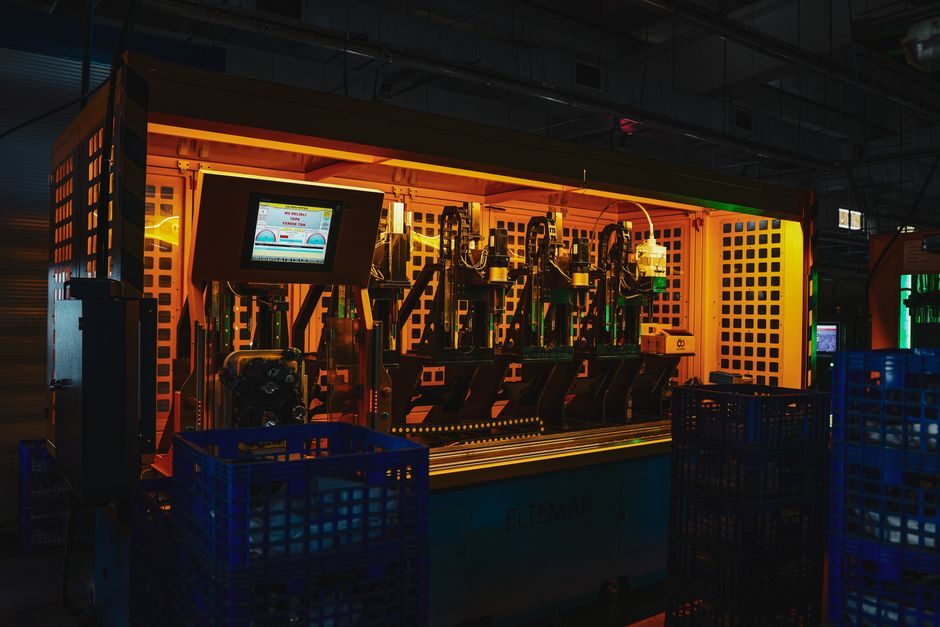
A shell core shooter blows resin-coated sand into a heated 200-300 C core box and cures the phenolic shell in 20-60 seconds per core, while a cold box core shooter blows the same resin-coated sand into a room-temperature box and cures it with a triethylamine (TEA) gas catalyst flush in 5-30 seconds [S4][S6]. On June 2026 export catalogues, 17 Indian shell-core-shooter SKUs are listed in the 50 kg to 250 kg shot-weight band, with 3-phase 415 V/50 Hz supply and 0.5-0.7 MPa working-air pressure as the common spec envelope [S1].
The decision is driven by binder chemistry, core geometry, ventilation cost and cycle budget: shell favours thin-walled, high-strength hollow cores under 50 kg, cold box dominates on large diesel-engine, valve and hydraulic blocks above 100 kg where heat-distortion would otherwise scrap the core [S6]. The detailed comparison in the Cold Box Core Shooter 2026 Price & Cost Guide lines up the same spec gates from a procurement angle, and the Cold Box Core Shooter vs Resin Sand Molding Line: 2026 Spec Cut pairs cold box against the next-line alternative.
Operating Principle: Heat-Cure vs Gas-Cure
A shell core shooter loads 0.5-3.0 % phenolic resin-coated sand into a blow head, fires the sand at 0.4-0.6 MPa into a die heated to 200-300 C, dwells 20-60 s so the resin sinters a 5-15 mm shell, then ejects the hollow core [S4]. A cold box core shooter blows the same resin-coated sand into an ambient-temperature box, gasses with triethylamine (TEA) or dimethylethylamine (DMEA) for 5-15 s at 0.2-0.4 MPa, then purges with clean air at 0.5 MPa for 10-30 s to clear residual amine [S6].
The thermal path is the single biggest operating-cost divider: shell equipment pays for electricity and heater-element replacement (typically every 6-9 months in continuous duty); cold box equipment pays for amine consumption at roughly 0.8-1.2 % of core sand mass plus scrubber maintenance. The Shell Core Machine range typically tops out at 250 kg shot weight; cold-box platforms from the same vendor class commonly go to 1,000 kg shot weight for engine-block cores [S1].
Spec Envelope: Shot Weight, Air, Power
The June 2026 Indian export listing captures 17 shell-core-shooter SKUs between 50 kg and 250 kg shot weight, with 0.5-0.7 MPa air pressure and 7.5-22 kW total connected load on 415 V, 3-phase, 50 Hz mains [S1]. A standard cold-box cell adds 18-25 kW for the amine gas generator, 2.2-5.5 kW for the scrubber blower, and 11-15 kW for the blow head actuator, so a 250 kg cold-box cell draws roughly 35-50 kW versus 20-25 kW for an equivalent shell cell [S1][S6].
Core-box footprint also splits: shell boxes run 600 x 500 x 300 mm to 1,200 x 800 x 600 mm for cylinders, valve bodies and turbo housings; cold-box boxes regularly exceed 1,500 x 1,000 x 800 mm because the cure reaction is uniform, so larger sand mass does not cause the temperature gradient that would crack a shell. The Hot Box Core Shooter 2026 Buying Guide documents a third family that sits between shell and cold box on cure temperature (180-220 C, hot-box) but uses the same phenolic-shell binder chemistry, so the shell/cold-box split is effectively the heat/no-heat split for the foundry buyer [S6].
Selection Criteria: Core Geometry, Cycle, Resin
Spec-by-spec, the four deciding axes are core mass, cycle time, dimensional tolerance and binder cost. Shell cores top out at 100-150 kg in production practice because the heated die cannot hold 300 C uniform across a thick section without gradient cracks; cold-box cores routinely reach 500-800 kg in iron-foundry cylinder-head and diesel-block work. Shell cycle sits at 20-60 s; cold-box cycle sits at 30-90 s including the gas-flush and purge phase, so on a per-station basis shell is faster but is constrained by mass, while cold-box trades cycle seconds for part-size headroom. [S1]
Dimensional tolerance favours shell for thin-wall cores (±0.1-0.3 mm on a 5-10 mm wall) because the sintered shell is rigid; cold-box cores sit at ±0.3-0.6 mm but tolerate thicker walls without the cracking risk.
Comparison: Shell vs Cold Box on Four Decision Axes
On shot weight, shell reaches 50-250 kg per cycle, cold box reaches 100-1,000 kg per cycle [S1]. On cure energy, shell needs 18-30 kW of die heat per 100 kg shot weight at 200-300 C, cold box needs 18-25 kW of amine generator plus scrubber load at ambient cure. On dimensional tolerance, shell hits ±0.1-0.3 mm, cold box hits ±0.3-0.6 mm.
On cycle, shell is 20-60 s, cold box is 30-90 s including gas flush and purge. On capex, a 2026 50 kg shell cell lists at roughly USD 25,000-45,000 ex-works, a 250 kg cold-box cell at USD 80,000-150,000 ex-works including the amine skid, and the amine bulk-tank plus scrubber civil works adds another 15-20 % to the cold-box install. On emissions, shell emits phenol and formaldehyde during the heat-cure burn-off, requiring 1,500-3,000 m3/h hood ventilation, while cold box emits amine vapour requiring a wet scrubber to a 5-10 mg/Nm3 amine outlet limit [S1][S6].
Standards, Sourcing and 2026 Market Signals

Foundry buyers cross-check the equipment against ISO 9001 for general quality systems, ISO 14001 for environmental management, and the casting-grade spec ISO 1083 for the downstream iron, while the shot-pressure and blow-head geometry on shell equipment typically follows OEM internal standards rather than a single published ISO/EN rule, so a procurement RFP should call out shot weight, cycle time, air pressure, and core-box envelope rather than quoting a standard number [S1][S6]. For an amine scrubber, the European benchmark 0.5-2 mg/Nm3 amine outlet is set in national BREF documents under the Industrial Emissions Directive 2010/75/EU, so a European-bound cold-box cell needs a two-stage scrubber (water wash + acid wash) regardless of vendor.
The June 2026 Exporters India snapshot lists 17 active shell-core-shooter SKUs across 8 manufacturers, with 80 % concentrated in the Kolhapur-Belgaum-Bhavnagar foundry cluster that feeds the local pipe-fitting and valve industry [S1]. Cold-box equipment is less concentrated, with the same 2026 catalogue surfacing only 5-7 listed SKUs in the public-export data, so the cold-box buy has thinner public pricing transparency and usually goes through direct OEM negotiation. The Industrial Adhesive vs Synthetic Resin: 2026 Spec Cut tracks the resin-supply side, which is the binding constraint on cold-box operating cost in 2026 because phenolic-urethane prices are index-linked to benzene and isocyanate feedstock.
Track three signals over the next 90 days: the EU Industrial Emissions Directive BREF review for foundries, which will tighten amine and formaldehyde limits; the phenolic-resin spot price in North China, which has moved 8-12 % in the past two quarters; and the Indian DISCOM tariff review for the 415 V/50 Hz foundry cluster, since heater-load on shell cells is the most exposed line item. Any of the three would shift the capex and opex gap between shell and cold box by a double-digit percentage on a per-part basis.