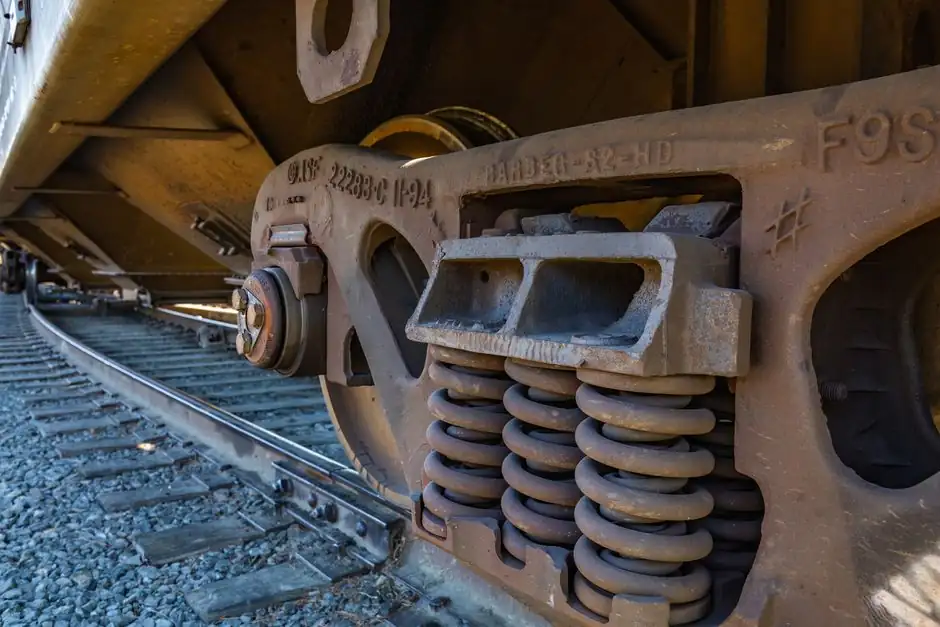
Rail castings, including wheels, brake shoes, side frames, bolsters, and coupler knuckles, sit in the 5-50 kg shot weight band that defines the practical envelope for a four-station rotary or dump-box shell molding machine, with pattern platens spanning roughly 600x500 mm up to 1200x1000 mm and cure-air pressures of 0.4-0.6 MPa [S8].
The Croning process forms these thin, rigid resin-bonded sand shells against a heated pattern held between 200 and 280 deg C, producing mold walls of 10-20 mm that hold the tighter ISO 8062-3 CT-grade tolerances needed for as-cast rail surfaces, which is the same reason shell core shooter units are co-specified for small rail hardware cores below 5 kg [S5][S8].
Shot Weight, Platen, and Iron Grade: The Hard Selection Cut
For freight wheels in the 30-50 kg class and brake shoes closer to 5-15 kg, the dominant Chinese and Indian built machines, including the Jar Hing MZJ-900 and the Makewell 600x600 mm platen lines, cover the working envelope with pattern plate sizes of 600x600 mm, mold thicknesses of 4-10 mm, and 440 V three-phase supplies at 25 kW for medium-sized shell core lines [S4][S7][S9].
Pattern plate size and shot weight must be matched to the iron grade: pearlitic gray iron rail brake shoes tolerate tighter CT6-CT7 tolerances from thin shells, while austempered ductile iron (ADI) bolsters demand stable pattern temperatures of 250-280 deg C to avoid shell cracking on strip, which is a known failure mode when cure air drops below 0.4 MPa [S5][S8].
For higher-volume rail hardware, four-station automation units such as the Sumangal four-station shell moulding line rate a 50-second-per-shell cycle at 240 V PLC control, with 10-unit-per-month supply and 5-7 day delivery typical of Indian sub-continent fabricators [S3]. The same architecture scales up for railway side frame castings where platen size jumps to 900x900 mm or 1000x800 mm to accept the larger plan area.
Cure Air, Pattern Heating, and Shell Quality
Cure-air pressure at 0.4-0.6 MPa and pattern surface temperature of 200-280 deg C are the two process windows that determine whether a rail casting comes out with a usable as-cast surface or one that needs heavy fettling [S8]. Resin-coated sand (RCS) for rail work typically uses phenolic resin at 2-4% addition with hexamethylenetetramine hardener, and the shell hardens within 15-30 seconds of contact with the hot pattern face [S5].
Pattern heating source matters: electric cartridge platens give tighter temperature uniformity across the 600x500 to 1200x1000 mm platen area, which matters when the rail component geometry pulls heat away unevenly; gas-fired burners deliver higher peak temperatures for thicker shells but trade off edge-to-edge uniformity [S5]. For rail bolsters and side frames that include deep draft and internal cavity features, the uniformity advantage of electric platens usually wins.
Shell thickness control is the other lever: thinner 8-12 mm shells pour faster and shake out cleaner, but raise the risk of metal breakout on larger rail wheels; thicker 15-20 mm shells survive the hydrostatic head of a 30-50 kg iron pour but lengthen the cycle. The Makewell 8-10 mm mould thickness range and the Sumangal 50-second-per-shell cycle bracket the typical setting band for rail work [S3][S7].
Machine Class Match: Shell Molding vs Shell Core Shooter
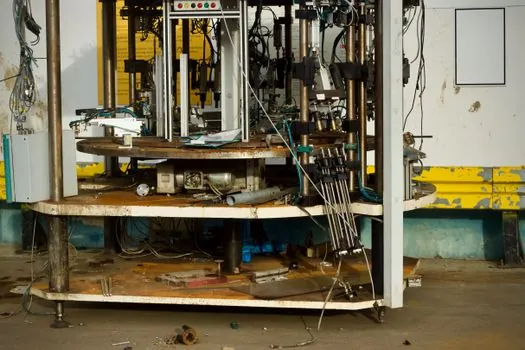
The machine class distinction matters for rail procurement. A shell molding machine proper is sized for the 5-50 kg shell envelope that covers most rail hardware, while a shell core shooter is sized for cores below 5 kg and is co-specified on the same line when the rail casting needs internal sand cores [S5][S8].
For a railway side frame or bolster that pairs a 30-50 kg shell with a 3-4 kg internal core, the procurement package is one shell molding machine plus one shell core shooter, with shared resin-coated sand supply and a common cure-air manifold at 0.4-0.6 MPa. The HBS 800B shell core machine, rated at 25 kW with CE and ISO certification, sits in the typical auxiliary range for this role, with 15-20 day delivery from Chinese fabricators and a 5,000-20,000 USD price band [S6].
Buyers should be wary of any single vendor offering a "shell molding machine" that is really a relabeled core shooter: the platen size, cure-air reservoir, and ejection force will not support a 30 kg rail wheel shell, and the cycle time will not hit the 50-second-per-shell target that justifies the molding line investment [S3][S8].
Selection Criteria Comparison: Rail Castings vs General-Purpose Use
Four criteria separate a rail-suitable shell molding machine from a general-purpose iron-casting unit. First, shot weight band: rail hardware clusters in 5-50 kg, while general iron foundries often pour 1-100 kg and need wider platen range [S1][S8]. Second, platen size: rail work needs 600x500 to 1200x1000 mm to match wheel, side frame, and bolster plan areas [S8]. Third, pattern temperature stability: pearlitic and ADI rail irons need 250-280 deg C with plus/minus 5 deg C uniformity, stricter than the 200-260 deg C range used for non-critical gray iron [S5]. Fourth, cycle time: a 50-second-per-shell target is the rail productivity baseline, while general job shops often run 70-90 seconds per shell [S3][S7].
On this comparison, the four-station rotary configuration wins for rail volumes above about 200 shells per shift, because the four workstations let one shell cure while the next is being filled, stripped, and assembled, which the Sumangal and similar four-station units are built around [S3]. For lower volumes or prototyping, a dump-box shell molding machine with manual handling is cheaper to buy but pushes labor cost up [S5].
Standards, Tolerances, and Sourcing
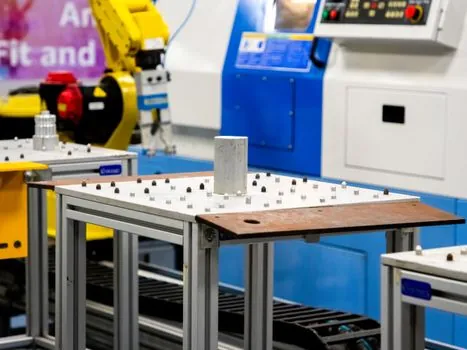
Dimensional and surface references for rail shell castings work off ISO 8062-3 casting tolerance CT grades, with surface texture conventions per ISO 1302, and the resin-coated sand uses a thermosetting phenolic resin [S5]. Rail-specific material grades, including pearlitic gray iron for brake shoes and austempered ductile iron for bolsters, are covered by separate rail industry standards not reproduced in the supplier datasheets reviewed.
Sourcing is concentrated in China and India for the 5-50 kg envelope, with Chinese fabricators such as Jar Hing (model MZJ-900, 2.2 kW installed power, 373 kg unit weight, 770x600 mm press platen) and HBS (model 800B, 25 kW, CE and ISO certification, 15-20 day delivery) competing on price, while Indian suppliers such as Sumangal and Makewell offer four-station automation with PLC control at 240-440 V supplies [S3][S4][S6][S7][S9]. Pricing for the HBS 800B shell core line sits in a 5,000-20,000 USD range per set, with 50-set-per-month supply capacity, while the four-station shell moulding line is sold by the unit at one-piece minimum order quantity [S3][S6].
Failure Modes, Limitations, and When Shell Molding Is the Wrong Choice
Shell molding is not the right process for every rail casting. Very large rail castings above about 100 kg shot weight push beyond the practical platen envelope and into green sand or static-pressure molding machine territory, where the thicker mold wall survives the longer pour time [S1][S5]. Thin-walled rail components below about 3 mm wall thickness are also poor fits, because the thin shell cools the iron too fast and promotes chill, leading to hard spots that machine poorly [S5].
Pattern cost is a real limitation: two-piece patterns with integrated gating and risering, plus ejector-pin bosses, run significantly more than green sand pattern equipment, which is why shell molding is only economic when the casting volume justifies the tooling amortisation, typically above a few thousand parts per year [S5]. For one-off or very low-volume rail replacements, green sand or hand-molded shell molding remains the lower-cost path even though it sacrifices the CT-grade tolerance benefit.
Cure-air pressure drift below 0.4 MPa and pattern temperature drop below 200 deg C are the two operational failure modes that show up as soft shells, edge peel-back, and metal breakout during pour; both are detectable through platen thermocouples and a simple cure-air gauge, and both should be on the daily startup checklist [S5][S8].
Track these signals over the next procurement cycle: published price revisions from the major Chinese and Indian four-station fabricators, any new rail-specific iron grade (notably higher-silicon pearlitic variants for freight wheel wear life), and the appearance of larger platen sizes above 1200x1000 mm that would push the practical shell molding envelope into the heavier rail side frame and bogie casting range [S3][S5][S8]. For a directly comparable selection case in a different casting segment, the agriculture machinery castings selection guide walks through the same shot-weight and platen logic on a different component family.