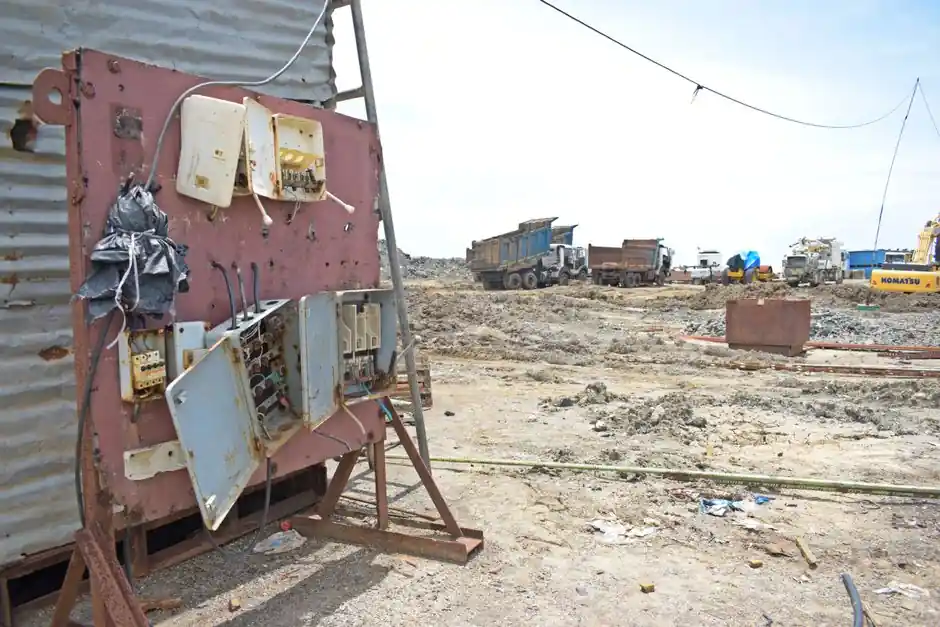
Demolition projects in 2026 are still spec'd primarily around structure size, neighbouring-building proximity, and access-road bearing capacity, not tunnel-bore ground models [S1]. A shield machine becomes relevant only on a narrow subset of jobs where a new tunnel drive runs beneath or immediately next to the teardown zone, because the cutterhead thrust, face pressure, and segmental lining control the surface settlement that demolition neighbours are protecting against.
For 90 percent of teardown work, the equipment shortlist stays within hydraulic excavators with demolition hammer attachments, long-reach booms, and concrete crushers sized to the building footprint and the available tracked-machine bearing pressure [S1][S2].
When a Shield Machine Belongs in a Demolition Project Scope
A shield machine enters a demolition specification when the demolition footprint overlaps a planned trenchless alignment, or when an existing tunnel beneath the site must be protected from vibration and ground loss during teardown. The five gates that close before any shield procurement are ground model, cutterhead family, nominal bore, total installed thrust, torque rating, and segment-ring compatibility [S5]. For mixed ground along a demolition-adjacent alignment, dual-mode convertible TBMs are increasingly specified because the same main beam can switch between EPB and slurry modes in 2 to 6 mode changes on a typical 2 km mixed-face drive, avoiding a second mobilisation [S5].
For 6 m EPB units in soft clay under demolition zones, installed torque sits in the 4,500 to 6,500 kNm band with total thrust of 35,000 to 50,000 kN; 15 m mixed-ground slurry machines push torque to 25,000 to 40,000 kNm and thrust to 100,000 to 150,000 kN, which is the envelope needed when a demolition neighbour is a sensitive heritage structure or an active hospital slab [S5]. Cutterhead face pressures above 15 bar with automated air-cushion control are now standard for deep river crossings where demolition above must not see settlement [S7].
Equipment Selection Logic for the Demolition Itself
On the demolition side, equipment is picked by three field-testable parameters, not by a brand sheet: structure size, proximity to other buildings, and access-road bearing capacity [S1]. A suburban teardown with 3 m access lanes forces tracked mini-excavators in the 3 to 8 tonne class with hammer attachments in the 200 to 400 kg class; a 12-storey commercial demolition on a constrained urban lot will run a 30 to 50 tonne high-reach excavator with a 1,500 to 3,000 kg breaker, plus dust suppression and a perimeter face shield for crew PPE [S1][S2].
Buried-foundation removal adds a second-pass requirement: a smaller tracked machine with a bucket and a hydraulic breaker is used after the main structure is down to break out slabs and footings, because pea-gravel or grout backfill is not an option on a building pad that will be re-graded [S1]. For interior strip-out before mechanical demolition, handheld demolition hammer tools in the 10 to 30 kg class still dominate over robotic options on jobs under 500 m² of floor area [S2].
Comparison: Shield Machine vs Demolition Hammer Family

The decision between bringing a TBM onto a demolition scope versus a hammer-equipped excavator comes down to four concrete criteria. Cost band: a new 6 m EPB shield machine spread lands in the multi-million-USD band, while a 30 tonne high-reach excavator with breaker sits in the low-six-figure band per month of hire, so a TBM is never amortised on demolition alone. Vibration and settlement control: hydraulic breakers transmit ground vibration that neighbouring structures register on seismographs, while a slurry or EPB shield controls settlement to single-digit millimetres through two-component grout with a 6 to 30 second gel time [S5].
Depth and reach: a demolition hammer is limited to roughly the boom reach of the carrier excavator, typically 15 to 25 m vertical; a shield machine operates at any depth the launch shaft allows, with hydrostatic face pressure independent of surface elevation [S3]. Project duration: a 2 km shield drive runs 9 to 18 months from launch to breakthrough, while a 12-storey demolition typically completes in 4 to 10 weeks including backfill [S1][S5]. The right rule of thumb: if the demolition scope includes the tunnel, or the tunnel scope includes the demolition zone, specify the shield; otherwise, the demolition hammer family wins on cost, schedule, and mobilisation simplicity.
Tooling, Consumables, and Crew Protection
Shield machine consumables for demolition-adjacent drives centre on disc cutters, drag bits, scrapers, and gauge cutters, with 17 inch and 19 inch disc cutters the most common interchangeable classes for mixed rock and soil [S7]. A Φ6440 mm EPB reference build runs 80 mm/min maximum advance, six 160 kW drive motors, 17 and 18 inch interchangeable hob boxes, four foam lines plus four bentonite lines, and single-liquid plus two-component grout systems at the tail-skin [S4].
Demolition-side consumables are simpler: breaker chisels in 95 to 210 mm shank diameters matched to carrier weight, plus a steady rotation of replacement steel because chisel life on reinforced concrete typically runs 80 to 200 hours before re-sharpening [S1]. Crew PPE always includes a polycarbonate full-face shield rated to the impact energy of flying chip and rebar, plus hearing protection because hydraulic-breaker noise routinely exceeds 100 dB(A) at the operator station [S2].
Standards, Permits, and Cross-Trade Coordination

Demolition contractors are expected to pull all local permits, secure environmental clearances for hazardous materials such as asbestos and lead paint, and arrange road-closure approvals ahead of the mechanical teardown [S2]. The U.S. demolition and wrecking industry was valued at 11.2 billion USD in 2025, which is a useful baseline when sizing insurance bonds and performance guarantees for a mid-rise teardown [S2].
For the shield side of a combined scope, the alignment between shield tail-skin inner diameter and segment ring OD must close within 20 to 30 mm or backfill volume balloons and convergence control suffers [S5]. Trenching, pipe-jacking, and segmental-lining QA on Chinese metro jobs in 2026 has settled on two-component A+B grout as the default because the gel time can be dialled into the 6 to 30 second window, which keeps surface settlement in the single-digit-millimetre range above shallow drives beneath active demolition zones [S5]. Coordination with a cutting machine supplier often enters here when slurry-circuit pumps or spoil-conditioning skids are pre-cut to length on the surface before shaft lowering.
Limitations and Failure Modes to Engineer Around
Shield machines fail the spec on three demolition-adjacent conditions: a short drive under 300 m where mobilisation cost dominates, a homogeneous soft-clay alignment where a simpler pipe-jack rig suffices, and a site where the launch shaft footprint would itself require demolishing an adjacent occupied structure [S3]. Stalled cutters in stiff clay are the leading cause of intervention dives on EPBs in demolition-adjacent drives, which is why the cutterhead de-rating curve at high-density ground must be on the data sheet, not in a sales deck [S5].
Demolition hammers fail the spec on three conditions: ground-bearing pressure that cannot support the carrier, an adjacent structure within 5 m that the vibration would damage, and a slab thicker than 400 mm where a hammer becomes the bottleneck and a wire saw or a core machine pre-cut is the faster path [S1]. For hazardous-material buildings, mechanical demolition must be preceded by a certified abatement phase, and the contractor's remediation protocol is the first thing a property owner should audit in writing before any breaker work starts [S2].
Track the next round of Chinese metro tender awards for dual-mode convertible TBMs as the leading indicator of demolition-adjacent tunnel work, and watch the 17 to 19 inch disc-cutter pricing index for signs of supply tightness that would push EPB mobilisation dates past 2026 Q4.
For related coverage, see Total Station Selection for Road Maintenance: 2026 Spec Map.